


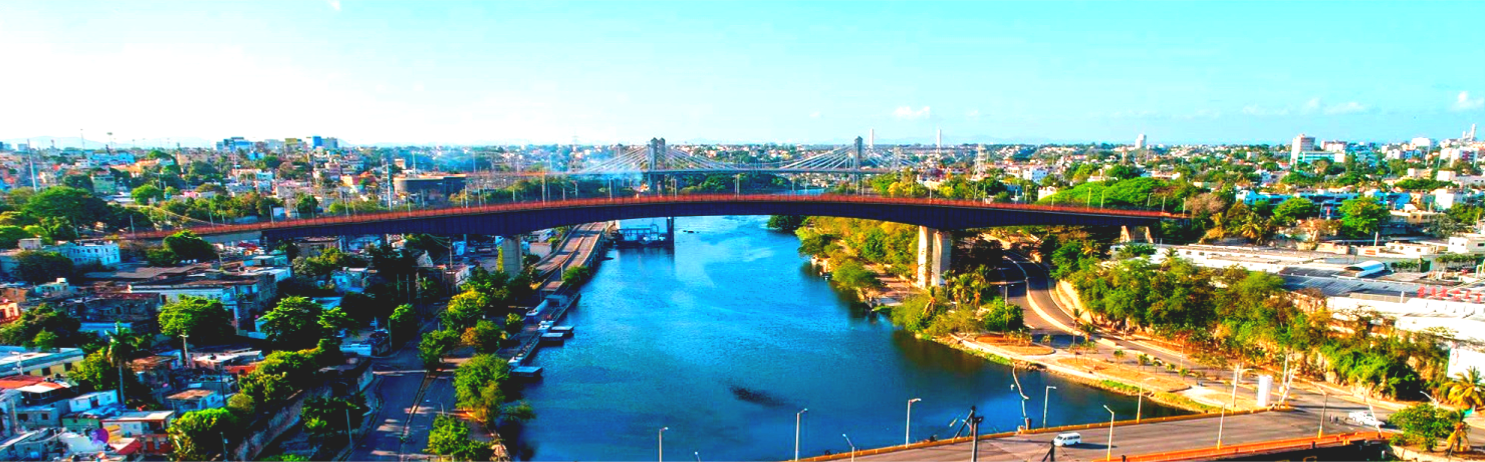
Between Borojol and Pajarito, the river has witnessed five bridges, a hurricane, a war, and the beginning of Juan Pablo Duarte's exile. This is the chronicle of a crossing that embodies urban resilience
SANTO DOMINGO – There was a time in the history of Santo Domingo when the two banks of the Ozama River faced each other without ever touching. Lacking bridges, crossings were made in small boats and canoes that traveled back and forth between the western side, close to the walls of the colonial city, where the Borojol neighborhood lay, and the eastern side, with its scattered houses known to the locals as Pajarito.
The references did not indicate how long it took to build, but on the afternoon of April 28, 1878, the first bridge over the Ozama was inaugurated: an iron and wood framework erected by the engineer Howard Crosby, and anyone who wanted to cross on that platform had to pay a toll to Crosby himself.
This is stated by historian Bernardo Vega in his book “Me lo contó el Ozama”, published in 2012 with the support of the AES Dominicana Foundation.
But the Ozama, contrary to what its flat surface suggests, has its own character, and that first structure survived for five years as it was conceived: a flood of the river swept it away in 1883, according to a publication in the newspaper El Caribe, and only half of it remained.
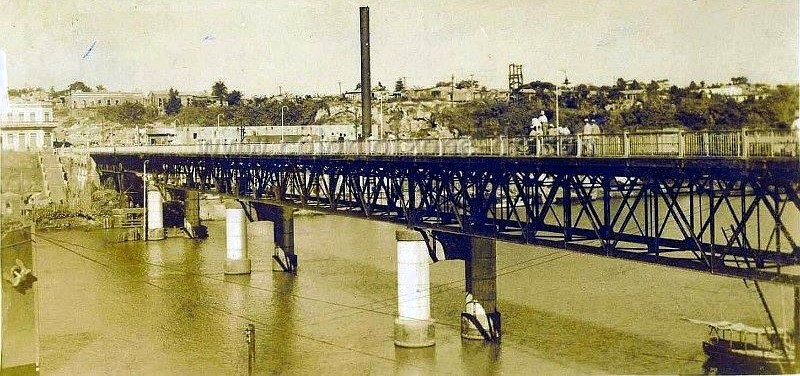
The Ozama Bridge is part of the historical roots of Santo Domingo. (Photo/AGN).
During the US military occupation, and probably as a communication strategy rather than a contribution to the infrastructure, work was carried out on the foundations for three years, between 1914 and 1917, to build a new platform which was named after Ulises Heureaux, the president who had inaugurated the original.
The modern bridge was a drawbridge. Its design required the central spans to be raised to allow ships to pass, a maneuver that could halt traffic for up to an hour. Family memory recalls this: a great-aunt of the author of this piece used to say that, when a ship approached, the central spans of the bridge would slowly rise, and that the whole structure, seen from the shore, resembled for a moment a bird spreading its wings.
The San Zenón cyclone severely damaged it in 1930, and three years later the dictatorship of Rafael Leónidas Trujillo rebuilt it with entirely national funds, a fact that the regime took care to emphasize in “La Nueva Patria Dominicana”, an official supplement published in 1935 by the Presidency of the Republic and preserved in the General Archive of the Nation.
The bridge is described as a "robust steel and concrete construction, swept away by the impetuous hurricane," a description that contrasts with those found about the initial footbridge, and that phrase, written five years after the events, did a double job: it certified the magnitude of the disaster and, incidentally, justified the state intervention that would come later in the reconstruction of Villa Duarte, on the other side of the river.
In 1976, at the very spot where Crosby had driven his first beams, President Joaquín Balaguer inaugurated the Ramón Matías Mella Bridge, nicknamed the "bicycle bridge" by the locals because of its narrow roadway. Even today, the foundations of the old Heureaux Bridge can still be seen beneath its structure.
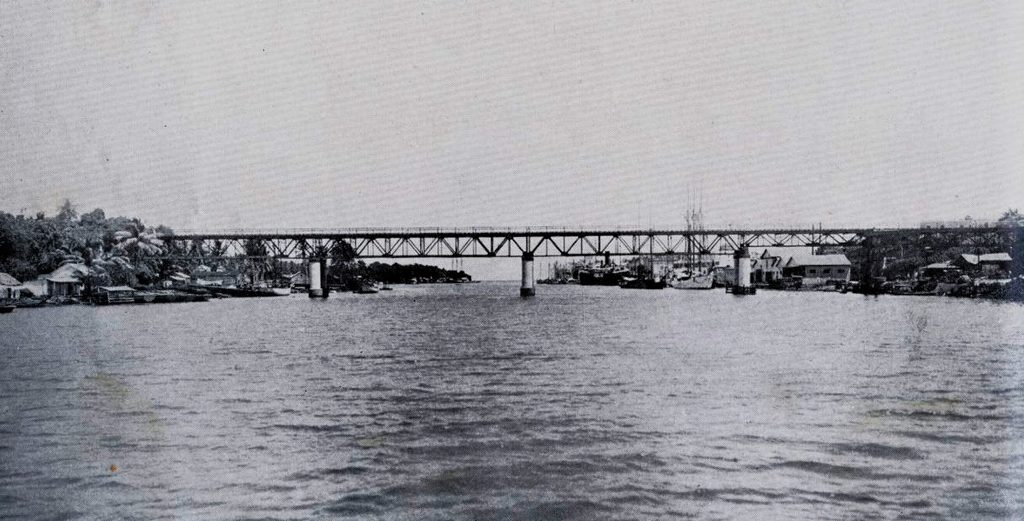
Between 1914 and 1917, a new platform was built and named after Ulises Heureaux. (Photo/AGN).
The Mella bridge only partially solved the problem, and, back in power in 1986, Balaguer decided to complete the road and in the early nineties ordered the construction of a twin bridge right next to it, to complete four lanes, a project that was inaugurated in 1996.
The construction took its toll before it was even finished, and newspaper archives record that on February 16, 1990, part of the structure collapsed, killing three Dominican workers and a Colombian technician. Today, thousands cross the Mella River every day in either direction, almost always unaware that it spans two different bridges, built twenty years apart and forever linked by tragedy.
On the western side, the neighborhood that bid farewell to travelers was none other than Borojol, now incorporated into the layout of the Ensanche Margara, although few still call it by that name. On the eastern side, the town of Pajarito received a new name on May 28, 1890, when the National Congress approved the law, promulgated by Ulises Heureaux himself, to rename it Villa Duarte, according to the historical archives of the Dominican Liberation Party.
And that name was not a coincidence, since, forty-seven years earlier, Pajarito had been Juan Pablo Duarte's last Dominican refuge before going into exile.
His sister Rosa Duarte recounts, in “Notes for the History of the Island of Santo Domingo”, that on the night of July 30, 1843, the leader of La Trinitaria crossed the river in a boat to the house of the Spaniard Pascual C. López, fleeing from the persecution of the Haitian government, and that days later, on August 2, he left for Vieques, Puerto Rico.
A war bridge
Pajarito returned to the headlines in February 1904, this time by force. The death of U.S. sailor J.C. Johnston, struck by rebel fire during the uprising known as the "War of Disunion," led President Theodore Roosevelt to order the cruisers USS Columbia and USS Newark to demand an apology from the government of Carlos Felipe Morales Languasco. On February 11, with diplomatic channels exhausted, the Newark, under the command of Commodore Richard Wainwright, opened fire on the rebel positions at Pajarito while the Columbia, under Captain James M. Miller, covered the landing of the Marines, according to researcher Carlos Danilo Morales Miller, based on U.S. naval archives.
It was one of the first episodes of an intervention that, twelve years later, would end in full military occupation, in 1916.
From Crosby's first plank to Balaguer's bicycle bridge, the memory of that crossing survives more in speech than in stone. In the oral tradition of the oldest residents, the word "Pajarito" (Little Bird) persists, applied to the same stretch of river where motorcycles and buses now travel.
The Borojol of that time barely remains in photos, in old maps, and between those two banks that changed their name more than once, the Ozama continues to flow, half alive and half dead, although just as powerful, indifferent to what the city decides to call it.
Recommended readings:






