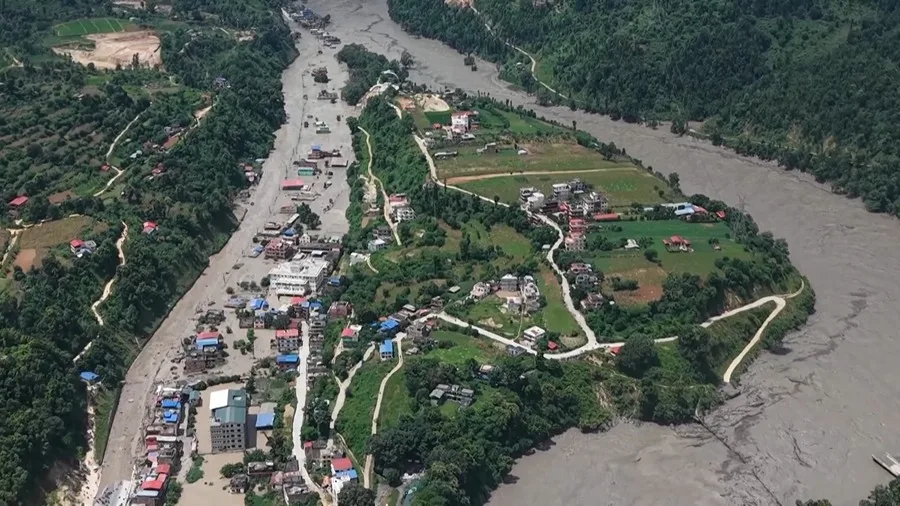
The Nepal Tourism Board (NTB) raised the number of missing travelers to 667 , including 540 foreign tourists from more than 30 countries
KATHMANDU – At least 359 people have died and another 910 remain missing or unaccounted for after the devastating flash flood that struck the Rasuwa district in northern Nepal, near the border with Tibet, EFE reported Thursday , citing the latest tally from Nepalese authorities.
The death toll was updated by the Nepalese Police, who also reported that 63 people are receiving medical attention in various hospitals in Kathmandu, while search and rescue operations continue in the affected areas.
A spokesman for the Nepalese police in Kathmandu, Abhi Narayan Kafle, confirmed to EFE that 445 people have been rescued alive in the last few hours, including 27 foreigners.
More than 900 people are still missing
Emergency teams are intensifying the search for 910 people who remain missing or incommunicado, according to the latest update from Nepal's National Disaster Risk Reduction and Management Authority (NDRRMA).
Those not located include 517 foreign nationals, 127 Nepalese residents abroad who were visiting the country, and 85 members of the security and customs forces, as well as residents of the affected communities.
The Spanish Ministry of Foreign Affairs confirmed that four Spanish citizens remain missing.
The Nepal Tourism Board (NTB) raised the number of missing travelers to 667 , including 540 foreign tourists from more than 30 countries
India also reported 285 citizens who remain unaccounted for. However, its Foreign Ministry spokesman, Randhir Jaiswal, confirmed the safe evacuation of 54 Indians, including 33 workers from the Trishuli-I hydroelectric project.
Rescues continue amid difficult conditions
Nepal's army and security forces rescued 123 people during the early hours of Thursday who were trapped or cut off from communication in flooded areas of the Rasuwa district.
Authorities are maintaining the deployment of helicopters to transport foreign nationals to Kathmandu, while rescue teams continue to search the affected areas for survivors.
According to authorities, numerous victims were swept several kilometers from the point where the flash flood originated. The force of the water displaced large quantities of mud, rocks, and infrastructure debris, causing widespread destruction.
On the Chinese side, authorities have reported three deaths and 558 people with whom contact has been lost in the Tibetan county of Gyirong. According to figures released by both sides, the disaster has left a combined death toll of more than 360 and around 1,400 missing.
Approximately 10,000 families urgently need help
The World Health Organization (WHO) warned that some 10,000 families in Nepal need immediate assistance following the flood, especially in areas near Rasuwa.
The United Nations agency indicated that at least four health centers were damaged, three of them completely destroyed, while two other hospitals are experiencing service disruptions.
The WHO has already sent an initial advance of aid, which includes multi-purpose tents to enable the provision of health services in the affected communities.
The NGO Care International also warned about the risk of waterborne diseases due to damage to water supply and sanitation infrastructure.
Deployment of thousands of troops
Some 7,400 Nepalese police and army personnel remain deployed in the affected areas to support rescue and relief efforts.
On the Chinese side, rain, unstable slopes, damage to access roads and disruptions to communications are hindering search operations in Gyirong, while the risk of further landslides persists.
China has also deployed aircraft and specialized equipment. A drone from Sichuan arrived in the area equipped with a mobile base and satellite communications, while an airplane transported 111 rescuers, specialized equipment, and four search dogs.
The United States, for its part, announced a contribution of $500,000 for emergency efforts, in addition to sending a specialized disaster response advisor.
A glacial collapse is believed to be behind the tragedy
Initial hypotheses about the origin of the flood pointed to a possible earthquake or the overflow of a glacial lake. However, the United States Geological Survey (USGS) and Chinese experts now agree that the collapse of a glacial mass was the trigger for the disaster.
The USGS determined that it was a glacial collapse followed by a debris flow, after the phenomenon was initially linked to a magnitude 4.4 earthquake recorded in Nepal.
Experts from the Chinese Ministry of Natural Resources, using satellite images, determined that the disaster originated from the detachment of a mass of ice in a glacial area of Nepal located between 5,200 and 5,500 meters above sea level.
According to Chinese authorities, the mass of ice dragged glacial materials and descended at high speed until it transformed into a debris flow and subsequently into a mudslide that reached the border port of Gyirong after traveling about 20 kilometers in just seven minutes.
The flood generated a seismic signal
The enormous force of the mudslide produced vibrations equivalent to those of a magnitude 5.1 earthquake, reported Chinese state television CCTV.
China's Earthquake Networks Center detected a seismic event of that magnitude near the border port of Gyirong on Wednesday, coinciding with the time of the tragedy.
Subsequently, the analysis of the waves determined that it was not a tectonic earthquake, but a phenomenon caused by surface collapse and massive displacement of mud and materials, which generated vibrations similar to those of an earthquake.
What is a flash flood and why can it be dangerous?
A flash flood is a sudden and intense rise in the flow of a river, stream, or waterway, usually caused by torrential rains or prolonged precipitation. The rapid increase in flow can cause overflows, flooding, and the sweeping away of people, vehicles, homes, and other objects in its path.
This phenomenon can cause serious material damage and endanger people's lives, especially in communities located near rivers, streams, ravines and other areas vulnerable to flooding.
Recommended readings:
- Colombian president decrees three days of national mourning after earthquake; death toll rises to 240
- More than 130 dead from earthquake in Colombia; hospital capacity is beginning to run out due to the high number of injured
- Venezuela begins demolition of unstable buildings; more than a thousand show damage