


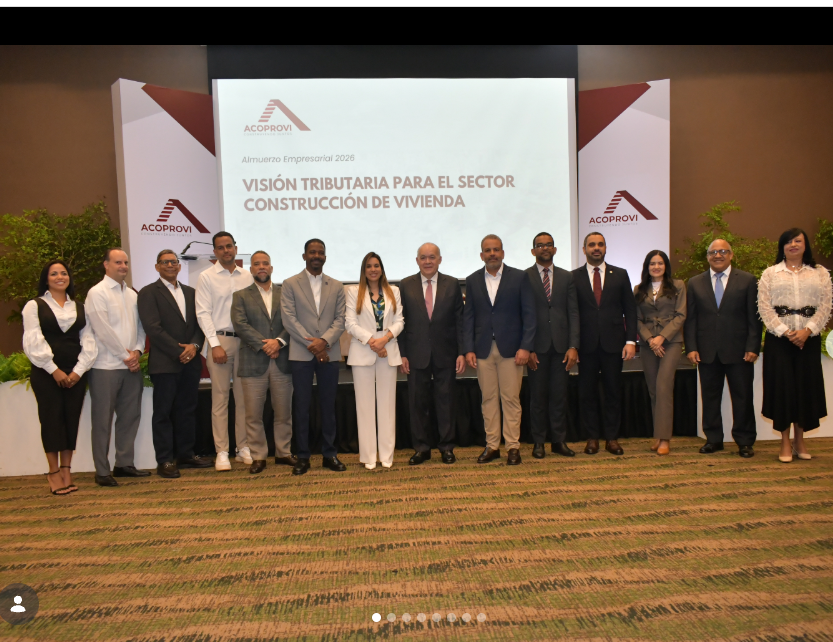
It highlights the importance of the construction sector for tax revenue and cites electronic invoicing as a tool to improve cost control, reduce errors, and enhance document security
SANTO DOMINGO.- At the monthly luncheon of Acoprovi, the Association of Housing Builders and Developers, the General Directorate of Internal Taxes (DGII) highlighted the strength of the construction sector as a key pillar of the Dominican economy, currently representing 12.2% of economic activity and registering a year-on-year growth of 14.9% as of June 2026, equivalent to about 30% of the expansion of the Monthly Indicator of Economic Activity during that month.
The entity's general manager, Pedro Urrutia, also referred to the high volume of investments mobilized by the real estate sector, warning that this sector requires solid traceability and control mechanisms, pointing out that electronic invoicing is not only a tax obligation, but also a tool to improve cost control, reduce errors and increase document security.
Construction is a heavyweight in terms of tax contributions
Urrutia specified that resources channeled through the financial system toward housing construction and acquisition reached approximately RD$650,306 million as of March, representing a 15.1% increase compared to the same period in 2015. In terms of tax revenue, construction contributed RD$21,226.7 million between January and July of this year, equivalent to 3.6% of total tax collections administered by the DGII (General Directorate of Internal Taxes). Transactions reported for ITBIS amounted to RD$244,314.7 million during the first half of the year, 4.7% of the total declared in the country.
During his presentation, "The Tax Vision for the Housing Construction Sector," the official stated that these indicators confirm construction as a key driver of economic recovery, given its capacity to mobilize investment, credit, employment, materials, and related activities. He argued that the tax system should support this expansion without introducing unnecessary complexities and ensure that tax obligations are clearly understood from the project's inception to its completion.
Real estate sector demands control
The Director General of the DGII warned that, due to the volume of investments involved, the real estate sector requires robust traceability and control mechanisms. In this regard, he presented electronic invoicing not only as a tax obligation, but also as a tool to improve cost control, reduce errors, and enhance document security.
“A transparent construction sector is also a more attractive sector for domestic and foreign capital,” he stated. The official concluded that the DGII (General Directorate of Internal Revenue) and construction companies are not at odds, as they share the interest of promoting an economy capable of attracting investment, generating jobs, and expanding access to housing for Dominicans.
Low-cost housing bonds
Urrutia announced that he will pay approximately RD$1 billion in outstanding payments for the Low-Cost Housing Bond, as part of a commitment made with the Ministry of Finance and Economy to support the development of housing projects and facilitate the
He explained that trust companies will be able to request the application of the bond through the institution's Virtual Office, noting that the new system is in its final adjustment phase and will be available by the end of September, allowing the procedure to be carried out entirely digitally, without physical documents. The DGII expects the measure to reduce response times and expedite refunds to purchasers.
The official emphasized that the incentive helps families complete the down payment on a home or reduce the amount they need to finance. He also noted that currently 60% of housing projects underway are for affordable housing, reflecting the growing importance of this segment within the real estate market.
New general rule
Another announcement made by Pedro Urrutia during his meeting with construction businessmen was the development of a draft general rule that would eliminate the obligation to withhold part of the ITBIS, in accordance with General Rule 02-05, when the supplier has been authorized as an electronic issuer and the operation is supported by an Electronic Tax Receipt.
The proposal, currently open for public comment, would affect service contracts between companies and could particularly benefit SMEs integrated into the construction supply chain. “The DGII’s role is to collect taxes, but we also need to make tax compliance increasingly easier,” he stated, explaining that the administration seeks to establish clear rules, simplify procedures, and expand the digitalization of its services.
He calls for strengthening transparency
The head of the DGII urged the sector to strengthen transparency and compliance with anti-money laundering regulations. He noted that the institution published Notice 12-26 in July to clarify which construction companies are considered obligated entities.
Recommended readings:







