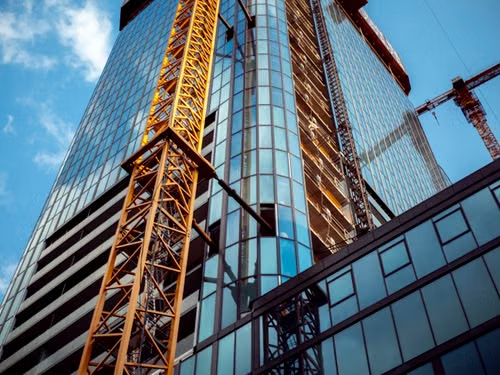
In any construction project, there's a moment that no one photographs, yet it determines half a century of its lifespan: the week after the concrete pour. When my team of engineers and I are overseeing a slab pour, the important conversation doesn't happen when the last mixer leaves the building: it happens seven days later, when the structure is still being built from the inside and hardly anyone is looking at it.
A slow chemical reaction called hydration occurs within concrete. The water in the mix acts as the active ingredient: it allows the cement to form the crystals that give the material its strength. As long as water is available, the reaction continues. The day the water disappears, the reaction stops. And what was left unfinished cannot be recovered.
The numbers are clear. Properly cured concrete reaches approximately 65 to 70 percent of its design strength after seven days, and 100 percent after 28 days. The same concrete, with the same mix, left in the sun without curing, can fall 30 to 50 percent short of its design strength. It doesn't collapse the next day. It simply ages faster, cracks sooner, and allows water to penetrate, ruining the reinforcing steel ten years later.
In the tropics, this is twice as significant. In the Dominican Republic, Panama, Colombia, Mexico, or Central America, a slab poured at midday in 32-degree heat, with direct sunlight and a coastal breeze, loses surface water in a matter of hours. The same structural design, with the same plans and the same concrete supplier, performs differently in Bogotá than in Punta Cana. This difference is due to the curing protocol.
Proper curing is simple: keep the surface continuously moist for a minimum of seven days, and up to fourteen for critical elements. This involves scheduled watering, saturated geotextile mats, curing membranes on surfaces that can withstand them, damp sand, and plastic sheeting where appropriate. Empty the area early in the morning or late in the afternoon. And someone with a name and surname must be held responsible for ensuring this is done, not just relying on the goodwill of whoever happens to be on duty.
What's interesting is the cost. Curing is one of the cheapest items in a tower's entire budget. Water, labor, some blankets. Compared to that, there's the cost of repairs: patching, repeated waterproofing, crack injections, leaks that appear in the sold apartment and become an awkward conversation with the buyer. It's one of the few decisions in construction where doing it right costs less than doing it wrong.
In the projects I manage, the curation process has a written protocol, is recorded in a logbook, and is signed off. More than one person has found this excessive for something so basic. Then they walk through a fifteen-year-old building without a single structural crack and understand why we insist so much on something no one else sees.
A well-built building is recognized by the years it lasts without problems. And a good portion of those years are gained or lost in a week that no one remembers.
Recommended readings: