


An analysis of month-by-month budget execution shows that investment in housing systematically accelerated in the first four months of each election year
SANTO DOMINGO – Every public administration executes its budget unevenly throughout the year. But when Ciudad Alternativa, in its research on Dominican housing policy from 2000 to 2016, cross-referenced the monthly budget execution reports from the General Directorate of Budget with the country's electoral calendar, it found a pattern that repeats itself regularly.
The exercise consisted of calculating what proportion of the total spending that the housing sector would execute in a whole year had already been disbursed by the end of April, that is, in the first four months, the period prior to the May elections.
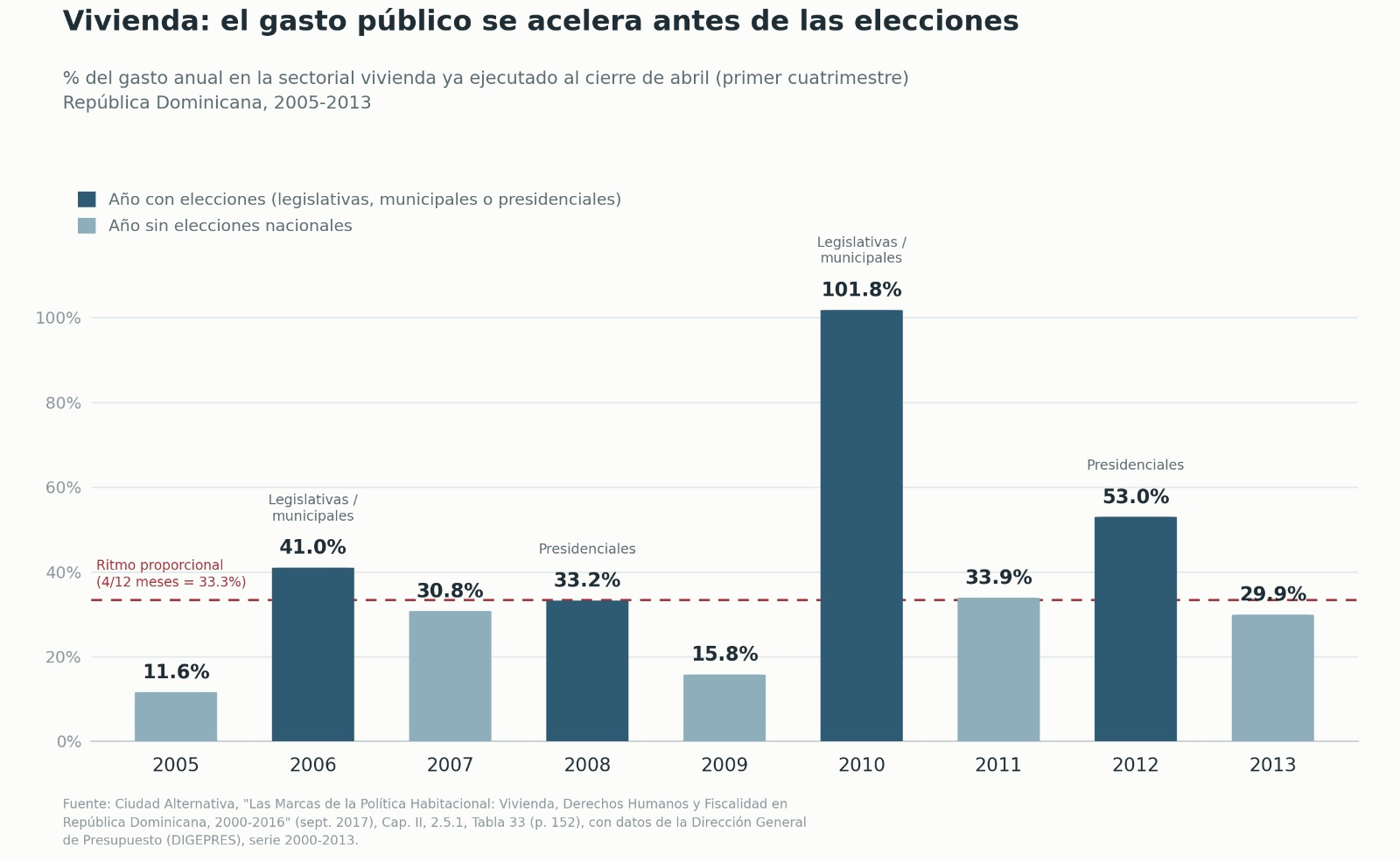
In 2005, a year without national elections, that percentage barely reached 11.6%. The following year, 2006, a year of legislative and municipal elections, the figure soared to 41%. In 2007, again without elections, it fell to 30.8%. The pattern was repeated even more strongly in 2010, a year of legislative and municipal elections.
The accumulated spending on housing during the first four months of that year represented 101.8% of the total that would finally be executed in the entire fiscal year, a figure that is only possible because the government ended up spending less in the rest of the year than it had already spent in the first four months.
In the immediately preceding non-election year, 2009, that same indicator barely reached 15.8%, and in the following year, 2011, it reached 33.9%. For 2012, a presidential election year, the pattern held once again: 53% of annual housing spending had already been executed by the end of April, compared to 33.9% in 2011 and 29.9% in 2013.
According to the same comparison, no other sector of social services shows such markedly different behavior between election and non-election years.
Ciudad Alternativa's research complements this reading with the year-on-year growth of housing expenditure, that is, how much more or less the State spent in one year compared to the previous one.
In 2006, the amount accrued in the sector grew 175% compared to 2005. In 2008, a presidential election year, it grew 148.8% compared to 2007. In 2012, another presidential election year, the growth was 62.6% compared to the previous year.
In contrast, in three of the five non-election years of the analyzed period, 2007, 2009 and 2011, the accrued spending on housing showed negative growth, that is, it contracted compared to the previous year.
These data correspond to the aggregate series of the functional housing classifier, the same one that, as explained in another installment of this series, includes, in some years, expenses on urban and road works that are not strictly housing projects.
Even so, the coincidence between the budget execution cycle and the electoral calendar is also repeated, as documented by the same research, in two additional sectors, drinking water and sewage, and to a lesser extent sports and social assistance, which suggests a generalized behavior in the programming of social spending during this period, not exclusive to housing.
Sources: Ciudad Alternativa, “The Marks of Housing Policy: Housing, Human Rights and Taxation in the Dominican Republic, 2000-2016” (Santo Domingo, September 2017), Chapter II, section 2.5.1, with data from the General Directorate of Budget (DIGEPRES), series 2000-2013.
History of Social Housing in the Dominican Republic 2004-2012.
Recommended readings:







