


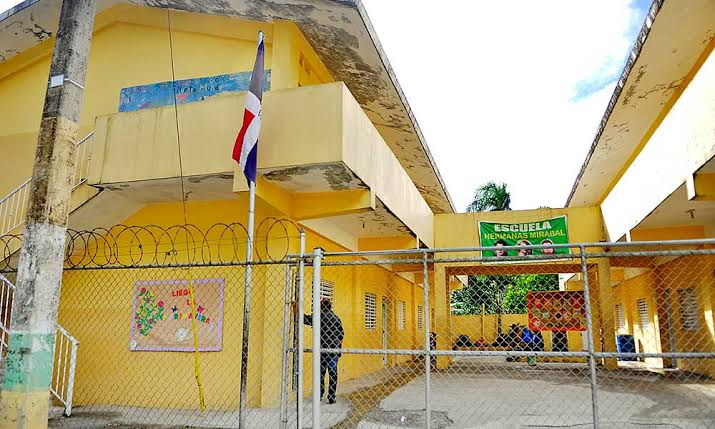
An assessment of educational infrastructure commissioned by the Government has identified schools that require demolition, reinforcement, or intervention
SANTO DOMINGO. – The first edition of LA Agenda Semanal, the new space for monitoring government management, revealed a fact that goes beyond the closure of 57 schools: the Government is building, through structural vulnerability assessments, a comprehensive picture of the conditions of part of the country's educational infrastructure in the face of seismic risk.
The data was presented yesterday, Monday, at the National Palace by Roberto Herrera Polanco, director of School Infrastructure, who explained that 12 companies were contracted to carry out structural vulnerability assessments in educational centers in different areas of the country.
The initial result is that 57 schools were taken out of service: 34 will have to be completely demolished and 23 will undergo partial demolition, figures which, by themselves, do not reveal the exact dimension of the diagnosis.
It remains to be seen where the evaluated schools are located, how old they are, what structural characteristics they presented, what were the technical reasons behind each demolition or reinforcement, and how many students occupy those facilities today.
What did the experts find?
Herrera Polanco explained that the assessments have focused particularly on areas near the Northern Mountain Range, due to the presence of a seismic fault and the terrain characteristics in those locations. The official noted that the island is located in a seismically active region and that its history includes large-magnitude earthquakes.
The National Office for Seismic Evaluation and Vulnerability of Infrastructure and Buildings (ONESVIE) is responsible for assessing the seismic vulnerability of buildings, infrastructure, and lifelines. However, in Monday's presentation, Herrera Polanco attributed the evaluations to the 12 companies contracted by the School Infrastructure department, without specifying ONESVIE's role in the process or how the work was divided among them.
The official also reported on a second group of buildings, identified at the beginning of his administration for having the defect known as "short column": there were 60 in total, of which 42 were being worked on and 19 had already been reinforced and delivered.
What is a short column?
The term has a technical definition within earthquake-resistant engineering. According to the Seismic Engineering Laboratory of the University of Costa Rica (LIS-UCR), the short column effect occurs when the free length of a column is reduced. This can happen unintentionally due to construction errors, deficiencies in urban planning regulations, or because the designer did not consider how the entire structure would behave during an earthquake. When restricted to a shorter span, the column becomes stiffer than a full-height column and absorbs a much greater proportion of the horizontal force generated by an earthquake, which can lead to brittle shear failures.
In practice, this condition typically arises when masonry walls with windows partially surround a column, leaving only a portion of its height unobstructed. This portion concentrates stresses far greater than those the same column would withstand if it were unobstructed along its entire length, as described by engineers José Luis Beauperthuy and Alfredo Urich in a technical study on the phenomenon. It is also one of the most frequently identified causes of school collapses during earthquakes in various countries of the region.
The fact that the School Infrastructure Directorate itself detected short columns in dozens of buildings and initiated repairs does not mean that this was the defect that led to the closure of the 57 schools. Without individual technical reports, it is not possible to extrapolate this finding to the entire situation.
Maintenance and new classrooms
The structural vulnerability assessment is progressing alongside other work fronts within the School Infrastructure department. Herrera Polanco reported that, through the 24/7 maintenance program, work is underway at 1,457 schools with the participation of 297 micro-enterprises, of which 1,226 had already been completed at the time of the presentation.
Regarding infrastructure expansion, the official reported the delivery of 1,321 new classrooms, with a projection of reaching 1,503 by the end of August and approximately 1,700 in September. These are separate processes from the seismic assessment, although they are part of the same management.
Furthermore, with the school year already underway, 268 evaluated schools remain pending intervention, while new bidding processes are being prepared to complete it.
A network built over decades
The Dominican Republic's educational infrastructure is the result of decades of construction under standards that have changed over time. The age of a school building does not, in itself, determine its vulnerability—that is a conclusion that should be reached through technical evaluations—but it does make it relevant to know under what regulations each building was designed and whether it has been evaluated or reinforced since then.
The School Infrastructure Directorate has previously indicated that much of the educational physical plant dates back to the Trujillo and Balaguer governments, before the current anti-seismic standards existed. Therefore, the ongoing evaluation is not only about deciding what to do with the schools that already show visible damage, but also about understanding how a network built in different eras responds as a whole to current technical criteria.
The map that is still missing
Monday's presentation revealed the scope of some decisions, but not the detailed territorial scope of the assessment. The complete list of schools evaluated by the 12 contracted companies, as well as the individual results of each study, remain unavailable.
Nor is there, in a single publicly accessible document, a list of the 57 centers that have been decommissioned, including their location, age, enrollment, and the specific circumstances that led to each decision. Without this data, the figure of 57 measures the problem, but it still doesn't explain how it is distributed or what patterns it follows.
Recommended readings:
- More than 2.6 million students begin the 2026-2027 school year in the Dominican Republic
- Government intervenes in bridges, schools and critical infrastructure to reinforce them against seismic events, says President Luis Abinader
- More than 3,000 buildings assessed: ONESVIE seeks to strengthen the country's seismic preparedness







