This data is particularly relevant in a region that combines industrial, tourist, residential, and service activities
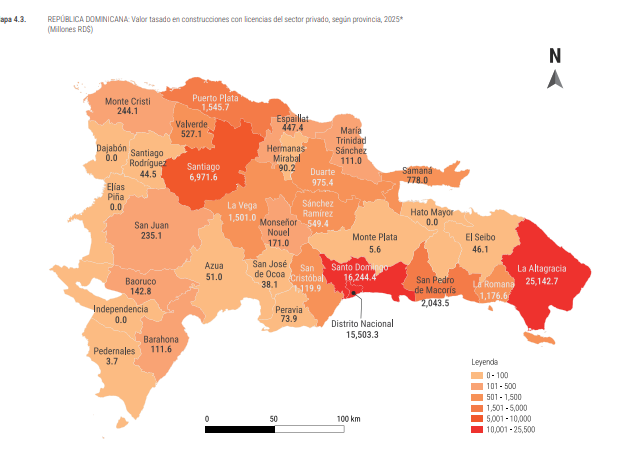
SANTO DOMINGO. The 2025 Yearbook of Economic Statistics, prepared by the National Statistics Office (ONE), shows that, in addition to the country's main economic, urban, and tourist centers, other provinces registered significant activity in licensed private construction during the year. San Pedro de Macorís, Puerto Plata, La Vega, and La Romana led this group, with construction values exceeding RD$1 billion.
The data shows a construction market with marked differences between provinces, where some reached several hundred million pesos in licensed projects, while others remained below RD$100 million or did not report any value in the indicator.
San Pedro de Macorís takes center stage in the East
San Pedro de Macorís, with RD$2,043.5 million, led the group of provinces that followed the territories with the highest national values.
The figure places this province among the markets where the private sector developed projects of considerable size during 2025. Its record also stands out within the Eastern region, exceeding the amounts recorded for La Romana and Samaná.
In this sense, the data becomes relevant in a territory that combines industrial, tourist, residential and service activity, factors that contribute to diversifying the demand for new built spaces.
Puerto Plata and La Vega exceed RD$1.5 billion
Puerto Plata reached RD$1,545.7 million in appraised value of licensed private constructions, while La Vega registered RD$1,501.0 million.
Both provinces practically equalized their levels of activity, although they correspond to different economic profiles.
In Puerto Plata, construction development is linked to a territory with significant tourist activity and a growing demand associated with accommodation, services, and residential projects.
La Vega, on the other hand, represents one of the main urban and productive centers of the Cibao region, so its record shows that private construction also maintains an important space in the interior of the country.
La Romana exceeds RD$1.1 billion
La Romana completed the group of provinces that exceeded RD$1 billion, reaching RD$1,176.6 million.
The result keeps the East among the regions with several important construction markets, adding the records of La Romana and San Pedro de Macorís to those of other provinces in the area.
The figure also shows that real estate and construction activity in this region is not limited to a single territory.
Samaná is approaching RD$800 million
With RD$778.0 million, Samaná was at an intermediate level, although below the group that exceeded RD$1,000 million.
The record is significant within the national context and places the province above several districts with higher amounts of construction activity.
The presence of Samaná among the provinces with the highest values also expands the map of territories where the private sector promoted projects through construction licenses during the year.
Duarte came close to RD$1 billion
Another noteworthy figure corresponds to Duarte, who reached RD$975.4 million.
The province was less than RD$25 million away from reaching the RD$1 billion threshold, far surpassing most of the country's districts.
Its result confirms the importance of the Cibao region as a space where, in addition to Santiago, several provinces maintain significant private construction activity.
A second group ranges between RD$400 and RD$600 million
After the provinces with the highest values, there is a group with records ranging between RD$400 million and RD$600 million.
Monsignor Nouel reached RD$549.4 million, María Trinidad Sánchez totaled RD$527.1 million and Espaillat reached RD$447.4 million.
Although there is a considerable difference compared to the main markets, these values show that formal private construction also found space in provinces that are not usually among the largest recipients of real estate investment.
The map also reveals smaller-scale markets
In other areas, licensed construction activity was carried out on a much smaller scale.
Monte Cristi recorded RD$244.1 million, while San Juan reached RD$235.1 million. They were followed by Sánchez Ramírez, with RD$171.0 million, Baoruco, with RD$142.8 million, San Cristóbal, with RD$119.9 million, and Barahona, with RD$111.6 million.
Also appearing are Hermanas Mirabal, with RD$111.0 million, and Santiago Rodríguez, with RD$90.2 million.
These results show a reduced, but equally present, construction activity in different areas of the national territory.
Less than RD$100 million in several provinces
The level drops even further in Peravia, which registered RD$73.9 million, San José de Ocoa, with RD$51.0 million, El Seibo, with RD$46.1 million, and Azua, with RD$38.1 million.
In Pedernales, the value dropped to RD$3.7 million, while Monte Plata registered RD$5.6 million.
The gap between these amounts and the billions allocated in the main markets highlights the unequal territorial distribution of private construction that obtained licenses during 2025.
Four provinces appear without an appraised value
The ONE statistical table also identifies demarcations where the indicator appears at RD$0.0 million.
This is the case for Hato Mayor, Elías Piña and Independencia, while the data corresponding to Dajabón presents a discrepancy in the information provided, so it must be verified in the original source before establishing a definitive figure.
A market that is not limited to the capital and tourist areas
Reading the data allows us to identify a second map of construction activity within the Dominican territory.
San Pedro de Macorís, Puerto Plata, La Vega, and La Romana each exceeded RD$1 billion, while Samaná and Duarte approached that level. Monseñor Nouel, María Trinidad Sánchez, and Espaillat were also among these territories, with values exceeding RD$400 million.
The distribution shows that the development of licensed private projects also extended to urban and tourist centers in the North, the Cibao region, and the East.
Different markets, different scales
The 2025 records show that formal private construction operates in the country on very different scales.
While some provinces concentrate projects valued in billions of pesos, others gather works worth hundreds of millions, and a third group remains below RD$100 million.
This difference does not necessarily imply an absence of real estate activity, but rather reflects the value of the constructions that obtained licenses and were incorporated into the statistical indicator during the period.
The ONE's 2025 Yearbook of Economic Statistics thus offers a look at the territorial behavior of private construction beyond the major markets, allowing the identification of the provinces that maintain a relevant share within the national map of licensed works.
Recommended readings: