


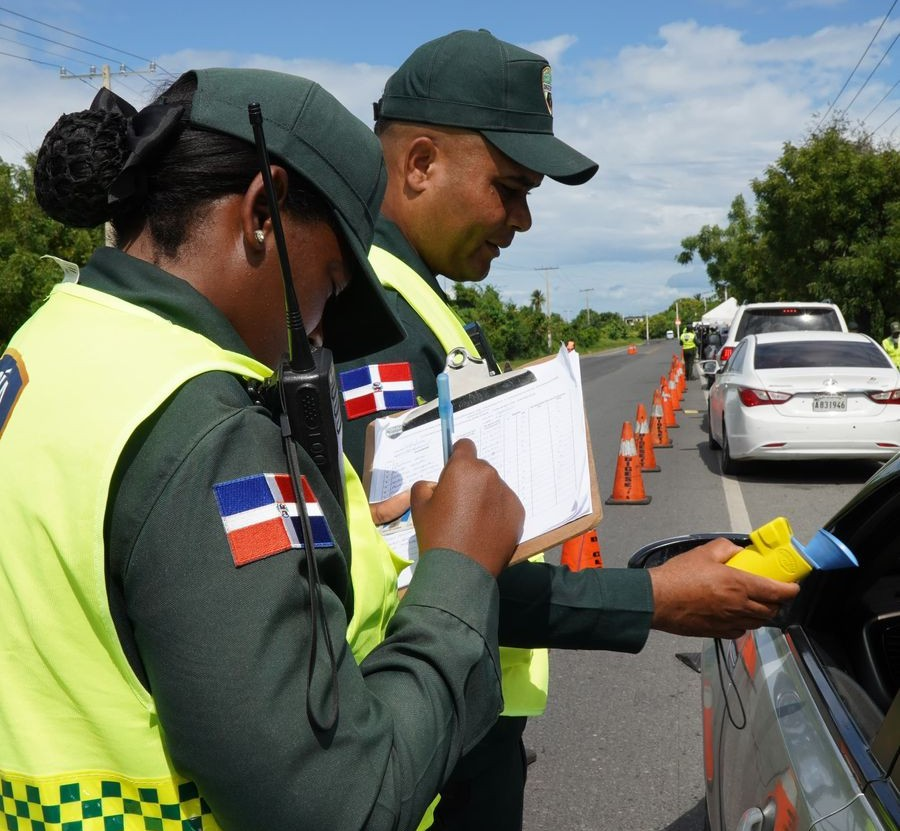
SANTO DOMINGO – Juan Manuel Méndez, the man who left his mark on the Emergency Operations Center (COE), wants to continue expanding his legacy now as executive director of the National Institute of Transit and Land Transportation (INTRANT). Guiding this agency toward modernization by eliminating the traditional ticket books used by traffic officers to issue fines to lawbreakers is part of his plan to revitalize the organization.
In fact, INTRANT issued a statement clarifying that the digital enforcement contemplated by the institution does not correspond to the implementation of photo tickets, but rather is a technological tool aimed at modernizing and making the process of issuing traffic violations more efficient.
“Digital enforcement is not the same as photo enforcement. I haven't mentioned photo enforcement,” the director of Intrant clarified, referring to the information and comments that have arisen on the subject.
Méndez explained that the device would allow enforcement agents to make inquiries by reading elements such as the vehicle's license plate, sticker, and driver's license, facilitating the verification of the corresponding data and reducing errors in the process of issuing violations.
The official noted that one of the objectives of this modernization is to avoid situations that can occur with the use of handwritten forms , such as difficulties in interpreting the agent's handwriting or errors in the recorded data, which can later cause an infraction to be incorrectly associated.
“It’s basically replacing the ticket book that Digesett uses to issue fines, which sometimes has letters that even they don’t understand, with a tablet or a device,” explained Juan Manuel Méndez García during an interview on the program Zol de la Mañana.
It's not about cameras
The director of INTRANT also emphasized that the system maintains a physical component, as the officer conducts the inspection and uses the device to consult and record information related to the infraction. In that regard, he clarified that it is not a system where a camera takes a picture of a vehicle and automatically generates a fine, a concept commonly associated with photo enforcement.
Méndez explained that the implementation of a photo-fine system corresponds to a different mechanism and that, for its application, the process related to traffic light networks and the necessary technological infrastructure would first have to be completed.
Technology to strengthen oversight
The CEO stated that the incorporation of digital tools aims to contribute to more organized, transparent, and efficient oversight, reducing errors inherent in manual processes and facilitating the availability of information. He also emphasized that the purpose of oversight is to fulfill the authorities' responsibility to enforce traffic regulations and contribute to order and road safety.
“The role of the authority is not only to oversee in order to receive the resources; it is simply to ensure that the law is being followed,” he stated.
Juan Manuel Méndez recalled that the modernization of management and oversight processes is part of the institutional efforts aimed at strengthening the application of Law No. 63-17, on Mobility, Land Transport, Transit and Road Safety.
With this clarification, the information highlights, INTRANT seeks to guide citizens on the true scope of digital enforcement, differentiating it from a possible photo-fine system and avoiding interpretations that could generate confusion about the measures under evaluation.
Recommended readings:






