


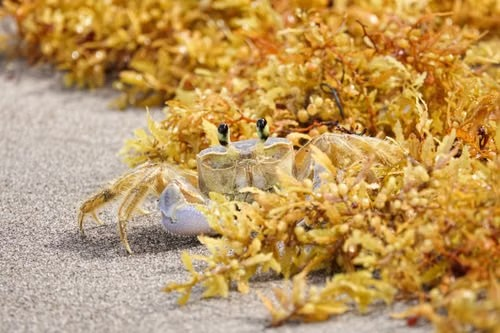
The University of South Florida's August bulletin confirms the decline in floating biomass in the Caribbean, just as the hotel sector demanded a firm policy from the Dominican government, which then activated a new operation in the eastern region
SANTO DOMINGO. – There are changes that a fisherman or a bather notices before they appear in a report: the color of the sea, the texture of the surface, the smell that repels them when approaching the shore, or what floats around the boat.
This year, that empirical reading and the scientific data point, for the first time in months, in the same direction: the sargassum biomass that reached extraordinary levels in the middle of summer began to subside, but the same data that brings that relief came accompanied by a public warning from the hotel sector, which demanded a policy from the Government that, according to its own spokespeople, does not yet exist.
The August 2026 bulletin from the Optical Oceanography Laboratory of the University of South Florida (USF), published on September 2 by the CARICOOS network, confirms that the total amount of sargassum continued to decline in all regions analyzed.
Within the so-called sargassum belt, the amount was reduced by half compared to the level in July, while in the Gulf of Mexico it remained at approximately one-third of that recorded the previous month.
The news doesn't mean that the Dominican coast is free of sargassum, nor that the problem is over. It means something more precise, and, after a particularly intense year, encouraging: the amount of floating sargassum in the satellite-monitored regions has begun to decrease.
The belt is still there, stretching from the west coast of Africa to the Gulf of Mexico, and maintains a distribution similar to that observed in previous months. USF oceanographer Frank Muller-Karger explained that "what were initially small patches ended up becoming a new, stable population in the tropical Atlantic," referring to a belt that, since 2011, has reappeared each year with varying intensity.
But what's important to note now is that the amount has begun to decrease. The decline comes after a season that once again placed sargassum at the center of scientific, environmental, and tourism discussions in the Caribbean.
The Deputy Minister of Coastal and Marine Resources, José Ramón Reyes, had described the moment as “a situation that must be treated as an emergency” on June 3, when he warned that the Caribbean had accumulated between 70 and 80 million tons of floating sargassum, compared to 30 and 40 million the previous year, with arrivals doubling month by month between January and May compared to 2025.
In June, the phenomenon reached one of its highest levels, with a NASA report indicating that it was the second June with the highest amount of sargassum observed by satellite, second only to 2025, while USF estimated around 33.6 million metric tons in the monitored regions.
The story takes a different turn
The USF August bulletin notes that, except in the eastern Atlantic, the amount of sargassum in the regions studied was still above the 75th percentile of historical levels recorded for August between 2011, the year measurements began, and 2025.
The decline does not yet return the Caribbean to a normal situation: there is less than during the peak, but there is still more than usual for this time of year in much of the region.
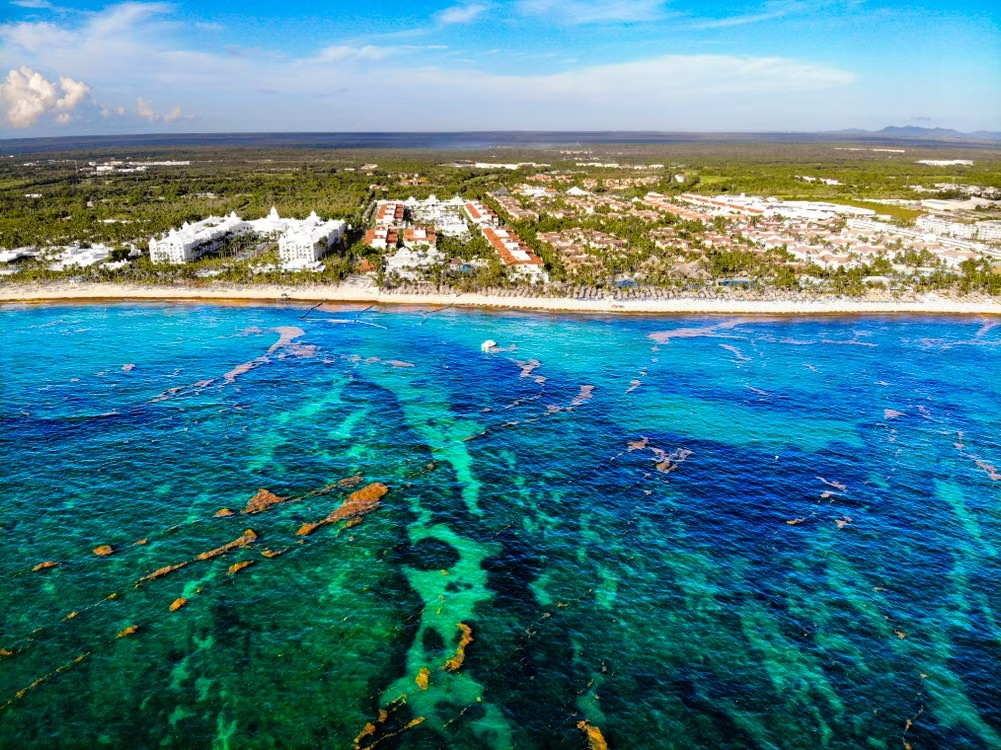
The current situation in the Dominican Republic has, in addition to a scientific component, a political and business one, which precedes the operation by days. (Photo/Pexels).
The university anticipates that the decline will continue over the next few months, possibly until November, and at the same time warns that arrival events on the coasts of the Caribbean and the Lesser Antilles will continue, although with less intensity than during the summer months.
There's a key difference to keep in mind: less sargassum in the ocean doesn't mean the seaweed is absent from a particular beach. Satellite data allows us to observe large areas of the ocean and track the regional evolution of the biomass, but it doesn't automatically translate that data into a prediction of what will happen tomorrow off a specific beach. USF itself cautions that its regional products should be interpreted according to scale, and it offers high-resolution maps for specific coastal areas.
NOAA and USF also developed a daily coastal flood risk assessment system for sargassum. The indicator uses data from the USF Floating Algae Index and analyzes conditions within a 50- to 100-kilometer radius of each coastal point to classify the risk as low, warning, medium, or high.
This tool helps to understand why the regional decline does not equate to an immediate disappearance on the beaches: a mass of sargassum can continue to move, concentrate, and reach certain coastlines while the total amount in the ocean begins to decrease.
Businessmen are pushing
The Dominican situation these days has, in addition to a scientific component, a political and business one, which precedes the operation by days.
On September 4, during the Asonahores Annual Convention in Punta Cana, tourism entrepreneur Frank Rainieri, of the Puntacana Group, warned: “We have to create a policy against sargassum; so far it has been talked about, but there is no coherent and firm policy,” and asked for the immediate authorization of marine barrier programs, since the supplies take six months to arrive in the country and an additional two months to install.
That same day, the hotel association Inverotel sent a letter to the Minister of Tourism, David Collado, requesting action "with the utmost speed" to prevent the Dominican Republic from experiencing what Quintana Roo is already suffering, a letter that was published in the specialized tourism press on September 8.
Minister Collado, for his part, had warned since September 1 that the massive arrival of sargassum "puts at risk the competitiveness and image" of the destination, while coordinating a cleanup at Playa Rincón with the Navy, the Ministry of Public Works and brigades from CEIZTUR.
The funds available to the Ministry of Tourism itself illustrate the gap between diagnosis and solution: Collado confirmed on June 29 that he has nine million dollars deposited in an Asonahores account, earmarked for a collection mechanism at sea, but contingent on the emergence of “a definitive solution.” To date, the funds have not been disbursed.
It is in this context, with the private sector publicly demanding a policy and a fund of nine million dollars while awaiting a viable mechanism, that the Ministry of Environment and Natural Resources, headed by Armando Paíno Henríquez, announced, five days later, on September 9, the start of a national environmental protection operation in the eastern region due to the massive presence of sargassum.
The operation includes technical brigades, inspection of cleaning protocols, environmental impact analysis and evaluation of sustainable solutions, framed within Resolution 0046-2025, which establishes the general guidelines for the collection of sargassum on the country's coasts.
However, there is no scientific contradiction between this data and that of USF. One describes the amount of sargassum that remains floating in large regions of the ocean; the other reflects what continues to reach the coasts and requires management, as well as the public pressure to ensure that management is effective. For a country whose tourism economy depends heavily on its coastline, this difference is crucial.
What's happening in Mexico
Mexico offers a contrast worth examining closely, and one that also changes with the calendar. In mid-August, Reuters reported that Quintana Roo had already removed more than 105,000 tons of sargassum in 2026, surpassing the total amount collected during 2025.
Three weeks later, on September 8, the Mexican Navy Secretariat reported that the figure had risen to more than 123,400 tons collected so far in 2026, 33% more than the 92,782 tons removed during all of 2025. The pace of collection, in other words, has not stopped despite the decline documented by the USF in floating biomass.
Mexico is also combining satellite tracking, artificial intelligence, and monitoring centers to anticipate the phenomenon, while preparing a circular economy center in Puerto Morelos that will open in 2027.
It is a process that shows how the response to sargassum is shifting from beach cleaning to monitoring, prevention, and the utilization of biomass.
After months of record highs, the decline brings news that until recently wasn't at the center of the conversation: the pressure on the ocean is beginning to ease. But the USF isn't talking about disappearance, it's talking about decline, and that word is key.
The scientific forecast indicates that the amount will continue to decrease during the coming months, possibly until November, as the arrivals will continue, although less severe than during the summer.
For the fisherman who looks at the sea, for someone who works on a beach, for a hotel that has had to remove tons of seaweed from its coastline, or for a community that lives off the coast, the change is not measured only in millions of tons.
It is measured by how long it takes for the water and sand to reappear, by how much effort is no longer needed to maintain a usable beach, and by how much time elapses between the moment the satellite detects that the sea is releasing sargassum and the moment that improvement actually reaches the shore.
Rainieri framed it in terms of a timeline: a barrier program authorized today would take at least eight months to install, meaning it would arrive after the next season had already begun.
For now, the signal coming from the ocean is favorable; the 2026 sargassum season has already passed its peak, but the Caribbean, and the industry that depends on its coasts, still have to wait to fully feel the relief.
Recommended readings:






