


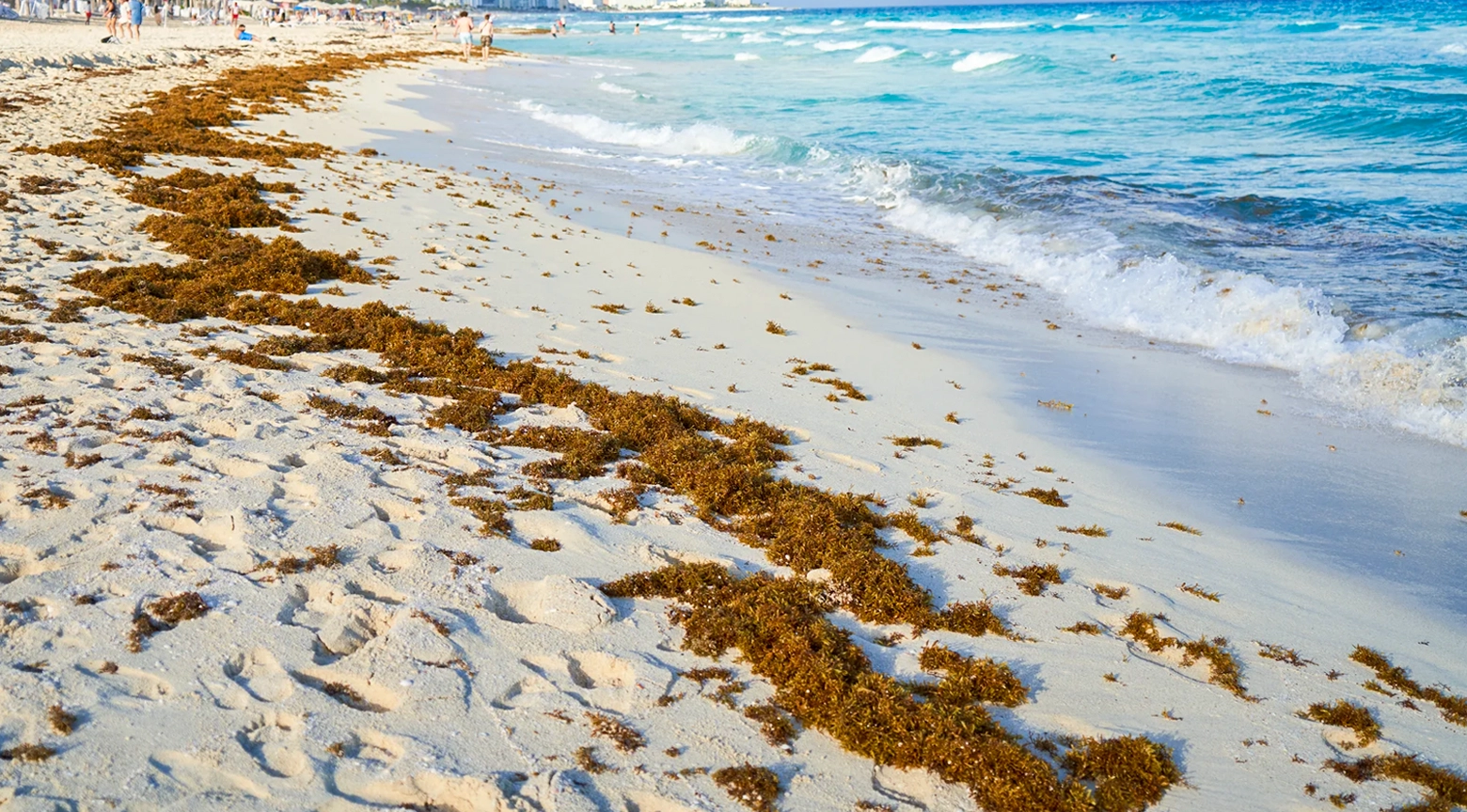
A year after the country took the problem to the United Nations, the most comprehensive ocean report ever written confirms it: sargassum doesn't originate here, but this is where the bill is paid
SANTO DOMINGO. – “Strengthening the global response to the massive influx of sargassum blooms” was the name of the proposed resolution brought by the Dominican Republic, with the co-sponsorship of Barbados and Jamaica, to the UN Environment Assembly (UNEA-7), which approved it on December 11, 2025, in Nairobi.
This resolution was entirely dedicated to sargassum and was the first time in history that such a resolution was passed.
The Dominican Foreign Ministry announced the achievement days later, and the head of the negotiating delegation, Claudia Taboada, Minister Counselor at the Permanent Mission to the United Nations in Geneva, described it as the result of years of diplomatic work dedicated to making visible a problem that the country does not generate, but which it receives with increasing intensity.
Six months after that vote, the most comprehensive scientific assessment ever conducted on the state of the oceans, the United Nations WOA III, ultimately vindicated the Dominican proposal with concrete data.
And, in parallel, the numbers from this same year show that the diplomatic urgency was not rhetorical: the 2026 sargassum season is already the most severe ever recorded in the region.
Pollution and climate change
The support comes from the subchapter dedicated to the Sargasso Sea, in WOA III, which confirms that the blooms that flood beaches in increasingly southern latitudes, that is, the phenomenon that hits the Caribbean, are attributed to anthropogenic contributions of nutrients to the ocean system.
The document specifically links these blooms to discharges from the Orinoco and Amazon rivers and to human-caused climate change, and clarifies a nuance that rarely comes up in public discourse: the sargassum that reaches the Caribbean coast is not, in genetic terms, the same as that which gives the Sargasso Sea its name.
A different variant predominates there, identified as S. natans VIII, which forms less diverse biological communities than those of the sea that gives rise to its name.
The subchapter dedicated to macroalgae in general, within the biodiversity section of the same report, estimates that the so-called Great Atlantic Sargassum Belt contains more than 20 million tons of floating sargassum, distributed from West Africa to the Gulf of Mexico.
That same subchapter, coordinated by researcher Elizabeth Cottier-Cook, along with a team of fourteen specialists, documents that the increase of macroalgae on the reefs of the Mexican Caribbean and the proliferation of pelagic sargassum beyond its area of origin are already recorded in peer-reviewed scientific literature.
Evidence by the ton
While the UN was documenting the scientific backing for the Dominican resolution, the phenomenon was accelerating in real time. According to data from the Optical Oceanography Laboratory at the University of South Florida (USF), reported by the EFE news agency, between January and June 30, 2026, nearly nine million metric tons of sargassum accumulated on the coasts of the Dominican Republic and Puerto Rico, the highest figure recorded for that period since systematic satellite monitoring of the phenomenon began.
The volume exceeds the 8.3 million tons of the same semester in 2025 and multiplies by more than seven the record of just 1.2 million tons in 2024.
The USF itself had warned of the magnitude of the season weeks in its May 31, 2026 bulletin, when it reported 28.9 million metric tons of sargassum in the central-western Atlantic, 13.8 million in the Caribbean Sea and 6.6 million in the Gulf of Mexico, unprecedented levels for that month in most of the monitored areas.
The researchers themselves attribute the increase to a process called vertical mixing, whereby nutrient-rich deep waters rise to the surface due to winds and ocean currents, combined with warmer temperatures and greater sun exposure.
The UN investigates, the State spends
The December resolution tasked the executive director of the United Nations Environment Programme (UNEP) with preparing a comprehensive report on existing initiatives against sargassum and convening a high-level meeting to strengthen international cooperation, but that multilateral process takes time.
Meanwhile, the impact is being managed internally: the Ministry of Tourism has about US$9 million available to finance initiatives against sargassum in the country's main tourist destinations, although Minister David Collado has conditioned its use on there being a technically validated solution, since spending those resources without a proven answer, he warned, would be an irresponsible decision.
In parallel, the Ministry itself delivered thirty trucks, six tractors and six sweepers to municipalities and district boards in coastal areas, with an investment of RD$128 million. Among the municipalities that benefited were Boca Chica, Haina, San Pedro de Macorís and Laguna de Nisibón, among other tourist activity points.
Turning a problem into an opportunity
While Dominican diplomacy is betting on the international community investigating the origin of the phenomenon, Dominican science is already working on what to do with the macroalga that keeps arriving anyway.
The Technological Institute of Santo Domingo (Intec), through its Interdisciplinary Sargassum Research Group, maintains two simultaneous lines of research. The first, developed in conjunction with the Banelino Association and published this year, evaluated the use of sargassum as a biofertilizer in tomato crops and found that elements of concern such as arsenic, cadmium, and lead remained below the quantification limits in the harvested fruit. However, the team itself recommended longer-term field studies before extending the practice to other crops or agricultural conditions.
The second, more recent line of research successfully extracted alginate from sargassum seaweed washing up on Dominican shores. The research originated as a thesis project by Cristal Richiez, a Biotechnology student, under the guidance of Professor Yaset Rodríguez Rodríguez, and achieved a 16% yield of this biopolymer, a figure that falls within the range reported in international literature, between 8% and 30%.
Alginate has applications in the food, pharmaceutical, cosmetic and agricultural industries due to its gelling and thickening properties, and its successful extraction opens a path of industrial use for a macroalga that, until now, the country has treated mainly as a problem of collection and final disposal.
What remains to be done
There are still two processes running in parallel, albeit at different speeds. On the one hand, there is the comprehensive report that UNEP is required to prepare under the Dominican resolution, and on the other, the high-level meeting that it should convene to discuss it, for which no public date has been set so far.
On the other hand, there is a sargassum season that, according to USF itself, has been breaking records every year since 2024, and Dominican science that, without waiting for Nairobi or New York, is already looking to turn the macroalga into raw material.
Between these two rhythms, the diplomatic and the scientific, lies a good part of whether the Dominican Republic can move from managing a recurring crisis to turning it, as Intec itself proposes, into an opportunity for a circular bioeconomy.
Recommended readings:







