


The period from 1996 to 2000 built much of its political identity around the modernization of the State, and yet in the academic historiography of Dominican social housing, it is a four-year period with a very poor record
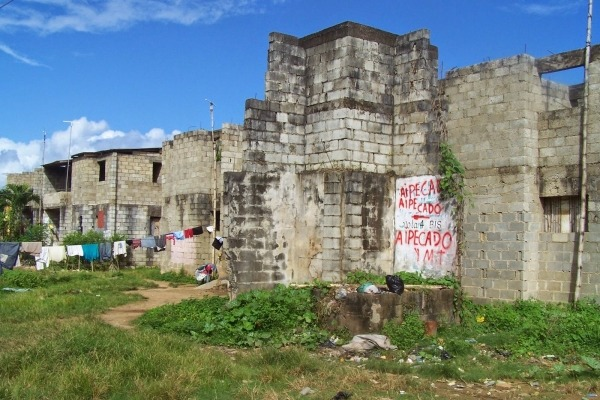
SANTO DOMINGO. – In Constanza, a poured and plastered slab that was part of a project of 100 homes, half of them duplexes, intended for families left homeless by Hurricane Georges in September 1998.
The Kennedy Colony, as the sector is called, appears registered years later in the national inventory of paralyzed works compiled by Citizen Participation: an almost finished and uninhabited construction.
That slab is an entry point to recount what happened with social housing during Leonel Fernández's first government (August 16, 1996 – August 16, 2000) because it summarizes, in one place, the central tension of the period: a State that did build, that did respond to an emergency, but that left an important part of that response unfinished, repeating a pattern that this series has already documented in previous governments.
What existed in August 1996
When Fernández took office, the country was burdened with a housing deficit that the Economic Commission for Latin America and the Caribbean (ECLAC) had measured just a year earlier: 29.6 percent of the Dominican housing stock, according to the 1995 calculations collected in the study "Housing Situation in Latin America and the Caribbean" (UNECLAC, 1996) and cited by Alan Gilbert in his work "Housing in Latin America", published by the Inter-American Development Bank/INDES, in 2001.
Of that total, 16.7 points corresponded to quantitative deficit, housing that was missing to be built, and 12.9 to qualitative deficit, the latter measured in that study more narrowly than current methodologies: only as the proportion of homes without access to drinking water.
This is, as far as this research could trace, the oldest and best-documented figure for the Dominican housing deficit expressed as a national percentage. However, there is no census-based measurement of this figure: the first of its kind would only appear with the 2002 Census.
The Dominican Republic entered 1996, with an administration that would present itself as the most modern in the country in generations, without an official and proper way of quantifying the problem it inherited.
The shift: grow the economy, not necessarily housing
The hallmark of Fernández's first government was macroeconomic, and the archives speak of a country that registered the highest growth in Latin America and one of the highest in the world during those years, a performance that the economic press of the time dubbed the "Dominican economic miracle".
The construction sector was a visible part of that dynamism because it grew 18.2 percent in 1999, and the square meters of construction of apartments and houses under permits from the then Ministry of Public Works went from 1.8 to 3.1 million, according to figures that the Press Office of the Presidency itself released in 2003 in response to statements by the then President Hipólito Mejía about an alleged abandonment of the provinces.
That document, which by its origin and purpose should be read as what it is, a piece of political defense and not a neutral technical report, contains, however, an admission that is of interest to this series: "We found many unfinished housing projects.".
It is the confirmation, in the words of the government that came after Leonel, that the legacy included unfinished works from the previous administration and the Citizen Participation inventory allows us to name some of them, such as the Pica Piedra housing project, in La Romana, started in 1994, which was paralyzed precisely in 1996, the year of the change of government.
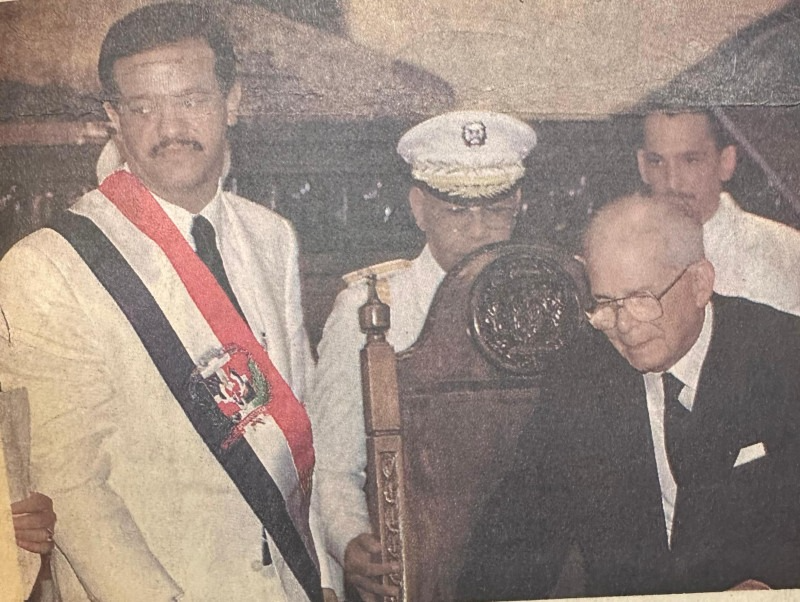
From 1996 to 2000, Leonel Fernández Reyna governed the Dominican Republic. (Photo/Listín Diario).
According to that same document from the Presidency, the Directorate of National Assets had delivered, up to May 1999, 23 projects with a total of 2,297 houses and apartments distributed in different provinces, La Goya, Galván, Santiago Rodríguez, Monción, Moca, Ciudad Satélite, Los Ciruelitos, Los López, San Miguel in La Vega, Los Maestros in Bonao, El Cercadillo in Yamasá and Villa Fundación, in addition to the Porvenir housing complex in San Pedro de Macorís, of 34 buildings.
These figures correspond to a more modest and dispersed scale than the massive construction programs that this series has documented in the Balaguer governments.
The inventory of stalled works
The other side of the file is offered by Participación Ciudadana, which in its document reports housing projects identified at the national level that began between 1996 and 2000, among which the following stand out: the Arroyo Seco project, in Tamayo (Bahoruco), started in 1997 with 52 homes and stopped that same year; a building for professionals in Pedernales, started in 1998, with three levels and six apartments, stopped in 2003.
It also points out, already corresponding to the administration of Hipólito Mejía, the Gautier project, in San Pedro de Macorís, started in 2000 with 150 planned homes, of which 54 were built before being halted in 2004; and, on the side of the National Institute of Aid and Housing (INAVI), the Ramón Paulino street project in Valverde, with 200 planned homes, also started in 2000 and halted in 2003.
It should be noted that none of these projects individually reaches the scale of the multi-family complexes that defined Balaguer's housing policy and the Citizen Participation inventory itself, unlike what it does with aqueducts, roads or electrification, does not offer a percentage breakdown of the 1996-2000 period in the housing category: the comparison has to be built case by case, not citing a statistic already calculated by the source.
A silence that is also a fact
There is also another gap worth pointing out because it speaks volumes. None of the three most rigorous academic investigations on the history of Dominican social housing—the doctoral thesis of architect Natalia Ulloa Cáceres (2017), the master's thesis of Evelyn Vanessa González Mueses (Polytechnic University of Valencia, 2014), and the thesis of Andrés Navarro García on evictions and urban renewal under Balaguer (UNAM, 2014)—dedicates a section to Fernández's first government (in the latter case, the research period covered up to 1990).
Ulloa Cáceres's work, the most recent and complete in its chronological treatment, jumps directly from the Fifth Centenary projects in 1992 to "La Nueva Barquita," a 2014 project. The period from 1996 to 2000, that of a government that built much of its political identity around the modernization of the State, is, in the academic historiography of Dominican social housing, a four-year period without a clear record to follow.
Sources: Citizen Participation. “National Inventory of Stalled Public Construction Projects” (Ginell Castillo, author; data collected up to August 2004). | Press Office of the Presidency of the Republic. “Summary of the works carried out by the government of Dr. Leonel Fernández in three and a half years of his administration” (2003). | Gilbert, Alan. “Housing in Latin America.” Inter-American Development Bank/Inter-American Institute for Social Development (INDES), Working Paper I-7UE/Es, September 2001, with data from UNECLAC, “Housing Situation in Latin America and the Caribbean,” Santiago, 1996. | Ulloa Cáceres, Natalia. “Social Housing in Santo Domingo: Opportunities for Recycling the Existing Housing Stock.” Doctoral dissertation, 2017. | González Mueses, Evelyn Vanessa. “On Dominican Social Housing in the 20th Century: The Case of Santo Domingo.” Master’s thesis, Polytechnic University of Valencia, 2014. | Navarro García, Andrés. “Neighborhoods in Turmoil: State and Popular Organizations in Urban Renewal in Santo Domingo, 1986–1990.” Master’s thesis, UNAM, 2014.
Recommended readings:







