


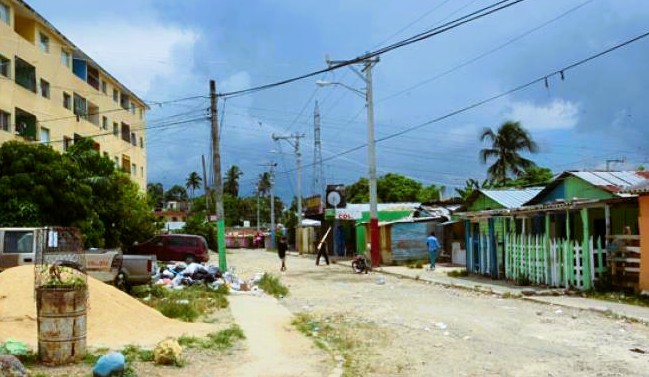
Challenge, globalization and poverty, the combination of words in the same sentence that sums up the tension of the entire four-year period
SANTO DOMINGO. – On February 27, 2000, in his last accountability speech before the National Assembly, President Leonel Fernández described a transformed country: construction had grown 18.2% in 1999, cement consumption placed the Dominican Republic first in Latin America and the Caribbean, and the square meters of construction under permit from the Ministry of Public Works and Communications had increased from 1.8 to 3.1 million square meters in three years, an increase of 80%.
The speech was entitled "The Challenge of Globalization and Poverty," and that combination of words, globalization and poverty in the same sentence, sums up the tension of the entire four-year period.
Because the same government that displayed unprecedented economic expansion figures had acknowledged, just two years earlier, that the housing deficit in the country exceeded 700,000 units, and that figure, far from being reduced at any point during the period, remained the constant backdrop to every presidential speech at the end of February.
Progress in discourse
The macroeconomic data at the end of the 20th century were remarkable, according to the presidential speech of 2000, which announced an 18.2% growth in construction during 1999 and explained it by the combination of private investment in shopping centers, hotels, residential towers and family homes, along with public investment in roads, airports, schools and hospitals.
Tourism was also recovering after the blow it received in 1998 from Hurricane Georges, with 2,649,000 visitors in 1999, 15% more than the previous year.
This growth in construction coexisted with a housing economy that continued to operate at two speeds: that of towers and tourist projects financed by private capital, and that of low-cost housing solutions that the State tried to produce through the National Housing Institute (INVI), without managing to close the gap between the two.
The speech continued with the communications sector, which grew 15.6% in 1999, driven by the installation of new residential and commercial telephone lines, cell phones, and internet services.
Local industry grew by 10.9%, driven by increased demand for construction materials such as paint, rebar, and cement. It was this context of widespread expansion that allowed the president's end-of-century speech to speak of "modernization" without the word sounding empty, at least for those who could access mortgage loans or tourism projects. For those dependent on state-run housing, the pace was quite different.
What INVI reported
Official housing production figures for the period, taken from President Fernández's own accountability speeches, show a modest pace compared to the magnitude of the deficit.
During 1997, government execution of housing projects nationwide exceeded 3,000 housing units, with an accumulated investment exceeding 1 billion pesos.
To that figure were added more than 10,000 units inherited from previous administrations, whose gradual completion required an additional investment estimated, as of December 1997, at more than 2 billion pesos.
By 1998, INVI reported the completion of 21,538 housing solutions, with another 34,973 under construction, and the figure seems high until it is contrasted with the accumulated deficit of 700,000 homes mentioned just a year earlier: even at the most productive rate of the four-year period, the Dominican State would take decades to close the gap, not counting the natural growth of demand due to the formation of new households.
The weight of the past
The most revealing fact of the period doesn't appear in the production figures, but rather in the list of unfinished projects that each government inherits from the previous one. In his 1998 speech, Fernández announced the completion, by April of that year, of the Los Barrancones housing project, begun in 1979 to house the victims of Hurricane David—a project almost 19 years behind schedule. In the same speech, he pledged to continue the Invivienda housing project, started in 1984.
The same speech offers other examples of the pattern, although outside the strictly housing sector: the regional hospital of San Pedro de Macorís had been under construction for 18 years, and the elementary school of El Cedro, in Miches, for 19 years.
As the president himself observed before the Assembly, the child who was supposed to enter that school when its construction was ordered had already finished elementary school, middle school, high school, university and a specialization, by the time the work was finally completed.
Dominican social housing at the end of the century shared that same logic of persistence: projects that outlived several governments, each of which took them up again without necessarily completing them.
This pattern of projects being carried over from one administration to the next, also documented in academic works on the subject, such as the studies by Natalia Ulloa Cáceres and Evelyn Vanessa González Mueses on 20th-century Dominican social housing, suggests that the Dominican housing problem has not been so much a matter of policy design as of institutional continuity. Each government announces its own solutions without necessarily completing those of the previous one.
The housing bond is born
The period 1996-2000, however, introduced a change in approach that would have consequences beyond the four-year term. According to the 1999 presidential address, INVI and the National Housing Bank initiated the housing bond program, a scheme that advocated for a joint effort between the public sector, from a facilitating perspective, and the private sector, as the implementing entity, both in its role as financier and housing producer.
This was a shift towards a demand-side subsidy model instead of direct state construction, a model that would become established in the following years and would shape much of Dominican housing policy in the new century.
Along the same lines of reassigning state assets towards housing, the government declared the property occupied by the Enriquillo Nail Factory to be of public utility and ordered its transfer to INVI for the construction of a housing complex, a practice of converting industrial properties into land for social housing that would be repeated in other contexts.
A century-end assessment
As the 20th century drew to a close, the Dominican Republic had a booming construction economy and a social housing policy that, despite respectable production figures in absolute terms, still did not come close to resolving the structural deficit inherited from previous decades.
The very language of presidential speeches, which went from "Democratic Governance" in 1997 to "The Challenge of Globalization and Poverty" in 2000, reflects this growing recognition that economic modernization and housing poverty were advancing in parallel, without the former resolving the latter.
What none of those speeches could have anticipated at the time was that, halfway through the period, a natural phenomenon would put the entire housing infrastructure of the country to the test in the most brutal way possible.
The next report in this series deals with that, and with how Hurricane Georges became the breaking point for the housing policy of Leonel Fernández's government.
Sources: Accountability speeches of President Leonel Fernández before the National Assembly (February 27, 1997, 1998, 1999 and 2000), published in The Modernization of the Dominican Republic: Memoirs of a Management 1996-2000; Natalia Ulloa Cáceres, Social Housing in Santo Domingo (doctoral thesis, Polytechnic University of Valencia, 2013); Evelyn Vanessa González Mueses, On Dominican Social Housing in the 20th Century. Case of Santo Domingo (TFM, MAAPUD 5, Polytechnic University of Valencia, 2014).
Recommended readings:







