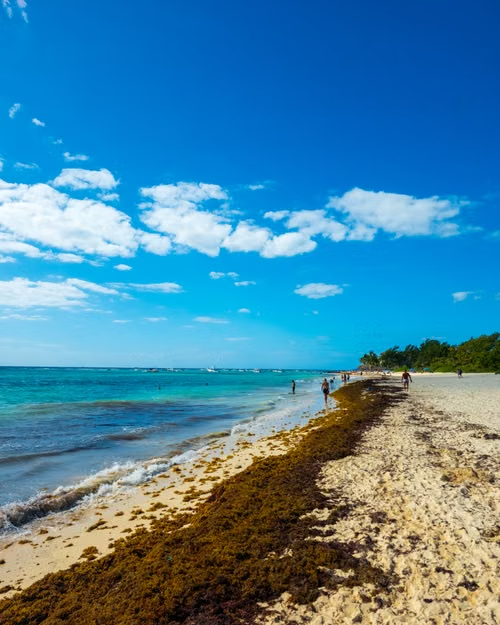
The massive influx of sargassum also poses a challenge to the tourism industry, especially for establishments located in the eastern coastal areas of the country
SANTO DOMINGO.– Sargassum continues to increase its presence on the coasts of the Dominican Republic and, although traditionally the largest influxes were concentrated in the Caribbean Sea, the phenomenon is extending towards the Atlantic and represents a challenge for coastal communities and the tourism sector.
This was explained by the Deputy Minister of Coastal and Marine Resources of the Ministry of Environment, José Ramón Reyes, who also called for avoiding direct contact with large accumulations of these algae, especially when they remain on the shore and begin to decompose.
Health risks
Reyes referred to a video recently recorded in Gran Calera, Samaná, in which a group of children can be seen playing inside a large influx of sargassum.
“Mainly because of the video we saw of the children in Gran Calera, that must be avoided,” the official warned.
He explained that the sargassum accumulated on the shore and in the process of decomposition can represent a risk, particularly for people who have wounds or cuts.
“That can cause health problems. For someone who has a cut, since the sargassum is already decomposing, the seaweed on the shore is decomposing, and it releases a lot of liquids and heavy metals,” he said.
He also indicated that exposure can cause allergic reactions and drew attention to the odors that algae give off when they begin to decompose.
“That smell it gives off, that smell breathing it in inside, like those children were, can cause health risks,” he said.
Hotels face the impact of sargassum
The massive influx of sargassum also poses a challenge to the tourism industry, especially for establishments located in the eastern coastal areas of the country.
Reyes explained that hotels must implement measures to protect their beach areas and remove the seaweed that washes up on the shores.
“Here in the East, we have the situation that the children from the hotels have to go from their shelter and clean up that sargassum,” he said.

José Ramón Reyes, Vice Minister of Coastal and Marine Resources of the Ministry of Environment. (External source).
The accumulation of these algae necessitates regular beach cleaning and poses a challenge for destinations that rely on their coastlines as one of their main tourist attractions.
A problem that transcends the Dominican Republic
The deputy minister insisted that sargassum should not be analyzed solely as a Dominican problem, since it affects numerous territories in the Caribbean and has also begun to be observed in other regions.
“We have a global problem that greatly affects the Caribbean region,” he stated.
As an example of the phenomenon's expansion, he cited the case of Spain. "In Galicia, in Spain, sargassum is arriving. It's not the same type we have, but sargassum is arriving," he explained.
Reyes also pointed out that the entire Antilles region is facing the phenomenon, so its effects must be analyzed from a regional perspective.
“It’s going to be a problem for the entire region. The whole island, the entire island of the Antilles, is suffering from this,” he said.
Sargassum fulfills a function in the ecosystem
The official clarified that sargassum is not inherently harmful. On the contrary, it is an alga that plays a role in the marine ecosystem.
“Sargassum is not bad. It is a live algae that provides shelter,” he explained.
According to Reyes, the problem arises when environmental conditions favor an extraordinary proliferation and large quantities of these algae end up arriving and accumulating on the coasts.
Global warming favors their proliferation
Among the factors related to the increase in sargassum, the deputy minister pointed to global warming and the availability of nutrients in the oceans.
“With global warming… the fertilizers used on land, mainly in Brazil and those countries… in Africa, mining, Saharan dust, well, the sargassum finds nutrients,” he said.
In his opinion, the increase in temperature also favors an accelerated growth of these algae.
“With warming, its production doubles. It even doubles every 20 days, that mass doubles,” he stated.
37.5 million tons worldwide
Reyes also highlighted the magnitude that the phenomenon has reached and pointed out that there are currently large quantities of sargassum distributed throughout the ocean.
“Right now there are, as calculated by NOAA and satellite data, approximately 37.5 million tons,” he said.
The Dominican Republic has been receiving massive influxes of migrants for over a decade
Although sargassum has always been present in the region's waters, Reyes explained that its massive arrival on Dominican coasts began to be more evident between 2008 and 2011.
“Sargassum started coming in here, it has always been present, but it began to arrive massively from 2008 to 2011,” he said.
The deputy minister linked this increase to changes in wind patterns and ocean currents. “It's when the winds and currents changed due to ocean warming,” he explained.
Quintana Roo and Cancun also face large influxes
The situation is not unique to the Dominican Republic. Reyes cited as an example the impact experienced by tourist destinations in the Mexican Caribbean, particularly Quintana Roo and Cancún.
“The Quintana Roo and Cancun area receives five times what the Dominican Republic receives,” he stated.
The situation shows that large influxes of sargassum seaweed constitute a challenge shared by the main tourist destinations in the Caribbean.
For the Dominican Republic, the challenge involves maintaining beaches in good condition, protecting the health of residents and visitors, and continuing to confront a phenomenon that, according to Reyes, already has a dimension that transcends the country's borders.
The spread of sargassum towards the Atlantic and its presence in different areas of the Caribbean and other regions make this phenomenon an environmental challenge that also has direct repercussions on coastal communities and tourism.