


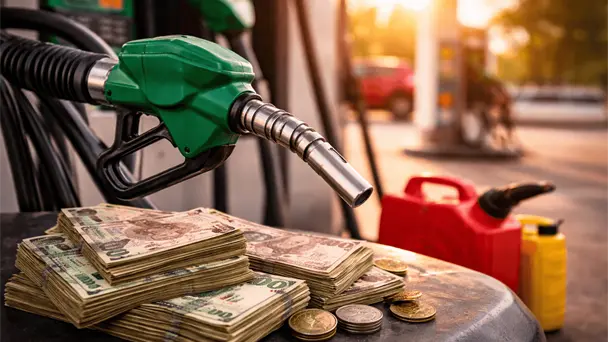
Since 2021, the National Institute of Transit and Land Transportation (Intrant), in agreement with the Ministry of Industry, Commerce and MSMEs (MICM), has coordinated a program through which drivers' federations receive diesel fuel at a reduced price, in addition to the liquefied petroleum gas subsidy provided by the Bonogás program
SANTO DOMINGO. – The National Confederation of Transport Workers (CNTT) announced a general increase in fares on at least 47 urban, suburban, and intercity transport routes, which will take effect next Monday in the capital, the Cibao region, and the eastern provinces, despite also having a fuel subsidy.
The president of the entity, Juan Marte, reported that the readjustment will range in stages between RD$5.10 and RD$25 per route and explained that the measure responds to the high operational costs that drivers have assumed in recent months, including the price of fuels and supplies such as motor oils, tires and spare parts.
The increase is applied, however, at a time when the Government maintains an active mechanism to freeze fuel prices for three months, arranged by the Ministry of Industry, Commerce and MSMEs (MICM) as part of the Pro-Economic Growth and Mitigation of the International Crisis plan, presented by the Minister of Finance and Economy, Magín Díaz.
The mechanism, activated after a final adjustment of between RD$3 and RD$6 per gallon applied on June 12, contemplates maintaining the price of fuels without variation as long as the barrel of oil does not exceed 95 dollars in the international market.
Despite this commitment, since the international price of crude oil has fallen, according to figures cited by the carriers themselves, below $70 per barrel, after the highs of more than $117 recorded in April amid the conflict between Iran and the United States, the CNTT will pass the increase directly on to public transport users.
Marte questioned why the subsidies granted by the Executive Branch to the sector do not reach the drivers, and stated that state compensation for fuel is concentrated in a small group of transport entrepreneurs and considered that, with the price of oil below the threshold of 95 dollars set for the freeze, the Ministry of Industry, Commerce and SMEs should reduce the price of fuels in the domestic market.
Subsidy allocations
The CNTT is among the organizations that have historically received allocations under this subsidy scheme.
A union leader in the sector stated this week that the current compensation only covers about 15 days of operation per month and proposed to the government that it be expanded to help contain fare prices.
The anti-crisis plan recently launched by the Government includes, in addition to the fuel price freeze, a proposed tax reform that will be submitted to the National Congress, with which the Executive seeks to raise between RD$40,000 and RD$50,000 million to sustain the fuel subsidy and other mitigation measures against the international crisis, as explained by Minister Díaz.
Public transport users in Santiago de los Caballeros and other locations expressed concern about the impact of the fare increase on their budgets, while the National Institute of Transit and Land Transport (INTRANT) is expected to convene a dialogue with organized transport operators to seek alternatives to the measure.
Recommended readings:







