


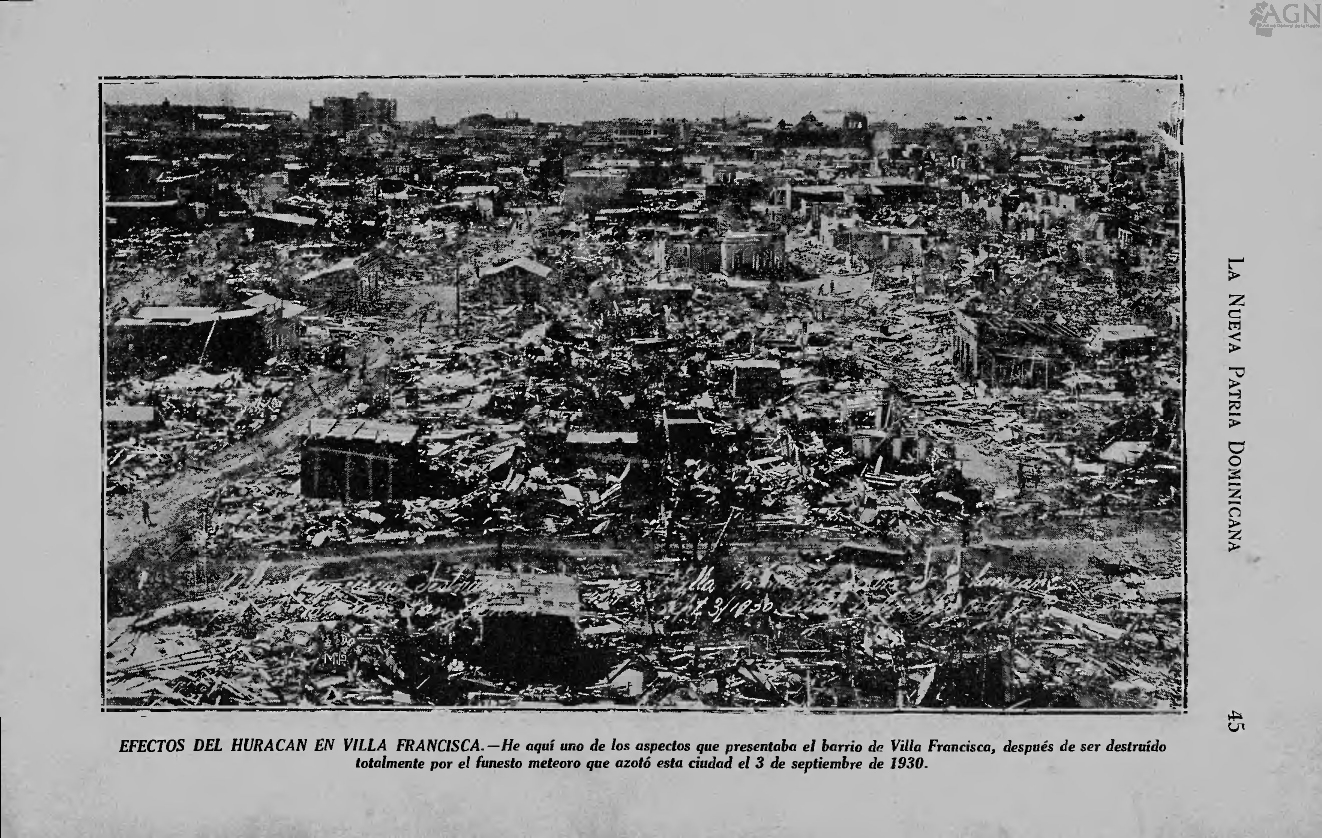
This is the first installment in a series that traces the history of social housing in the Dominican Republic from the rubble of Hurricane San Zenón to the present day. The starting point is not a public policy or an urban planning decree: it is a catastrophe, and the question of who rebuilt first
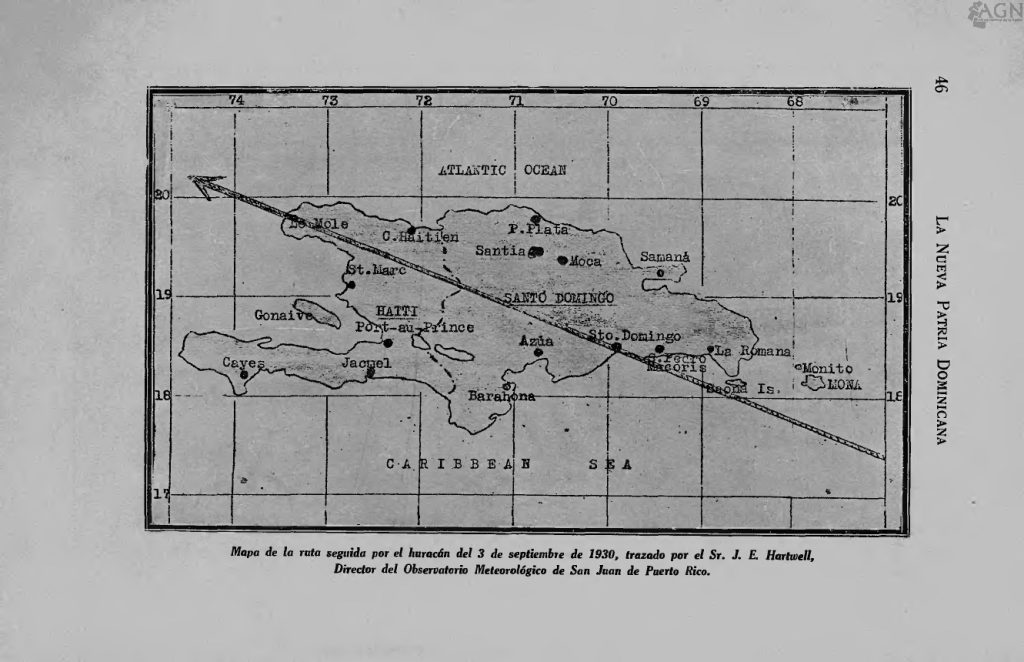
SANTO DOMINGO. – On August 16, 1930, Rafael Leónidas Trujillo assumed the presidency of the Dominican Republic after elections preceded by political violence, and on September 3, the San Zenón cyclone devastated Santo Domingo, a city that, according to Frank Moya Pons in General History of the Dominican People, had approximately 50,000 inhabitants at that time.
The city was left in almost total ruins: 4,000 dead and 19,000 wounded. Researcher Marcos Prados Martín, in "From bohíos to social housing" (Culture & History Digital Journal, 2025), points out that the expansion zones that emerged in the previous decade were completely destroyed, and that only the colonial city withstood the onslaught.
The main cause, according to the same author, was the structural fragility of the wooden houses with zinc roofs that predominated in the poorest neighborhoods, although the widespread use of deficient concrete techniques also caused numerous collapses.
Trujillo responded from the Ozama Fortress with a series of decrees that, according to the official book "The New Dominican Homeland" (Presidency of the Republic, 1935), began just 48 hours after the cyclone, on September 5.
In decrees 8, 9, 10 and 11, he established the Red Cross, presided over by the ruler; formed loss assessment commissions made up of the commercial and military elite; prohibited the sale of provisions above the cost price, with the Court Martial as the sanction, and organized mobile kitchens and cleaning of the capital.
Through Decree No. 24, dated September 9, he froze the prices of construction materials and wages throughout the national territory.
On September 20, seventeen days after the catastrophe, Trujillo sent a telegram guaranteeing the payment of the external debt without moratorium, as documented in the same official book, a sign that the new government was reliable for international creditors.
Prados Martín confirms that the regime's propaganda campaign was effective in obtaining credit for reconstruction and in establishing a symbolic link between the restoration of Santo Domingo and the national reconstruction project.
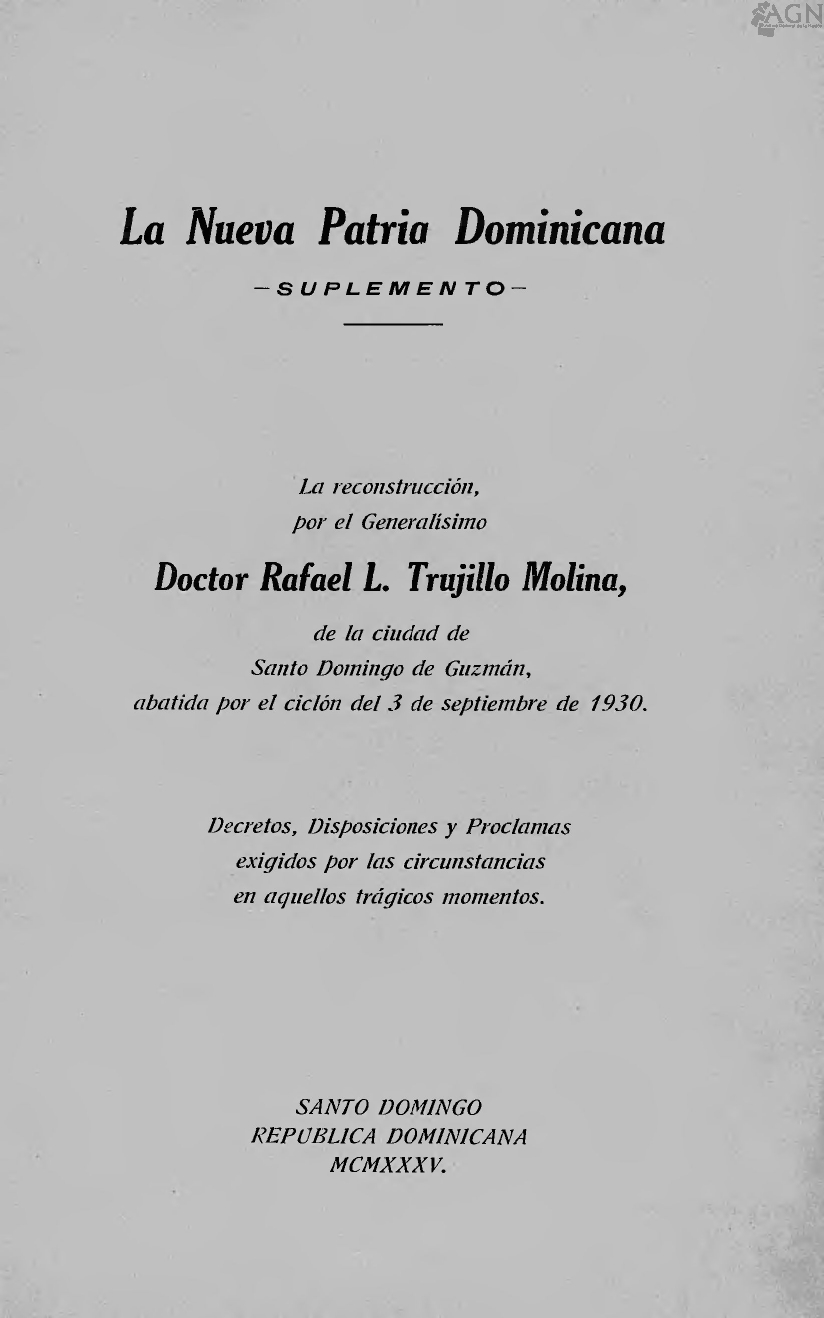
In November 1935, exactly five years after the hurricane, the regime published “The New Dominican Homeland”, edited by Emilio Espínola, Undersecretary of State of the Presidency, and Ramón Emilio Jiménez, Secretary of Education.
The book, preserved in the General Archive of the Nation, presents in images and text the "reconstructive work" of the dictator and in its final Recapitulation, dated November 14, 1935, states that "the work of reconstruction has been a gigantic work, unrealizable for a ruler who does not have the extraordinary amount of energy that the illustrious leader has.".
In its stated intention, the book is a five-year assessment of the regime. In its content, it is also an inventory of who benefited and who did not.
Anonymity in destruction
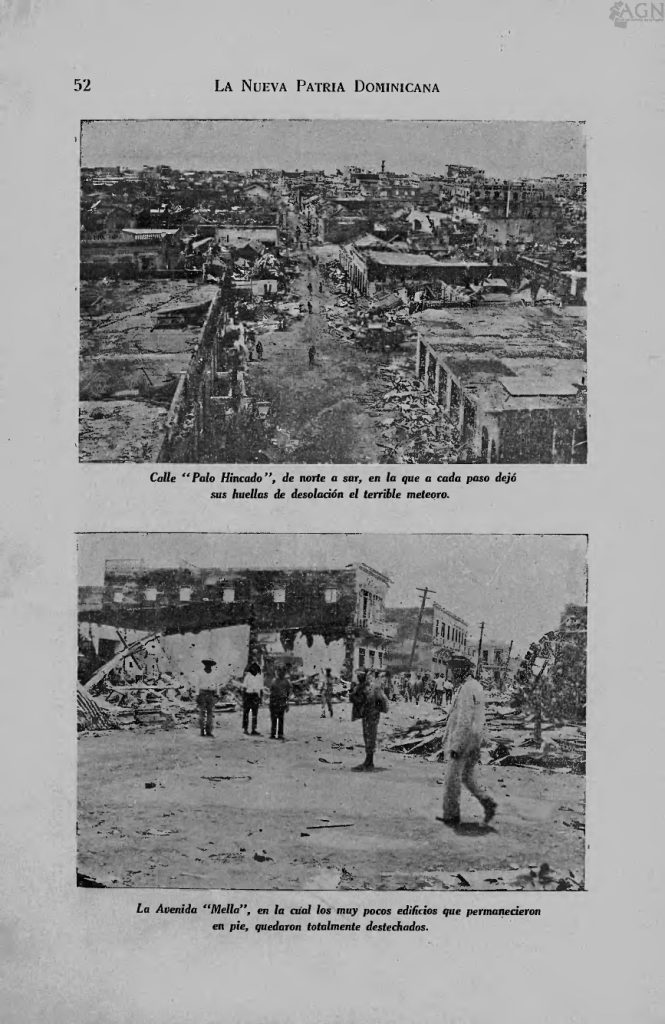
“The New Dominican Homeland” organizes its photographic content into two blocks that the book presents as complementary: the destruction caused by the cyclone and the reconstruction led by Trujillo.
But a close reading of the captions reveals an asymmetry that the book doesn't address. The images of destruction document the Ciudad Nueva neighborhood in two pages of rubble—wood, zinc, and demolished masonry—without a single proper name.
The collective funerals in Plaza Colombina, now Parque Eugenio María de Hostos, the pilgrimage a year later, the effects of the hurricane around the Lighthouse: all anonymous.
Who benefited from the reconstruction?
From page 70 onward, however, the same book devotes more than twelve pages to reconstructed private residences, each identified by the name and surname of its owner. Major General José García, Secretary of State for the Interior, Police, War, and Navy, appears in his "aristocratic residence" in Gazcue (p. 71).
Lieutenant Colonel Manuel E. Castillo of the National Army, in his "elegant residence" also in Gazcue, photographed with the Dominican flag waving (p. 73). Dr. Jacinto B. Peynado, Vice President of the Republic, in his "beautiful residential mansion" on Pasteur Avenue (p. 75), Major J. Arismendy Trujillo, brother of the dictator, in his "beautiful mansion" in San Carlos Land, Duarte Highway (p. 80).
The list also includes Major Frank Félix in Gazcue (p. 70), Virgilio Pimentel on Doctor Báez Street (p. 72), Miguel Ángel Recio on Doctor Delgado Street (p. 72), Manuel Alfaro Reyes on Pasteur Avenue (p. 74), Ernesto Freites and Arsenio Freites on Independence Avenue (p. 76), Marcos Guerrero on Pasteur Avenue (p. 78), Pedro Freites on Independence Avenue (p. 80) and René M. de Lepervanche on Bolívar Avenue (p. 82).
None of these properties are identified as social housing or as beneficiaries of state aid for reconstruction.
The book's final recapitulation mentions the intervened neighborhoods: Gascue, "now elegantly modernized"; Villa Francisca, endowed with the new "José Trujillo Valdez" avenue, now Duarte Avenue, named after the dictator's father; Ciudad Nueva and San Carlos, described as "populous expansions that rival the best in the Republic.".
The contrast between the neighborhoods named in the destruction and those named in the reconstruction defines, without intending to, the geography of privilege in Santo Domingo in 1935.
Prados Martín points out that the modernization process was accompanied by deep-seated prejudices against vernacular architecture. Internal records from the Ministry of Public Health and Social Assistance from 1941, cited by the same author, documented the "elimination of obstacles and hazards" identified by the Undersecretary of State during a "car trip through the city streets.".
The decision to demolish or preserve did not depend on technical criteria, but on the route taken and the prejudices of an official.
Sources consulted:
Espínola, Emilio and Jiménez, R. Emilio (eds.). The New Dominican Homeland – Supplement. Santo Domingo: Presidency of the Republic, 1935. General Archive of the Nation.
Prados Martín, Marcos. “From bohíos to social housing: authoritarian modernization and urban transformation in Ciudad Trujillo, Dominican Republic (1930-1961).” Culture & History Digital Journal, vol. 14, no. 2, 2025. DOI: 10.3989/chdj.2025.418.
Moya Pons, Frank. General History of the Dominican People. Santo Domingo: Dominican Academy of History, 2007.
reconstruction report 1930-1935_page-0008
Series: History of social housing in the Dominican Republic. Chapter I.
Recommended readings:





