


A cabinet with a chief executive since February, 16 pieces of equipment donated by Japan, $10 million in Korean cooperation, and regulations open for public comment until December 4th. What's missing is the data to determine if all of this is working
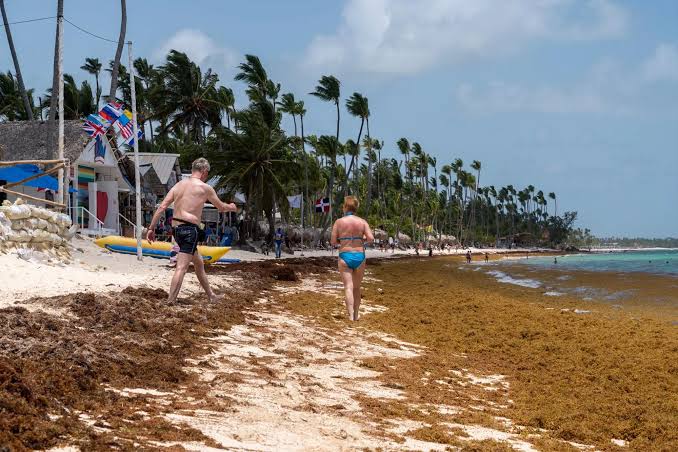
SANTO DOMINGO– Environment Minister Paíno Henríquez stated in Cancún that approximately 3,000 tons of sargassum seaweed are washing up on Dominican shores daily, collected from over 100 beaches, according to a report by El Universal of Mexico. At this rate, the country will see the equivalent of the 50,000 tons that the government offered to make available to the European Union throughout 2026 pass through in just 17 days.
The comparison is imperfect, but the offer, as presented by the Environment Ministry in July 2025, consists of collecting and making available 5% of the projected volume for 2026, which is 50,000 tons, and 10% for 2027, which is 100,000 tons and is a portion intended to be processed, not the total that arrives.
In October 2025, at the Global Gateway conference, the Dominican Republic, Mexico, and Grenada committed to collecting and processing at least 660,000 tons between 2026 and 2027. The Dominican quota, 150,000, is the sum of those two goals; Mexico's is 500,000 and Grenada's is 10,000.
As of October 6, public documents do not show how much of that portion has been collected in the Dominican Republic.
A review of official and press releases up to October 2nd did not find a consolidated national figure for 2026 showing the tonnage collected, processed, stored, and sent for final disposal. The available volume figures are either older or regional.
More than three million tons reached the Dominican coast in 2024, according to the Ministry itself, and at the beginning of 2026, the Vice Minister of Coastal and Marine Resources, José Ramón Reyes, spoke of some quantified 800,000 tons, although he clarified that in several areas it was not possible to measure what arrived.
And the University of South Florida calculated that nearly nine million tons accumulated between January and June of this year for the Dominican Republic and Puerto Rico combined.
A cabinet with a chief executive officer
The Sargassum Combat Cabinet was created on August 21, 2023 with Decree 379-23, as an advisory council chaired by the Minister of Tourism and coordinated by the Minister of the Environment.
The decree required it to approve its internal regulations within the first 60 days and to hold regular meetings every two months. Decree 122-26, dated February 24 of this year and published in the Official Gazette on March 2, amended Article 3 to reinstate it.
It is now composed of the Ministers of Tourism, Environment, Foreign Affairs, Agriculture and Finance and Economy, the Executive Vice President of the National Council for Climate Change, the Director of the National Maritime Affairs Authority, the Commander General of the Navy, a representative of the Ministry of the Presidency and one from Asonahores.
The same decree appointed retired Vice Admiral Ramón Gustavo Betances Hernández as executive director, as special advisor to the president.
It is not public knowledge how many sessions the Cabinet has held in these three years or what it has decided in them.
Trucks, sweepers, and a blank card
In May, during an event at the Ministry of Tourism, the Government of Japan delivered six dump trucks, five sweepers and five tractors, through its non-reimbursable financial cooperation program AF2023, to strengthen the collection, containment and handling of the algae.
On June 3, in Boca Chica, the Tourism Ministry delivered 30 trucks, six tractors and six sweepers to the mayoral offices and district boards of coastal areas, with an investment of 128 million pesos, and announced the bidding process for another 30 trucks and 20 sweepers.
Minister David Collado said at the time that the Ministry of Tourism has about US$9 million available and that it will not be spent until there is a technically validated solution, because investing it while the sargassum continues to arrive would seem irresponsible to him.
The Ministry of Environment reported at the UN Ocean Conference in Nice in June 2025 an investment of over 100 million pesos in valorization initiatives. It also has an ongoing cooperation project with the Korea International Cooperation Agency (KOICA) entitled "Improving Response Capacity to the Climate Crisis through Monitoring and Management of Sargassum Coastal Events in the Dominican Republic.".
It began in 2025, ends in 2029, and has an approved budget of US$10 million, with an integrated management plan, community training, research, and early warning systems. On its official page, the field for the amount spent is blank, the page does not include associated documents, and the appointment of a focal point is still pending.
The regulations and operations of the East
On October 1, the Ministry of Environment put the Draft General Regulation for the Integrated Management of Sargassum in the Dominican Republic into public consultation, which will remain open until December 4, 2026.
That same day, an operation was launched in the East, where technicians inspected more than 15 hotel properties between Uvero Alto and Cabeza de Toro to review how they collect, store and dispose of sargassum, and determined which ones can operate with their own collection centers and which ones must use authorized final disposal sites.
Meanwhile, in the Senate, the Natural Resources Committee heard from Vice Minister Reyes in September about a bill that would declare sargassum a national and regional environmental emergency, proposed by Senator Rafael Barón Duluc Rijo.
Regulating the disposal of sargassum in hotels was a missing piece, but there's also no public figure indicating how much of what hotels collect is included in the national tally. For the government and for the EU target, the sargassum a hotel removes from its beach and that collected by a municipal brigade represent tons of the same problem.
Measure from the satellite
In December 2025, the National Statistics Office published experimental statistics on sargassum and other debris influxes using drone images, one of the first institutional attempts to turn the seaweed into data.
The Central Bank, in its Econoclima series, analyzed the concentration of sargassum between July 2016 and September 2025 with the alternative floating algae index, AFAI, and found an increasing trend in all coastal provinces, with high levels in Samaná and María Trinidad Sánchez and consistently high concentrations in La Altagracia.
At the beginning of the year, Reyes also announced a pilot program with cameras and drones, together with SOS Carbón, to measure what reaches the most affected areas.
At universities, the focus shifted to the sea. UNIBE is developing SargoTech, which combines historical data and technology to study the behavior of algae. INTEC conceived the QuisqueyaSat-1 nanosatellite to photograph clusters from low Earth orbit, georeference them, and identify the material using artificial intelligence. INTEC also coordinates the regional CARIBS project in the country, funded by France, with Mexico and Cuba, which includes satellite surveillance, scientific protocols, and biomass valorization.
Diplomacy outpaced statistics. On December 11, 2025, the United Nations Environment Assembly adopted in Nairobi the resolution "Strengthening the global response to the massive influx of sargassum blooms," drafted by the Dominican Republic and co-sponsored by Barbados and Jamaica, the first resolution that this body has dedicated to the phenomenon.
From the laboratory to the plant
In April, researchers from INTEC, with the companies Algaltek, from Switzerland, and CADE Soluciones, from Spain, presented results of a project financed by the IDB that processes wet sargassum by biorefinery and hydrothermal gasification.
The system separated arsenic from biomass, utilized 88% of the moisture from the sargassum itself, and produced synthesis gases and other compounds of industrial interest, with an estimated levelized cost of energy of 80 euros per megawatt-hour.
The team is seeking funding for a 500-kilogram-per-hour pilot plant in 2028, and another INTEC project from June extracted about 16% alginate from sargassum collected on Dominican coasts. The next steps include further characterizing the material and evaluating quality requirements for higher-value uses.
In trials using tomatoes as a biofertilizer, the fruits showed no worrying accumulation of trace elements under the evaluated conditions, and the study itself presents this as experimental evidence, not as authorization to use sargassum as fertilizer.
All of those are laboratory or pilot results; none appear, as far as could be checked, as tons processed within the 2026 target.
The stick that Mexico brought
At the Cancun conference, on October 1 and 2, Mexico proposed measuring the progress of the regional commitment with three indicators: catches at sea versus catches on the beach, biomass valued versus confined biomass, and projects with financial closure.
Applied to the Dominican Republic, with what has been published, the table looks like this:
| Indicator | What does it measure? | Dominican public data consulted |
| Catches at sea off the beach | Tons removed before reaching the shore versus those removed on the shore | No figure given. The operations described in official statements are beach-related and related to hotel stockpiling. |
| Biomass valorized versus confined | Tons processed versus those stored or sent for final disposal | No figure. The reported valuation is from a laboratory and pilot study. |
| Projects with financial closure | Projects with committed funding | The Environment and EU call for proposals was opened in July 2025; no public result was found. |
Mexico did come up with numbers
Mexican Undersecretary of the Environment, José Luis Samaniego, reported at the inauguration that in Quintana Roo, more than 123,000 tons have already been collected in the 2026 season, with the arrival period still open.
The Dominican Republic set a target of 150,000 tons, and as far as could be checked, there is no equivalent published data.
On October 5, it was also reported that a US$6.3 million operation for sargassum projects in the country was announced, and EIB Global, the development division of the European Investment Bank, will grant a US$5.1 million loan to Banco Adopem, guaranteed by the European Commission and pending approval from the Superintendency of Banks.
The operation was presented as a contribution to the regional target of 660,000 tons, of which 150,000 tons correspond to the Dominican Republic. The information consulted does not link it to the July 2025 call for bids, so the third item in the table remains unanswered.
The draft regulation remains open for comments until December 4th and is the place to ask if it will require the publication, year by year, of how many tons are collected, where they go and how much it costs to move them.
Recommended readings:
- Environment Ministry activates national operation in response to massive arrival of sargassum on East coasts
- Environment Ministry warns about the risks of contact with sargassum and asks people to avoid beaches with large influxes
- The sargassum problem is 500 meters lower, scientists have discovered





