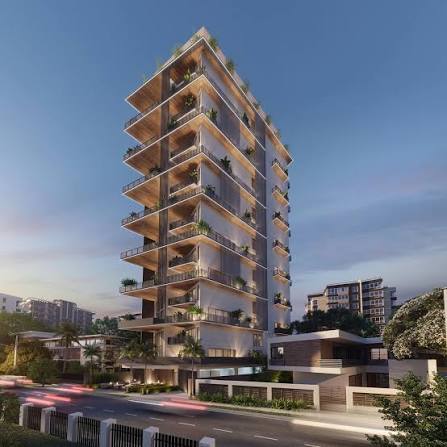
A building begins emitting carbon long before anyone turns on the first light. By the day of its handover, with the project flawless and still unoccupied, a considerable amount of carbon has already been used to manufacture, transport, and assemble all its components. This is called embodied carbon, and it's the part of the sustainability conversation that is still frequently overlooked in the region.
Context helps put this into perspective. The building and construction sector accounts for approximately 37 percent of global CO₂ emissions, according to the latest report from the United Nations Environment Programme. A significant portion of that figure comes not from the operation of the buildings themselves, but from the materials used in their construction.
The correct unit to use for this is kilograms of CO₂ per square meter of built area. It has a virtue that no statement of intent can match: it allows for comparison. Two towers from the same project, in the same market, with the same number of units, can have different footprints, and that difference can be calculated, audited, and improved in the next project.
The bulk of the work is concentrated in two materials: cement and steel. That's both bad news and excellent news, because it means that we don't need to intervene in a hundred decisions to move the needle. We just need to intervene in a few well-chosen ones.
What can be done without increasing the project's cost is more than it seems. Optimizing the structure to use less concrete per square meter while maintaining the same performance also reduces construction costs. Working with cements that replace some of the clinker with additives like slag or pozzolan, available throughout much of Latin America. Buying locally to reduce transportation. And stopping the practice of oversizing just in case, which is probably the most silent source of carbon emissions and costs in the region's construction industry.
There's a financial reason to do it now, not in five years. Development banks, international funds, and green taxonomies already operating in several Latin American countries require this metric as a condition, not as a bonus. A developer who can present their project's carbon footprint in kgCO₂/m², along with the calculations, gains access to financing structures unavailable to their competitors.
There's also an opportunity that quickly disappears. The ability to reduce a building's footprint is enormous during the preliminary design phase, when the structural system, column spacing, and the ratio of facade area to usable floor space can still be discussed. By the time the project reaches the construction drawing stage, that ability is reduced to choosing between equivalent products. And on-site, there's almost nothing left to decide. It's the same curve as with all major development decisions: maximum influence at the beginning, minimum cost at the beginning.
The distinction worth defending is between what is declared and what is measured. A sustainable project is demonstrated with verifiable data, real certifications, and a methodology that can be audited by an external party. Everything else is just an intention, and intentions don't reduce emissions or qualify for anything.
A building weighs something before it's lit. The first thing is to know how much. Everything that comes after is easier.
Recommended readings: