


It highlights that this strength has been maintained despite the fact that the international landscape has changed a lot since the organization's last visit, with an energy shock and increased uncertainty due to the Middle East conflict
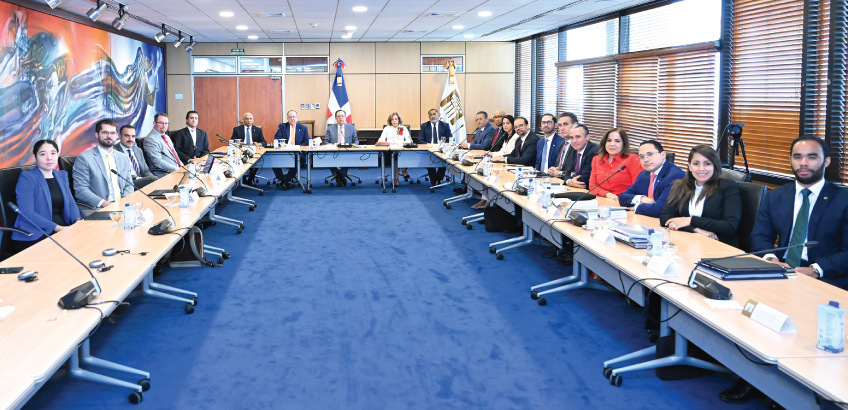
SANTO DOMINGO – The Governor of the Central Bank of the Dominican Republic (BCRD), Héctor Valdez Albizu, accompanied by the Minister of Finance and Economy (MHE), Magín Díaz, received a delegation from the International Monetary Fund (IMF), headed by Ricardo Llaudes, in order to gather preliminary data on the Dominican economy as part of an IMF Staff mission that will be in the country until this coming Friday, June 12.
During the meeting held at the Central Bank headquarters, Valdez Albizu told them that “the armed conflict in the Middle East finds the Dominican economy in a process of gradual recovery, with an accumulated year-on-year expansion of 4.0% in January-April 2026, driven mainly by the construction, free zone manufacturing and hotel, bar and restaurant sectors.”
In that regard, he informed them that “the Dominican economy generated tourism revenues of US$3.91 billion in January-March, while foreign direct investment totaled US$1.537 billion in the first quarter.”.
Valdez Albizu also indicated that “as of April, total accumulated exports reached US$5,689 million and family remittances approximately US$4,080 million. This dynamism in the external sector has contributed to the relative stability of the exchange rate, with an accumulated appreciation of the peso of around 8.0% during the months of the year.”.
The governor noted that, among the current forecasts, "it is expected that the good performance of the external sector will continue for the rest of the year, with a current account deficit projected at around 1.4% of gross domestic product (GDP) by the end of the year, which would be easily financed by a projected foreign direct investment (FDI) of US$5,346 million.".
Regarding the labor market, Valdez Albizu highlighted “the strong performance in the first quarter of 2026, reflected in an employed population that reached 5,236,178 people, equivalent to a year-on-year increase of 118,631 net new jobs. Thus, the open unemployment rate stood at 5.0% in January-March 2026, similar to the average recorded in 2025.”.
And regarding the Consumer Price Index (CPI), the governor informed them that “due to the impact of the war in the Middle East, forecasting models indicate that year-on-year inflation could remain temporarily above the upper limit of the target range of 4% ± 1%, during the next few months, returning to the target range during the fourth quarter of the year, as the impact of higher oil prices dissipates.”.
Finally, regarding the financial sector, Valdez Albizu specified that the financial system remains robust, well-capitalized, and highly profitable. The solvency ratio stood at 18.8% in March 2026, above the regulatory minimum of 10%, while the non-performing loan ratio was 1.7% in April 2026, and the return on equity (ROE) was 21.3% and the return on assets (ROA) was 2.7%
Thus, he concluded that “the Dominican economy has strong fundamentals, a robust financial system, and a proven capacity for resilience that will allow it to weather this adverse external shock. Furthermore, the Central Bank of the Dominican Republic reiterates its commitment to its inflation target and to macroeconomic stability.”.
Public investment as an engine
For his part, the Minister of Finance and Economy, Magín J. Díaz, highlighted the performance of the Dominican economy during 2025 and the role of public investment as an engine for returning to a path of growth. “In 2025, we managed to increase capital spending from the budgeted 2.2% of GDP to 2.6%, without creating pressure on the debt and, at the same time, reducing current spending compared to the previous year, so the fiscal rule was comfortably met,” he stated.
He also noted that during 2026 fiscal policy is focused on implementing prudent measures to address the adverse international context, while safeguarding equity and the sustainability of public finances.
Steady economic growth
For his part, Ricardo Llaudes, head of the IMF delegation, noted that “the international landscape has changed considerably since his last visit, with an energy shock and increased uncertainty due to the Middle East conflict,” and emphasized that “despite the complex international situation, growth in the Dominican Republic has remained strong, a testament to the solid foundations of its economy. This has been supported by a rebound in credit, resulting from the Central Bank’s liquidity policies, and by an external sector that has benefited from the positive performance of tourism and exports.”.
In addition to this opening meeting with the Central Bank of the Dominican Republic (BCRD) and the Ministry of Foreign Affairs (MHE), the IMF Staff Visit mission's agenda includes meetings with public and private sector entities throughout this week.
Valdez Albizu was accompanied by the Vice Governor, Clarissa de la Rocha de Torres; the manager, Ervin Novas Bello; the deputy general manager, Frank Montaño; the deputy manager of Monetary, Exchange Rate and Financial Policies, Joel Tejeda; the Dominican representative to the IMF, Frank Fuentes; the deputy manager of Operations, Liselotte Reyes; the economic advisor to the Governor, Julio Andújar Scheker; the deputy manager of National Accounts and Economic Statistics, Ramón González Hernández; as well as the deputy manager of Regulation and Financial Stability, Máximo Rodríguez.
Also present were the deputy manager of the Monetary Programming and Economic Studies department, Joel González; the deputy manager of the International department, Brenda Villanueva; the director of the National Accounts and Economic Statistics department, Elina Rosario; the director of the Regulation and Financial Stability department, Carlos Delgado; and the Treasury director, José Perdomo.
In addition to Mr. Llaudes, the IMF delegation included senior economists Nathaniel Arnold and Rasool Zandvakil, and economist Ilya Stepanov.
Representing the Ministry of Finance and Economy alongside Minister Díaz was the Deputy Minister of Fiscal Policy, Camila Hernández Villamán.
Recommended readings:
- Given the global scenario, the IMF adjusts its growth projection for the Dominican Republic and places it at 3.7% for 2026
- The Dominican Republic is growing faster than the region, according to the IMF, but the new global cycle could put pressure on the real estate sector's dynamism
- World Bank, IMF and rating agencies project solid growth for the Dominican Republic beyond 2026







