



In less than two years, the new government issued half a dozen decrees to reorganize who decided on the country's housing policy, an exercise that revealed both its ambition to coordinate the State and its difficulties in achieving it
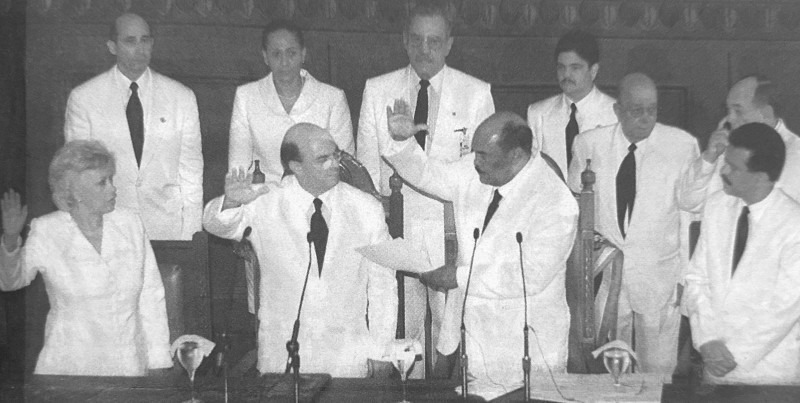
SANTO DOMINGO– Hipólito Mejía assumed the presidency on August 16, 2000, with a promise that went beyond housing, but fully encompassed it: to streamline a state apparatus that, according to the preambles of his decrees, suffered from “poor coordination” among ministries and agencies, with the consequent “duplication of functions” and waste of resources. Correcting this fragmentation became one of the first tasks of his administration, and the housing sector was caught at the heart of this institutional reengineering.
The starting point came just two weeks after the inauguration. On September 1, 2000, Mejía signed Decree 685-00, which completely reorganized the National Planning System inherited from Law 55 of 1965 and divided the public administration into twenty sectors, as stated in the full text of the decree published in Official Gazette No. 10058, each headed by a State Secretariat or a governing institution.
Housing became its own sector, with the National Housing Institute at the helm, a decision that on paper gave INVI a coordinating authority that it had not previously formalized.
A month later, on October 6, Decree 928-00 expanded the scope of action of the agency with the creation of the National Council for the Fight Against Poverty and transformed the Social Assistance Plan of the Presidency into the Presidential Plan Against Poverty, with INVI as one of the nearly twenty institutions called to integrate it, along with entities as diverse as the National Institute of Drinking Water, the National Lottery or the economic dining halls.
In that scheme, housing ceased to be an exclusively sectoral issue and became part of the general strategy against poverty that the government christened as the banner of its first year in office.
The architecture continued to mutate at a pace that suggested tentative steps rather than a master plan. In January 2001, Decree 28-01 created three operational cabinets (institutional, economic, and social) to group the Secretaries of State according to their area of work, and placed the director of INVI within the Social Policy Cabinet alongside the National Institute of Housing and Social Assistance (INAVI). Just one month later, Decree 279-01 again modified the composition of that cabinet, without the minutes publicly explaining why the first version was deemed insufficient.
The institutional design was stabilized, at least formally, with Decree 466-01, signed on April 19, 2001, with a regulation that replaced the two previous ones and created the Social Cabinet as a permanent structure, with a directory, a board of directors and an executive unit, and organized the work by operational sectors among which was housing, headed again by INVI and made up of INAVI and the National Housing Bank.
The same decree emphasized the need to align any housing project with the National Public Investment System, so that no program could be financed without first passing through the filter of the National Planning Office.
Before concluding that first year and a half of reforms, Mejía added another, more symbolic gesture, though one with some programmatic substance behind it. Through Decree 1211-01, he declared 2002 the National Housing Year, a declaration that, according to a subsequent study by the organization Ciudad Alternativa on Dominican housing policy, established two concrete lines of intervention: the construction of new housing and human settlements, and the improvement of existing housing.
Rarely, before or since, had a Dominican government dedicated an entire year, at least on paper, to this single cause.
The most significant chapter for the real estate market came the following year with Decree 45-02, which created the National Council for Affordable Housing, an organization chaired by the head of state himself and composed, in addition to INVI and the National Housing Bank, of representatives from the private sector: the Association of Commercial Banks, the League of Dominican Savings and Loan Associations, the Dominican Association of Housing Builders and Promoters, and the Dominican Chamber of Construction.
The text of the decree itself explains the fundamental shift: the fiscal measures adopted by the government had enabled banks to expand their real estate financing portfolios, and the State chose to support this capacity with its declared role as a "facilitator," rather than a direct builder. Hugo Guiliani Cury, then Secretary of Industry and Commerce, was put in charge of coordinating the program.
The National Fund for Popular Housing, FONDOVIP, already operational since November 2000 according to a subsequent report on evictions submitted to the United Nations, was added as a member of the new council by Decree 45-02, thus closing an institutional map that, in just twenty months, had gone through at least five successive reformulations.
A year later, in 2003, housing also became one of the pillars of the National Strategy for Poverty Reduction that the government itself was promoting, and with it came an internal diagnosis that rarely reaches the press.
That document, according to the same study by Ciudad Alternativa, identified eight fronts still unresolved: the institutional dispersion between INVI, INAVI and the National Housing Bank, the lack of property titles for the poorest families, the weakness of the financing system, the absence of a clear subsidy policy, the still incipient incursion of the private sector, the precariousness of the infrastructure in the settlements, a legal framework that sometimes hindered more than it facilitated, and the lack of coordination with territorial planning.
In other words, almost three years after the first wave of decrees, the State itself admitted that a large part of those problems remained intact.
Taken together, this series of decrees tells a story that rarely appears in official management reports: that of a government that tried, corrected, and tried again how to organize its own housing bureaucracy before being able to implement a single large-scale housing program.
This series will explore whether such an institutional framework managed to translate into concrete housing solutions before the 2003 banking crisis severely impacted the ability of Dominican families to access housing, and the State's ability to finance it.
Sources: Ministry of Economy, Planning and Development (MEPyD), “Social Policy of the Dominican Government, Volume I, Annexes”, Annex III: “Decrees of President Hipólito Mejía concerning institutional organization” (Decrees 685-00, 928-00, 28-01, 279-01, 466-01 and 45-02, full text). | Decree 685-00, full official text, Official Gazette No. 10058 of September 15, 2000, consulted via FAOLEX (Food and Agriculture Organization of the United Nations). | Housing and Land Rights Network (HLRN), report submitted to the United Nations on the International Covenant on Economic, Social and Cultural Rights in the Dominican Republic (reference to FONDOVIP, November 2000). Ciudad Alternativa, “The Marks of Housing Policy: Housing, Human Rights and Taxation in the Dominican Republic, 2000-2016” (Santo Domingo, September 2017), Introduction, section “Background and context” (references to Decree 1211-01 and the National Strategy for Poverty Reduction of 2003).
Recommended readings:







