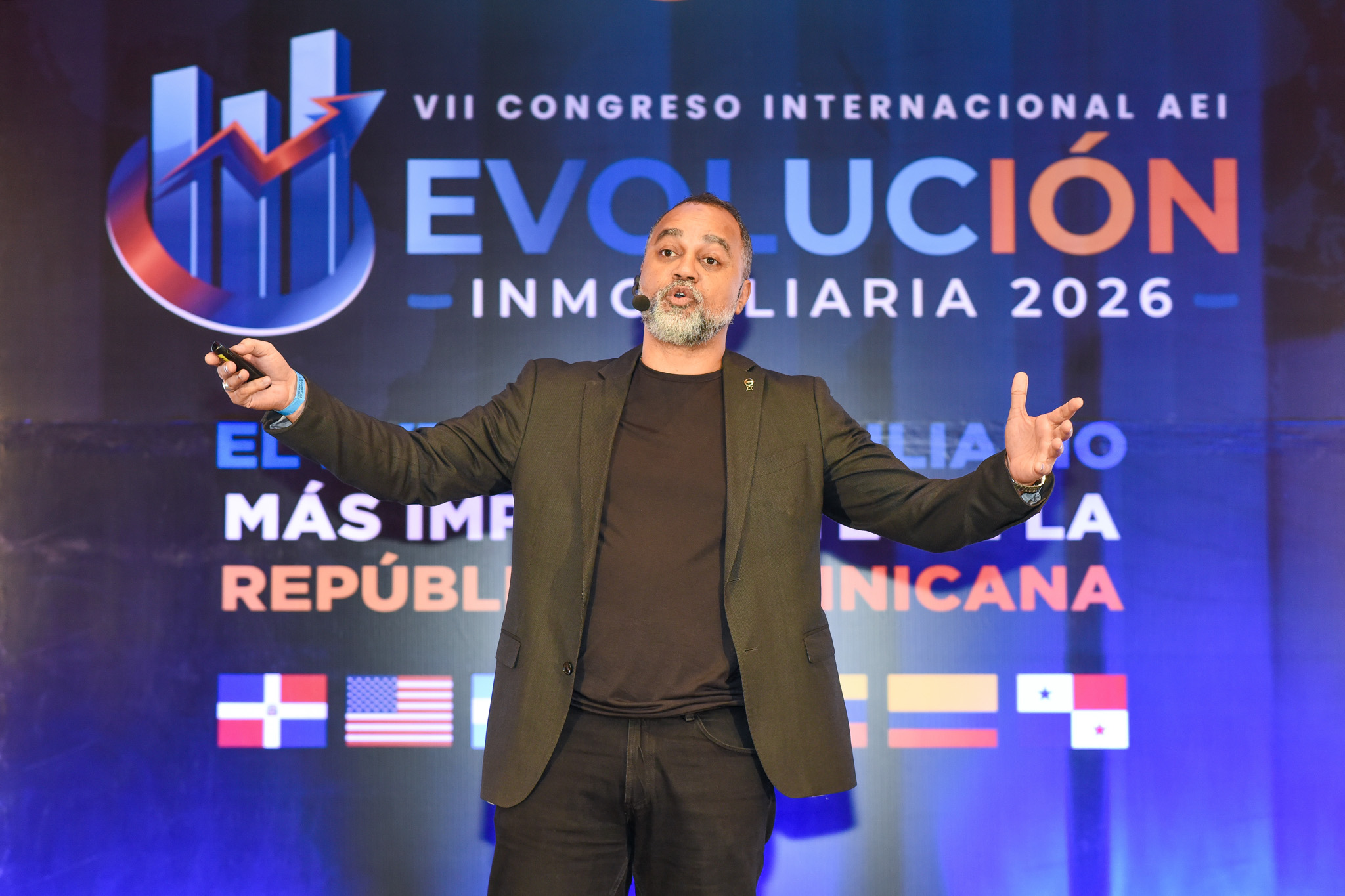
The booming real estate market does not guarantee the success of agents when processes, planning, and investment are lacking
SANTO DOMINGO.– Although the Dominican real estate market is experiencing one of its best moments, many agents continue to operate without defined processes, improvising and depending on isolated opportunities to close deals.
That was the main conclusion of instructor and sales coach Isaías Medina during his conference The DNA of the real estate agent: from improvisation to the closing machine, at the VII AEI International Congress: Real Estate Evolution 2026, where he stated that "most Dominican real estate agents do not sell, they buy."
As an example, he recounted the case of an associate who earned a commission of around US$33,000 for a transaction made earlier in the year, but did not make another sale until November, when she received about US$2,000.
According to the expert, the case highlights the importance of working with processes and systems, particularly among those who carry out real estate activity on a part-time.
The broker-owner of RE/MAX Independencia argued that this situation contrasts with the market's performance, emphasizing that the numbers indicate the real estate market has never been better. Despite this, he maintains that "the average agent has never been worse off.".
In this context of improvement, he noted that, between January and April 2025, the Ministry of Housing, Habitat and Buildings (MIVHED) approved projects worth more than RD$100 billion and that, in the same period of 2026, that figure doubled, which, in his opinion, reflects investor confidence and anticipates a greater supply of real estate in the coming months.
“In other words, there is a market where many investors are thinking that this is good and will continue to get better,” he pointed out.
The three barriers that hinder the professionalization of the sector
For Isaiah, one of the main obstacles in the sector is the ease of entering the real estate business. He stated that entry into the business is practically unrestricted, allowing "anyone to call themselves a real estate agent."
The second is the absence of a public registry that helps to distinguish professionals from the rest of the market participants.
“We are the only large real estate market in the entire region that does not have a public registry. That is unthinkable in many other associations and guilds,” he specified.
As a third problem, he added that the agents themselves do not invest in the growth of their businesses. On this last point, he stated that a large proportion of agents allocate few or no resources to client acquisition.
As a reference, he cited statistics from the US market showing that 62% of agents invest zero dollars a year in acquiring clients and only 4% exceed US$10,000 annually in that area.
The business is not in the tools, but in the process
The instructor and sales coach also questioned the idea that technology alone can transform a real estate agent's performance. While acknowledging the importance of tools like artificial intelligence, CRMs, automation, chatbots, and virtual tours, he insisted that "none of that is the business" and warned that the industry is confusing "the tool with the craft.".
As he explained, the real estate business can be summarized in three fundamental actions: acquiring properties, making them available to the market, and following up with interested parties through a work system.
As part of his presentation, he presented several indicators of the North American market to illustrate the challenges of the profession.
Among them, he highlighted that 85% of new agents leave the business before completing five years; that those who have been in the business for less than four years carry out a median of three transactions per year; and that, although 82% already use artificial intelligence, 46% say that this technology has had no impact on their business.
For Isaiah, these figures demonstrate that the problem lies not in the available tools, but in the way in which the agents carry out their activity.
Recommended readings: