


A chronicle of a century of life in the heart of Villa Francisca, where before the noise and the overflowing commerce there was a gazebo, Sunday concerts and a neighborhood that was learning to find itself.
SANTO DOMINGO. – Many years before Duarte Avenue became the river of buses, vendors, and passengers that now runs through downtown Santo Domingo, there was a place where the neighborhood paused.
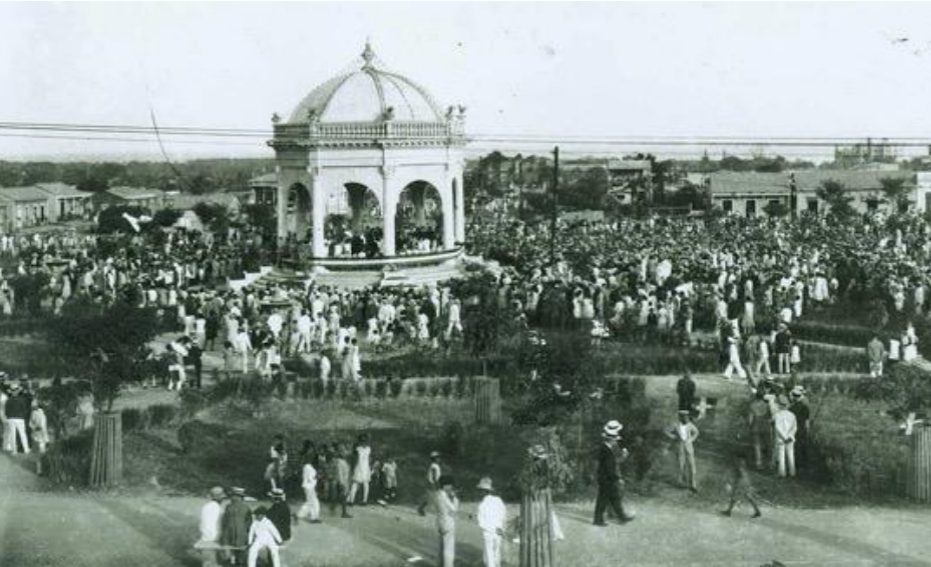
There, between Duarte Avenue and Caracas, José Martí, and Ravelo streets, Enriquillo Park began to grow more than a century ago, the public heart of Villa Francisca and one of the most enduring settings for the city's daily life. It was a plaza with young trees, royal palms, and an octagonal gazebo with open arcades and a light dome: a musical bandstand of neoclassical and Victorian inspiration.
More than a century after its foundation stone was laid, the park is still there, surrounded by the noise of buses, vendors, and passengers who pass through it every day. The gazebo is no longer the same wooden one that the first residents knew, the movie theaters are gone, and many shops have changed their names.
But the place retains something that no remodeling can erase: the memory of those who spent long hours reading newspapers on its benches, waited for someone who didn't arrive under its trees, or had their first date "on the park bench.".
Here many received their first kiss or wore their first high heels.
In a city that grows and transforms without rest, Enriquillo Park is undergoing a new renovation, sponsored by the National District City Hall, but deep down, its rebellious memory knows that it will continue to be what it always was: a point where the stories of the neighborhood, of commerce and of the daily life of Santo Domingo cross, mix and, for a moment, seem to stay.
The place where the city paused
There are public spaces that end up being a kind of public memory, and Enriquillo Park is that place where, for more than eleven decades, the city of Santo Domingo has been leaving layers of life, noise, and memories.
The first stone was laid on August 16, 1911, when Villa Francisca was a new neighborhood that was beginning to be populated beyond the limit of the wall of the old colonial city.
There were wooden houses with open galleries, and a population of artisans, merchants, and employees who unknowingly built a community that would mark the growth of the capital to the north.
It was built between what are now Caracas, José Martí and Juan Nepomuceno Ravelo streets, in front of the commercial axis that over the years would become Duarte Avenue and there was also built a light and elegant wooden gazebo, of eclectic design with neoclassical and Victorian influences, like those that existed in the region at the beginning of the 20th century.
On Sundays, band concerts could be heard from that structure, and the neighbors would sit on the benches to chat while the boys ran along the paths.
In 1913, photographs from that time even show sports matches organized by the Liceo Club in the space surrounding the park.
Although the park had existed since 1911, its formal inauguration took place in 1930, when it was named after Julia Molina, in honor of the mother of the dictator who ruled at the time. Santo Domingo was still a manageable size, but Hurricane San Zenón devastated much of the city and left its mark of destruction on the neighborhood as well, sweeping away many wooden structures, including the park's gazebo.
But the square was rebuilt and in the following years, it was filled again with people who already considered that place their own, the place where the community was happy.
Decades of splendor
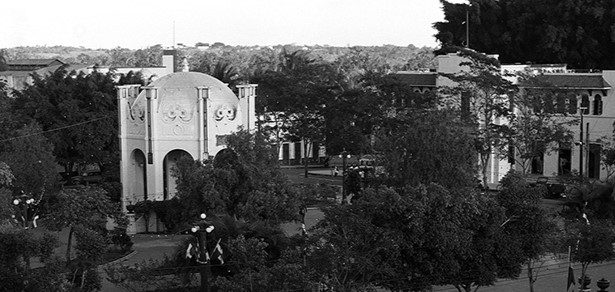
Although the park had existed since 1911, its formal opening took place in 1930.
By the 1950s, the area had already developed its own distinct urban rhythm. On Ravelo Street, for example, the Teatro Atenas, with its iron benches and open-air auditorium, opened in 1953 and eventually had a capacity of two thousand spectators. The Teatro Héctor, another cinema in the era's film circuit, also operated on José Martí Street.
The evening showings filled the streets with young couples walking towards the cinemas. Before arriving, a stop at the park was a must, and the gazebo, illuminated by lanterns, was the meeting point.
An urban change
The city changed radically between the seventies and nineties. Duarte Avenue became the first and one of the busiest commercial centers in Santo Domingo, and Enriquillo Park was right at the heart of that movement, and the surrounding streets began to fill with urban and interurban transport routes.
The park thus became a kind of makeshift terminal and landmark for travelers who arrived early with their bundles and suitcases, waiting for someone to pick them up. Street vendors appeared with popsicle carts, as did children selling roasted peanuts, and, of course, shoeshine boys. Because in those days, gleaming shoes were synonymous with elegance.
For decades they worked in the shade of the trees, their wooden crates lined up near the roundabout or on the sidewalks facing the avenue. There they served shopkeepers, drivers, police officers, and occasional customers.
René Villanueva, a journalist and lawyer native to Villa Francisca, recalls some of its famous characters. “Concentrate, Professor… what color is the gentleman’s shirt?” Professor Magandi would say to the Telepath, dressed in a striking circus costume.
They performed fortune-telling and street magic shows in exchange for a few coins in their bowler hats. And while everyone was captivated by the tricks, the snake around their necks, and the iguana "Rosario" that helped them "tell fortunes," pickpockets and thieves made off with chains and wallets.
Professor Magandi, the Child Prodigy, and Professor Galvez used to read fortunes in the palm of your hand, while Professor Suarez performed magic tricks with iodine stains on a handkerchief to sell soap. These days he preaches the gospel.
And there was the cleverest of them all, but Villanueva doesn't remember his name: he would test gold jewelry with mercury (it turns silver) and tell people it wasn't worth the low price. Then he would clean it and sell it at the real price.
These types of characters—magicians, preachers, prestidigitators, fortune tellers, shoeshine boys, and vendors—turned the park into what urban planners call a “spontaneous social stage,” a place where the city not only passes through, but also represents itself.
The evolution
Opposite the park, on José Martí Street, there were institutions that were also part of the everyday landscape: the Villa Francisca police station and, a few meters away, the Cradle of America Lodge No. 2, one of those discreet buildings that seem to observe the life of the neighborhood from a distance.
In the eighties and nineties, the atmosphere had a different rhythm, and the nightlife acquired its own distinct character. Since the late seventies, stalls had sprung up all around, especially on Duarte Street, selling clothes, toys, and fruit. The commercial area began staying open later, and when the grocery stores closed, the market for exchanges between passing clients and sex workers opened up, with the latter resting in the park between clients.
In the 90s, on Caracas street and in front of the park, the Areíto nightclub became very popular, frequented by journalists, artists and intellectuals.
Little by little, the homeless began to spend the night in the square, those who got lost when they arrived from the countryside to the city and found no one to receive them, the mentally ill, pickpockets, the drunks of life, and the slums conquered the place.
Even so, the park continued to fulfill its oldest function: being the place where people met, turning a blind eye.
For generations, for residents of the capital and non-residents alike, the phrase was simple and sufficient: "See you at Enriquillo." And there they met.
The park that is trying to reinvent itself
At the end of the 20th century, Enriquillo Park suffered such a significant decline that it suddenly became a focal point of public attention. The growth of informal commerce and traffic congestion gradually encroached upon the area's public spaces, and for many, the park ceased to be a place for leisurely strolls, becoming instead a hurried, devoid of entertainment.
This situation prompted a major urban intervention in 2008, when the National District City Council remodeled it as part of a broader project to revitalize the Duarte commercial corridor. The roundabout was restored, new lighting was installed, and walkways and green areas were reorganized.
That same year, the Paseo de la Lectura (Reading Promenade) also emerged on Caracas Street, a pedestrian corridor with dozens of modules intended for booksellers who for years had sold, mainly used books, on the sidewalks of Duarte Street.
For a while the park recovered some of the atmosphere it had decades ago: children playing on the paths, couples chatting on the benches, neighbors using the space to rest.
Today, the area is preparing for another transformation. The City Council has launched a new revitalization project that includes expanding the park, renovating the Paseo de los Lectores (Readers' Promenade), constructing a new station for the Municipal Police, building a service building with a multipurpose hall and medical clinic, as well as refurbishing children's play areas and replacing street furniture. It's yet another layer in the area's long history.
Because Enriquillo Park has never been just an urban garden. It has been a bus terminal, a movie theater entrance, a shoeshine stand, a meeting place for generations of lovers, and a silent witness to the city's growth.
A park where, for more than a century, Santo Domingo learned to pause for a moment amidst its own movement.
Recommended readings:







