SANTO DOMINGO. – In the 21st century, talking about piracy refers to copying computer programs, books, or the funny and ineffable Jack Sparrow, from the Pirates of the Caribbean film series, his archenemy Salazar, and the mythical ship Black Pearl.
But when the chroniclers of the 16th century spoke of Hispaniola, they did not describe it only as the first colony of the New World, but as a besieged island whose long, open and difficult-to-monitor coasts became the scene of attacks, makeshift shelters and shipwrecks that still fuel legends today.
The North Coast and the Birth of the Buccaneer
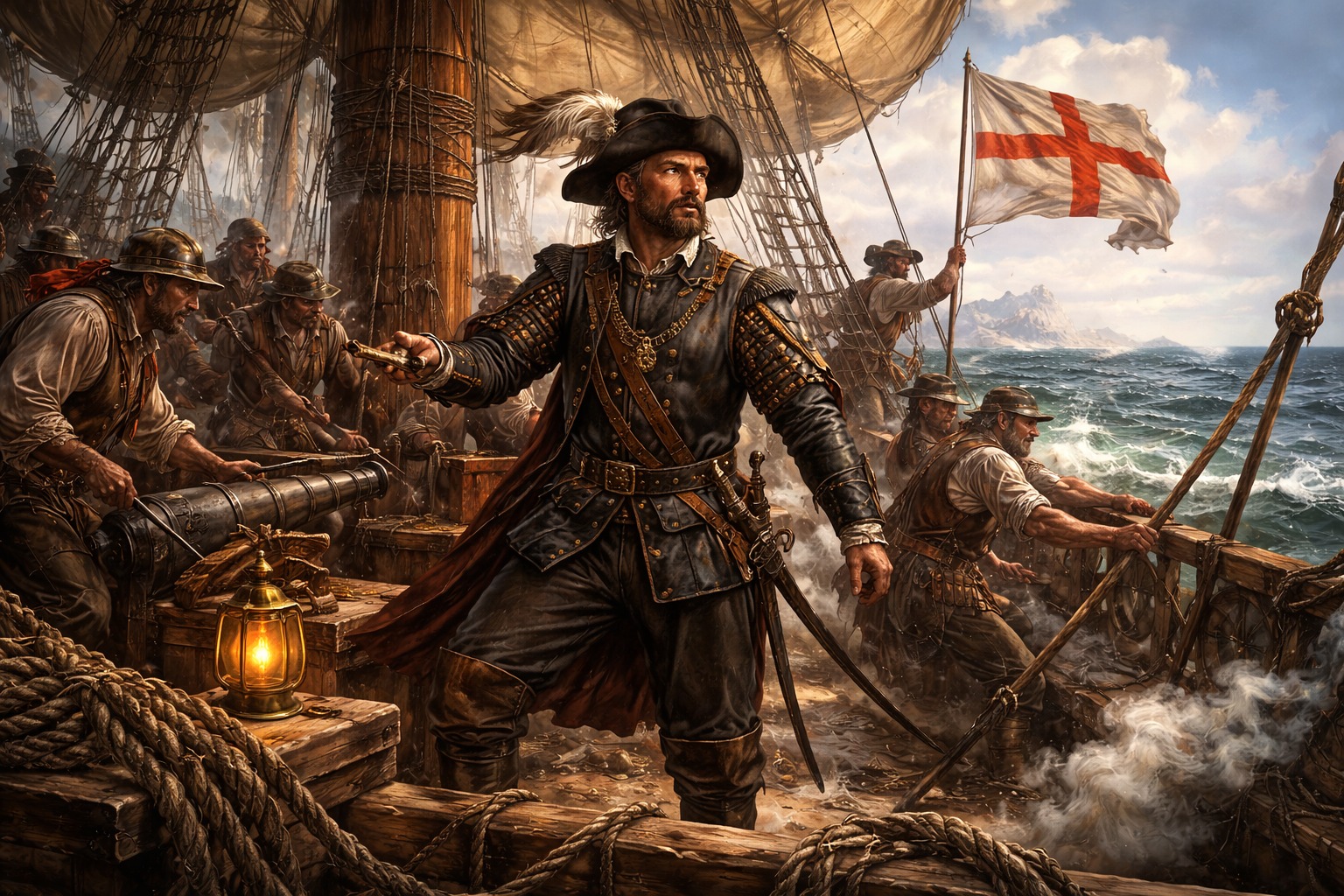
The north of the island, from Monte Cristi to Puerto Plata, was for decades a territory largely ignored and under little control by the Spanish Crown. It was there that the buccaneers emerged, originally French and English hunters who smoked meat on grills called boucans (from which the name derives).
Initially, these men were not pirates, but rather made their living by hunting wild cattle and illegally trading meat and hides. However, as Alexandre Exquemelin documents in *History of the Buccaneers of America* (1678), many eventually armed themselves and embarked on attacks against Spanish ships when trade and persecution drove them to the sea.
As an aside, the name “leather” assigned to the ladies engaged in prostitution, and considered a vulgar term, arose because at that time these women were part of the commercial exchange: they were currency for cattle hides.
La Tortuga: the lawless port
Off the northern coast of Hispaniola, on the Haitian side, lies Tortuga Island, perhaps the most important stronghold of Caribbean piracy in the 17th century. From there, the feared figures of François l'Olonnais and Michel de Grammont operated.
Olonais used Tortuga and the north coast of Hispaniola as logistical bases before attacking Spanish ports in Cuba and Central America.
Exquemelin describes it as brutal even by the standards of his time, and recounts that several of his ships ran aground or were lost in storms between Tortuga and the Dominican coast, forcing his men to survive for weeks inland, as described by Exquemelin (1678).
Corsairs: licensed pirates
Not all armed men in the Caribbean were outlaws. Privateers operated with letters of marque, official documents issued by kings or governors that authorized them to attack enemy ships in times of war.
A key example is Sir Francis Drake, who attacked Santo Domingo in 1586 and remained in the city for several weeks after capturing it. Richard Hakluyt's chronicle (The Principal Navigations, from the late 16th century) describes how Drake used the bay and nearby currents to maneuver his fleet, and how several smaller ships were damaged while attempting to enter the harbor.
Although Drake did not "live" on the island, his presence left a lasting mark: he demonstrated that Santo Domingo was vulnerable and made Hispaniola a recurring target.
In popular culture, a very successful restaurant between the 80s, 90s and 2000s was named in honor of the corsair.
Filibusters: When Everything Gets Mixed Up
The term filibuster (from the Dutch vrijbuiter) was used to describe those who didn't quite fit the mold of buccaneers or privateers. They were armed sailors of various nationalities who operated from Tortuga, Jamaica, or the coast of Hispaniola, sometimes with and sometimes without permission. They were the true pirates of the Caribbean.
Henry Morgan, although based in Jamaica, directly influenced this network, as Peter Earle wrote in The Pirate Wars, from 2003, where he recounted that Morgan's men used makeshift ports in Hispaniola to resupply and repair ships.
On more than one occasion, storms in the Windward Passage caused partial shipwrecks, the remains of which were never fully recovered.
The island that swallowed ships
The coast of Hispaniola was particularly dangerous due to poorly mapped sandbanks, seasonal hurricanes, and treacherous currents. The island was often a deadly trap.
The Spanish archives cited by Carlos Esteban Deive in Pirates and Corsairs in Santo Domingo, from 1996, mention French and Dutch vessels lost off Monte Cristi and Samaná, without it being possible to determine whether they were sunk by storms or by enemy fire.
The men came and went. Some died, others were shipwrecked, many disappeared without a trace. Hispaniola, on the other hand, remained a silent witness: a coast of refuge, ambush, and loss.
A belated echo: Cofresí
Much later, in the 19th century, Roberto Cofresí operated between Puerto Rico, Hispaniola and the Virgin Islands.
He was neither a buccaneer nor a filibuster, but an independent pirate from another era, yet his figure serves as a natural epilogue to this story: the last reflection of a Caribbean where the law of the sea still competed with that of empires, as described by López Cantos in History of Piracy in Puerto Rico.
Today, a part of the coast of Puerto Plata and a beach bear his name, like a reminiscent echo of that turbulent time.
Palenque in memory
In the maritime memory of Palenque, on the coast of San Cristóbal and its bays, there is still talk of old naval battles and French warships sunk after clashes with English forces at the beginning of the 19th century have been identified.
Local traditions have associated these sinkings, with some narrative license, to the presence of corsairs in the waters of Sabana Palenque, so maritime legends still speak of enemy ships found at the bottom of the sea.
Underwater archaeological remains of French ships sunk after battles with the English in the early 19th century have been interpreted as traces of ancient privateers who roamed these waters.
Although strict documentation about a 'pirate battle' in Palenque is scarce, the material presence of these sunken ships serves as a bridge between colonial history and popular memory.
If the waters of Palenque hold sunken hulls of old ships, and if the chronicles of the interior tell of buccaneers who left Tortuga to attack Santiago, then the line between history and legend is not so thin.
From legend to Hollywood
That same ambiguity is what cinema throws at us on the screen, where pirates have gone from being feared characters to likeable adventure heroes.
Today, as you stroll along the beaches, few imagine that many of them were run aground on ships without a flag, and that small wars were fought there that changed the Caribbean forever.
Over time, that real violence, made of hunger, shipwrecks and blood, was transformed into a romantic story and cinema finished polishing the image: the pirate ceased to be a predator of commerce and became a charismatic, ingenious and almost always free adventurer.
Hollywood replaced fear with epic tales and plunder with fantasy.
Films like Captain Blood (Michael Curtiz, 1935), The Sea Hawk (1940) or Treasure Island in its multiple versions, established the iconography of the noble pirate for decades and more than 20 years ago the Pirates of the Caribbean saga finished consolidating that image for the 21st century, mixing historical elements with humor, superstition and spectacle.
It is no coincidence that part of that cinematic universe has returned to the same shores that once knew buccaneers and filibusters.
Several scenes from Pirates of the Caribbean were filmed in Samaná, Dominican Republic, where the jungle, beaches and open waters still retain the untamed atmosphere that cinema seeks to recreate.
Thus, Hispaniola reappears, now on screen, as the setting for stories that will never cease to be told.
A necessary differentiation
Buccaneers: hunters turned pirates, born in Hispaniola.
Corsairs: sailors with legal authorization to attack the enemy.
Filibusters: hybrid pirates, without fixed loyalty, a product of Caribbean chaos.