


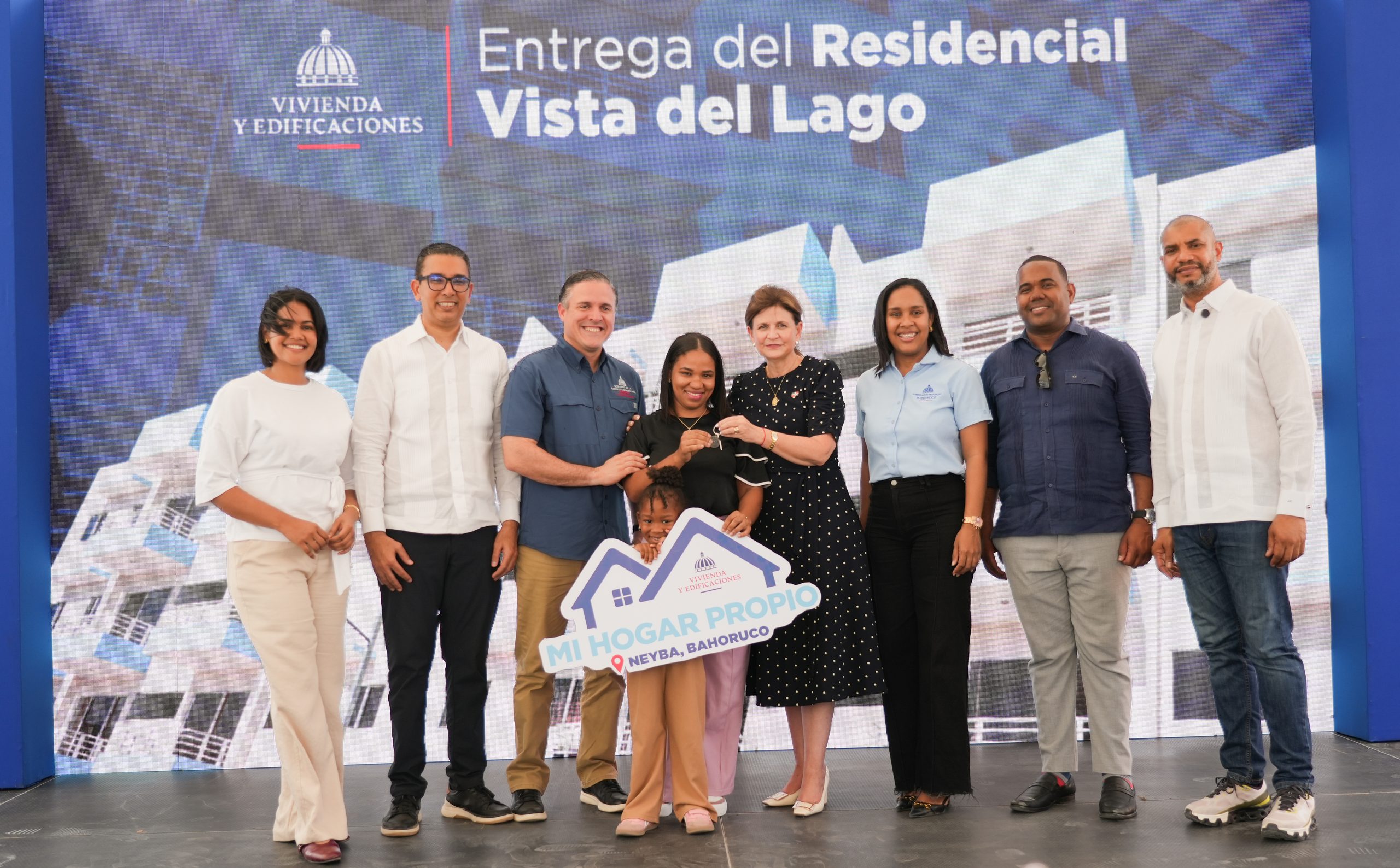
The Vice President of the Republic, Raquel Peña, and the Minister of Housing, Habitat and Buildings, Jean Luis Rodríguez, led yesterday, Thursday, the delivery of the first stage of the Vista del Lago I & II Residential housing project in the municipality of Neyba, Bahoruco province, a project that projects a total investment of RD$ 352 million.
The residential complex is managed through FONVIVIENDA, with a government subsidy of RD$76 million, according to the government statement. The statement also explains that the complex is being built on a plot of approximately 7,400 square meters, with a construction area of over 7,000 square meters, and will have a total of 240 apartments, with 128 units being delivered in this first phase.
The Vice President of the Dominican Republic called on the beneficiaries to preserve the project by establishing clear bylaws so that, within the law, it becomes a place where families can begin a new chapter in their lives.
Minister Jean Luis Rodríguez thanked the families who received their keys. “Thank you for your trust and for believing in this project. Know that the Ministry of Housing and Urban Development (MIVHED) will continue to support you, because our commitment doesn't end with the handover: it continues here, in the community that begins to grow today.” “We will continue building a better future so that more and more Dominicans can proudly say, ‘This is my own house, this is my home,’” the official stated.
What the homes include
The press release details that the homes feature a living room, dining room, kitchen, balcony, laundry area, gazebos, recreational and green spaces, paved access roads, and state-of-the-art electrical and plumbing systems.
According to the Ministry of Housing, Urban Development and Housing (MIVHED), the Vista del Lago housing project represents a high-impact social intervention aimed at prioritizing fair and equitable access for 70 vulnerable families. The state agency explains that a comprehensive socioeconomic survey was conducted to develop a holistic profile of the beneficiaries, providing technical support for decision-making aimed at reducing social inequalities.
It highlights that 55.7% of the homeowners are between 18 and 35 years old, reflecting a high proportion of young people establishing their careers and families. 28.6% are between 36 and 45 years old; 11.4% are between 46 and 55; and 4.3% are over 55, requiring special accessibility and inclusion measures.
It adds that 70.0% of the beneficiaries are women, highlighting the leading role of women in accessing housing solutions and the priority given to female-headed households. The remaining 30.0% are men.
Similarly, data provided by the government entity indicates that 5.7% of households report dependent persons with disabilities, requiring continuous social support.
In terms of employment, 87.1% of household owners are part of the economically active population (5.7% unemployed). However, the average monthly household income of RD$40,769.76 is insufficient for independent purchase of formal housing.
Recommended readings:
End of the century: the housing deficit that modernization failed to solve







