


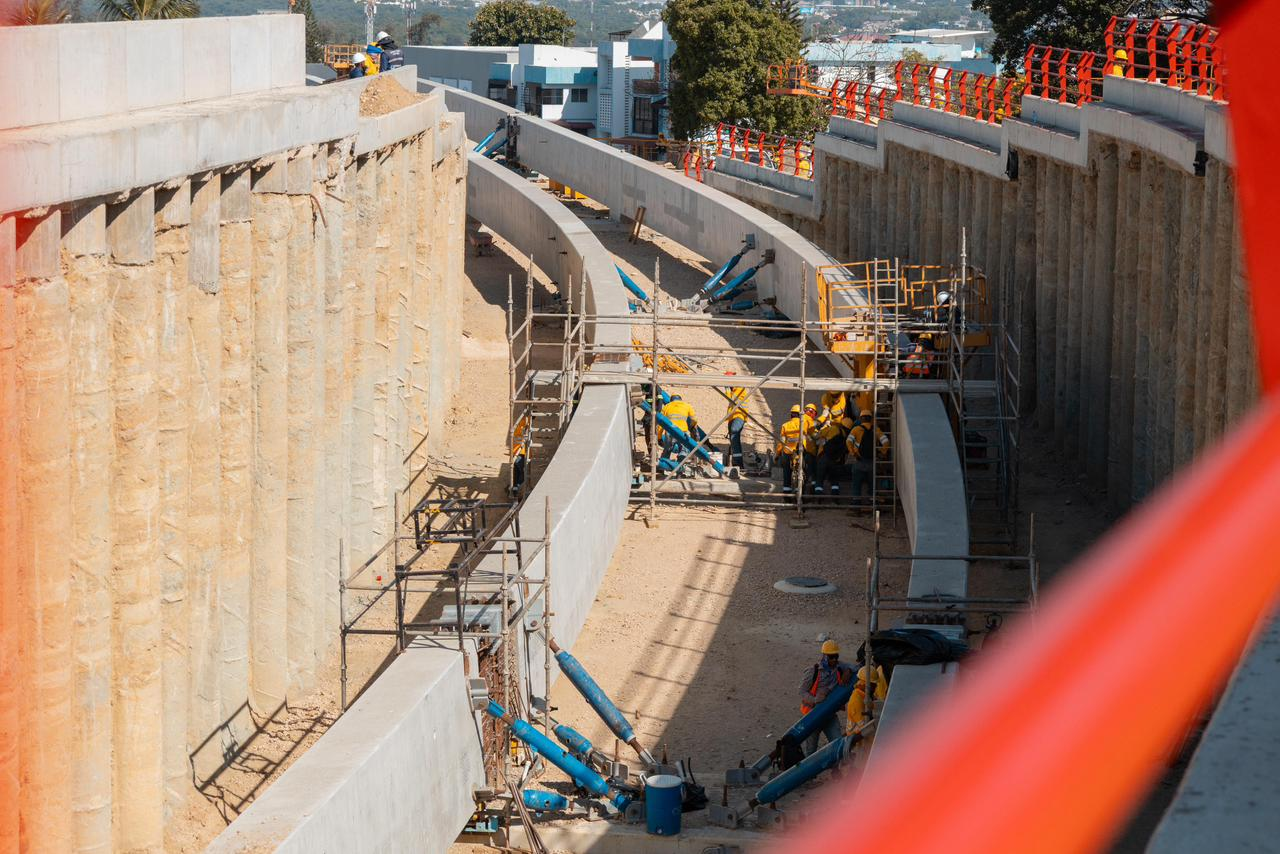
SANTO DOMINGO.- The Santiago monorail, one of the most significant road mobility projects currently underway in the Dominican Republic, specifically in the Cibao region, and which, according to projections, will move around 20,000 passengers per hour in each direction, with a journey time of approximately 30 to 35 minutes between the 14 stations, now has a date to test its operation.
The project, which began in March 2022, is part of the Santiago Integrated Transportation System , considered the largest infrastructure and mobility project in the province's history
During the Weekly Agenda held yesterday, Monday, September 14, in the Heart City, President Luis Abinader revealed details of his progress, along with the officials in charge of supervising the process.
Authorities explained that this initiative is part of a comprehensive regional development strategy aimed at overcoming decades of underinvestment, boosting the competitiveness of the city of Corazón, and decentralizing economic opportunities to prevent mass migration to the capital.
Testing begins in October
The director of the Office of Urban and Interurban Mobility Project Development, Jhael Isa, stated that the project, whose conceptualization began in September 2021 in conjunction with the Santiago Commitment initiative, stands out for its rapid execution. With an estimated time of four years and 138 days since its inception, the structural work has completed its main components.
What it consists of
The monorail covers 13 kilometers and 14 stations , reaching speeds of between 60 and 80 kilometers per hour, with a frequency of 90 seconds between trains.
Its complementary infrastructure includes 4,252 piles, 662 foundations, 716 columns, 658 capitals, 1,132 beams, a workshop yard with 3.2 kilometers of service road, two bridges over the Gurabo and Nibaje ravines, and a trench tunnel of approximately 500 meters to protect the Monumental Zone.
Its integrated system includes a cable car, 7 bus corridors and a public bicycle system.
Authorities reported that train service will begin in October, paving the way for guided tours and subsequent commercial operation of the system by the end of the year, making it the first of its kind in Central America and the Caribbean.
Integrated tariff
To ensure access for all citizens, the system will operate under an integrated fare model (with a unified cost of RD 35.00), which will allow passengers to make efficient transfers between OMSA buses , the cable car and the monorail, representing a significant savings in the budget of workers and students, said government representatives.
Regional impact and decentralization
The new mass transit system will connect the city's main points, from Cienfuegos to Pekín, linking universities, free trade zones, and the city center. It will also directly benefit users from across the Cibao region, including the provinces of Puerto Plata, Espaillat, La Vega, Duarte, and Hermanas Mirabal.
The project aims to provide Santiago with the necessary competitiveness standards to consolidate itself as the economic engine of the Cibao region, ensuring that its inhabitants have greater development opportunities without needing to move to Santo Domingo.
Recommended reading:






