



The mobile population of Santo Domingo represents 3,527,000 users, of which only 436,000 travel by metro, cable car, and OMSA buses, with an average travel time of 1 hour and 30 minutes and an average fare of between 55 and 100 pesos. Jhael Isa.
SANTO DOMINGO.- A tram, line 3 of the cable car, a Metropolitan Train, the three previous ones located in Santo Domingo; the San Cristóbal Train, the incorporation of urban interchanges and three urban bus terminals, will form the Integrated Transportation System of Santo Domingo (SIT-SD), presented last night by the Dominican Government.
During the presentation of the new system, led by President Luis Abinader, it was reported that it will have an investment of around 3.2 billion dollars, where the public sector will contribute around 2 billion dollars that have already been identified in funds selected for the multi-year budget.
Part of the works are scheduled to begin in 2024, with bidding processes currently underway, and will continue progressively until 2028.
Abinader explained that the initiative addresses the problems of saturation and congestion in the city's transportation system by incorporating new modes of transport with the goal of moving more than one million users to public transport and reducing private vehicle traffic.
“This will represent the most important investment made in the history of the Dominican Republic and in the entire Caribbean region in terms of mobility, building a modern, transparent and participatory model,” said the president.
He added that connecting the 5 entrances to Santo Domingo with an efficient, fast and accessible public transportation system will allow the best transportation system to reach those most in need.
“Residents of Santo Domingo Este, Santo Domingo Norte, Santo Domingo Oeste, Los Alcarrizos, San Cristóbal, Bajos de Haina, Guerra, and Boca Chica will no longer have to endure long traffic jams of more than two hours to access the National District. Nearly 3,500,000 trips that are made daily within the city will now be able to be made using public transportation.”.
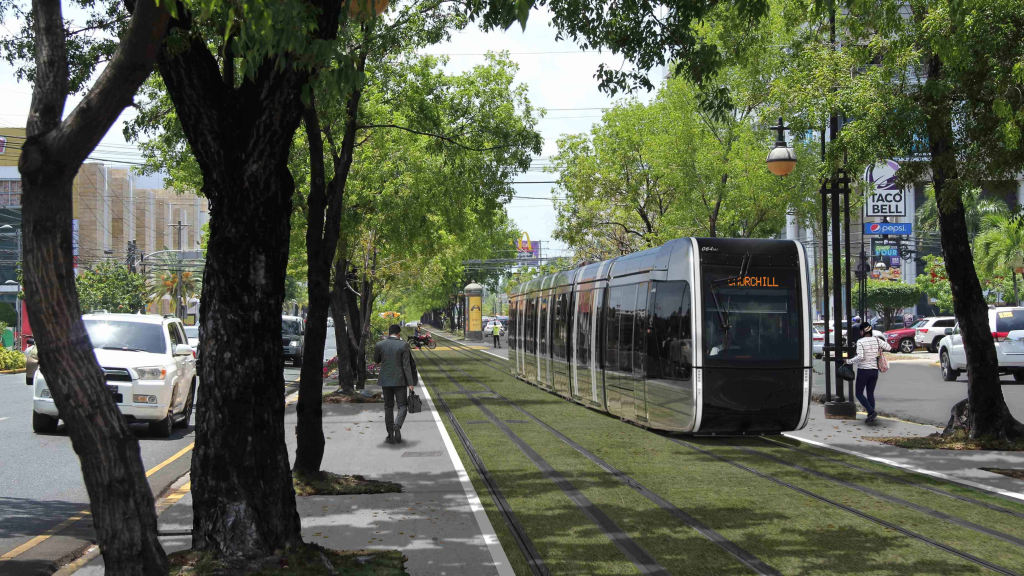
Design of the tram that will operate on Winston Churchill Avenue. ( External source) .
He opined that the new system will represent the greatest effort for social integration, building an inclusive and universal mobility system that integrates all social classes in a common space for the benefit of the environment and to improve the quality of life of our citizens.”.
"We have devised an accelerated investment plan for the next 5 years, so that before 2030, our children can access school by public transport, parents can go to work comfortably and safely, our grandparents can enjoy parks and public spaces, in a humane, livable city focused on its citizens," Abinader added.
For his part, the Minister of the Presidency, Joel Santos, referred to the strategic aspects behind the SIT-SD, highlighting sustainability by improving the quality of life of citizens and lowering the costs of the basic food basket; the environmental aspect in the reductions of carbon emissions; territorial planning through the improvements that the project represents in the reorganization of traffic and collective mobility; and citizen security.
“We need to make the connections from a road point of view; that is, from the perspective of public transport, to connect these centers with the National District, because the movement towards the city center will continue to grow as people continue to move in search of improving their living conditions; from the point of view of housing and, obviously, other characteristics,” emphasized the Minister of the Presidency.
Reduction of vehicular traffic
Jhael Isa, general director of the Trust for the Development of the Mass Transit System of the Dominican Republic (FITRAM), explained that the mobile population of Santo Domingo represents 3 million 527 thousand users of which only 436 thousand move by metro, cable car and OMSA, with an average travel time of 1 hour and 30 minutes and an average travel cost of 55 and 100 pesos.
According to Isa, an important element in the project is the reduction of private vehicle traffic to 1,481,340 vehicles compared to the 3,091,000 that currently travel.
This will result in a reduction in road congestion from 8 kilometers/hour to 15 kilometers/hour, equivalent to 50% less.
"To this we must add the 50% reduction in CO2 emissions, thus contributing to the commitments that the country has as signatories of the Sustainable Development Goals (SDGs)," he said.







