


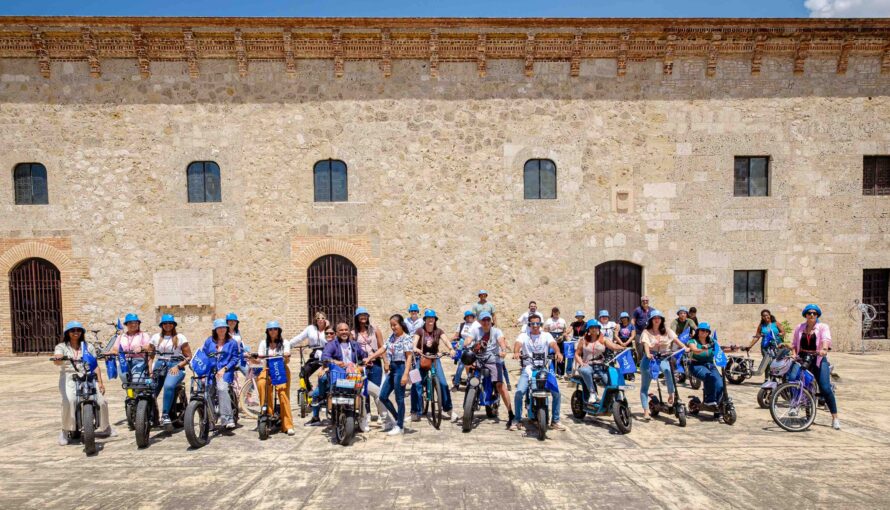
SANTO DOMINGO– The rich cultural heritage of the Colonial City served as the backdrop for an innovative experience that combined history, sustainability, and technology. Insurance advisors participated in a tour using light electric vehicles—scooters, bicycles, motorcycles, and other electric vehicles—an event that not only promoted an alternative to congested urban traffic but also highlighted the heritage beauty of Santo Domingo.
The tour passed through emblematic sites such as the Cathedral of Santo Domingo, the Taíno Museum, the Cathedral Museum and the Fortress of Santo Domingo, reinforcing the idea that electric mobility can also be an enriching cultural experience.
The tour promoted micromobility as an efficient and emission-free solution in urban environments and not only facilitated efficient travel, but also inspired reflection on how technological innovation can coexist with the preservation of our historical and environmental heritage, a press release highlights.
Nicole Hernández, head of mobility capacity at SURA, the organizing company along with its partner Celeste Colonial, highlighted that the growing traffic crisis in large cities demands more environmentally responsible alternatives, while Edwin Martínez, president of Celeste Colonial, emphasized that the national vehicle fleet already exceeds 500 vehicles per 1,000 inhabitants, which reinforces the urgency of adopting sustainable transportation.
Estefanía Sánchez, head of art and culture at Seguros SURA, stated that “art and culture are bridges that connect us with our identity and our environment,” highlighting how these types of experiences integrate social purpose with aesthetic sensitivity.
The figures support this trend
With over 3,000 electric cars on the road in the Dominican Republic and more than 600 charging stations installed, sustainable mobility is already a growing reality. Regionally, Latin America reached nearly 250,000 light electric vehicles in the first half of 2024.
This type of transportation not only improves air quality and reduces travel costs, but also positively transforms our relationship with the city. Micromobility is, ultimately, a key tool for building a healthier, more connected, and more humane urban future.
Photo: External source.







