


The city already had telegraph, railroads, public services, a modern bureaucracy, and more intense commerce. The public clock became a tool for a city that needed to synchronize itself
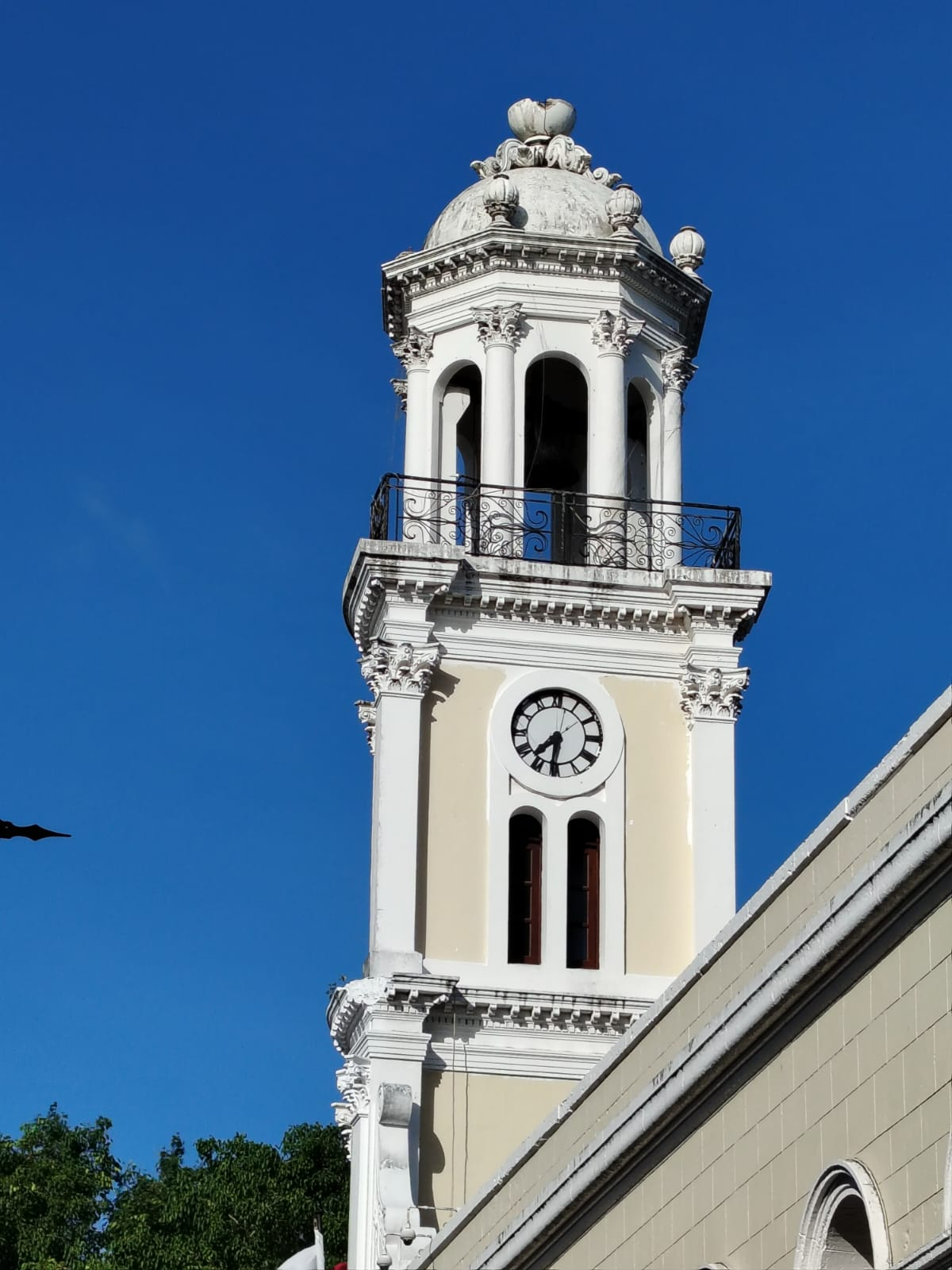
SANTO DOMINGO– The tower of the Santo Domingo City Hall starts on the curved corner of the building, above the semicircular arches that run along the ground floor and rises in stepped sections: first a balcony with a balustrade where the flag flies, then the clock body with its circular sphere flanked by pilasters.
Next, an octagonal bell tower with arched windows and an iron railing, and finally a ribbed, semi-spherical dome topped with a cylindrical lantern. Twenty-nine meters in total, white against the sky, visible from many points in the Colonial Zone.
That clock that almost never tells time, but sets the rhythm of the city, the visitor, local or not, even if he has a cell phone that shows a time synchronized with some atomic clock, always looks upwards.
There wasn't always a clock
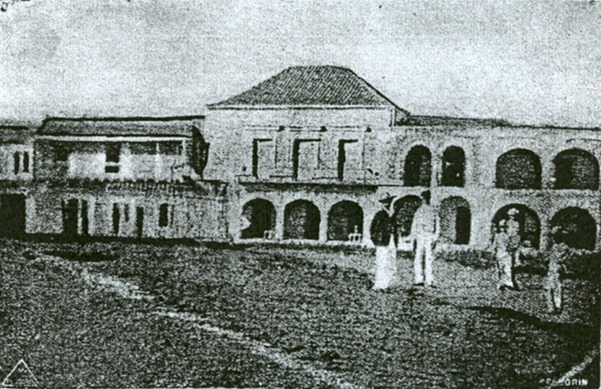
City Hall, 1906. The building before the intervention of Osvaldo Báez Machado, without the tower that identifies it today. (General Archive of the Nation, Dominican Republic/ AGN Photo Library).
In the 21st century, cell phones display the exact time, synchronized with atomic clocks somewhere in the world. But for centuries, the oldest city in the Americas relied on much simpler means of navigation, such as the shadows cast by sundials, an instrument that allowed people to track the passage of time based on the sun's position, long before the advent of electricity.
The story of the City Hall clock begins in the transition between two ways of understanding and living in the city.
The building that today occupies one of the most recognizable corners of Colón Park, at the intersection of El Conde and Arzobispo Meriño streets, has roots that go back to the early 16th century. It housed the Cabildo of Santo Domingo, the municipal institution in charge of administering a city that was just beginning to consolidate itself on the western bank of the Ozama River.
For more than four centuries, the building was simply the seat of the Cabildo (town council). Built starting in 1502, it served as the place where markets were regulated, decrees were issued, and the public affairs of the colony were discussed.
The transformation occurred between 1906 and 1913, when the Dominican engineer and architect Osvaldo Báez Machado directed a broad remodeling that gave the building its current appearance, incorporating neoclassical elements and the tower of about 29 meters high destined to become one of the most recognizable urban symbols of the city.
No, it's not colonial
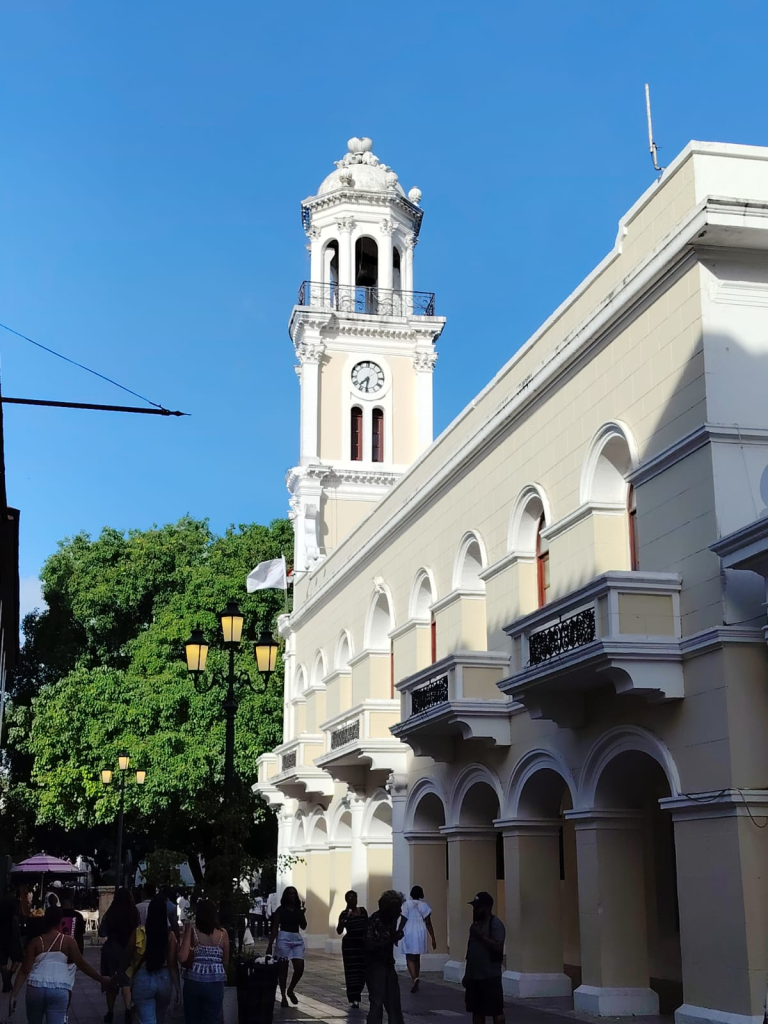
And although many may think that the current building dates back to the colonial era, it does not. (Photo/Solangel Valdez).
The architect and researcher Omar Rancier documented that the current City Hall was designed and built during the government of Ramón Cáceres and executed by the professional who graduated in Paris and one of the great names of Dominican neoclassical architecture, who replaced the old appearance of the town hall with a composition of eclectic and neoclassical inspiration that lasts to this day.
The works were carried out between 1911 and 1913, and the result would end up becoming one of the most important urban landmarks of the capital.
That intervention resulted in one of the city's most photographed buildings, whose presence forever altered the visual profile of the Plaza de Armas, now Parque Colón. Historian and architect Eugenio Pérez Montás, quoted by Rancier, described it as a structure that became an integral part of the city's character and the urban landscape of El Conde and Arzobispo Meriño streets.
But the story of this tower is not limited to its architectural value. The General Archive of the Nation records that on October 9, 1915, the public clock that has accompanied the life of the historic center of Santo Domingo ever since was installed in the City Hall.
Why a public clock?
At the beginning of the 20th century, the city began to experience changes that demanded a different relationship with time. The growth of public administration, commerce, services, and communications made the coordination of schedules increasingly important.
It was no longer enough to know if it was early or late. Urban life demanded a more precise reference point, and the Town Hall clock appeared amidst this transformation.
From then on, merchants, officials, visitors and passersby could look to the same point to know the exact time, in a city that for centuries had followed the course of the sun or the sound of the bells.
Time began to matter in a different way; it was no longer enough to know if it was morning or afternoon. People had to arrive at the office on time, coordinate business activities, and adhere to increasingly precise schedules. The public clock became part of this new urban discipline.
It wasn't the first instrument for measuring time in Santo Domingo. Nor was it the only one, but it became one of the most visible, and perhaps that's why it's so difficult today to separate the image of the City Hall from that of the clock that crowns its tower.
The paradox is that one of the most recognizable elements of Santo Domingo's historic landscape actually belongs to a relatively recent period in its history. This was when Christopher Columbus had already been observing the plaza from his pedestal for centuries, and the Primatial Cathedral had survived earthquakes, hurricanes, and occupations.
The tower and the clock arrived when the city was beginning to enter modernity and more than a century later, they are still there.
Thousands of people pass through Columbus Park every day without stopping to think about the clock mechanism they've photographed so many times. Perhaps because they no longer need it, since the time is displayed on phone screens, in vehicles, on computers, and on smartwatches.
However, the old clock in the Town Hall retains a symbolic function that goes beyond simply indicating minutes and seconds, although its operation has been intermittent for various reasons. The most common cause: damage to the mechanism from pigeon droppings.
Time, inexorable, continues its course and this clock stopped at 5:30, whether it is afternoon or early morning, continues to remember the moment when Santo Domingo stopped looking only at the path of the sun to begin to share the same time.
Recommended readings:







