


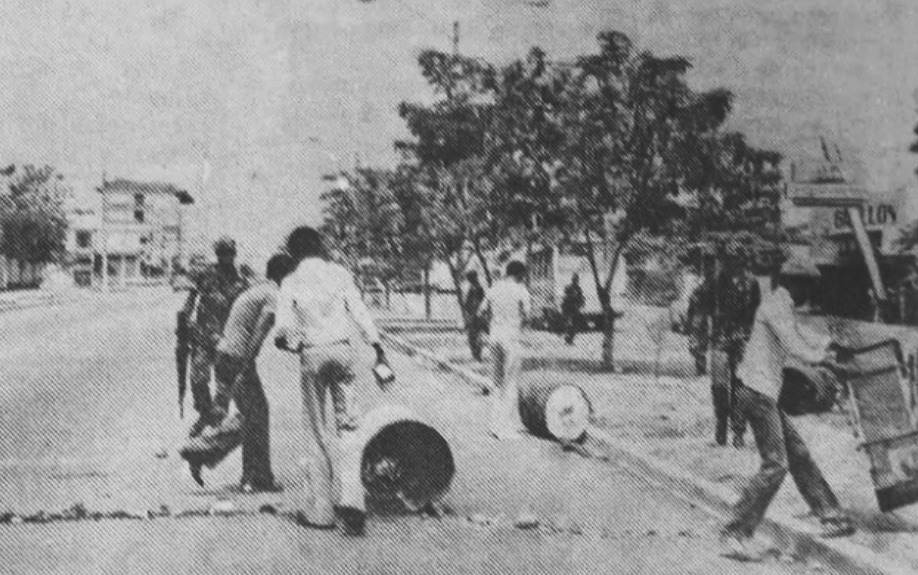
The agreement with the International Monetary Fund, signed in 1983, triggered 700% inflation and ignited the first popular uprising against neoliberalism in Latin America. The repression left 55 dead in the capital and around 300 throughout the country. The most ambitious housing program in the provinces that the Dominican state had attempted was left unfinished
SANTO DOMINGO. – In 1983, the government of Salvador Jorge Blanco signed an extended fund facility agreement with the International Monetary Fund, for the equivalent of 405.9 million dollars, the largest amount approved by the IMF for the Dominican Republic up to that time.
In exchange, the government pledged to eliminate consumer subsidies, restrict domestic credit, suspend all unbacked monetary issuance, and maintain budgetary austerity. The exchange rate for imports was fixed at 2.75 pesos per dollar, which effectively devalued the currency.
The consequences were immediate and devastating for the working class. As geographer Christian Girault documents in his analysis of the period, household food expenditures represented 40% of income for the middle class and up to 60% for the poorest sectors.
With the devaluation and the elimination of subsidies, the price increases hit first and hardest those who were already spending more than half their income on food. In the first months of 1984, inflation skyrocketed by 700%. Doctors, teachers, and nurses had already begun strikes in late 1983, according to press reports at the time.
The April 1984 uprising
On Monday, April 23, 1984, after the end of Holy Week, the working-class neighborhoods of Santo Domingo rose up. The uprising began in Capotillo, in the northern part of the capital, and spread within hours to Simón Bolívar, Cristo Rey, Gualey, Las Cañitas, 24 de Abril, Villa Juana, Villas Agrícolas, Los Mina, Villa Duarte, Herrera, and Los Alcarrizos.
By mid-morning on the first day, the entire capital was involved, with the exception of the central district and the exclusive areas inhabited by the upper and upper-middle classes. Professor Juan Bosch dubbed the uprising “the populace.”.
Girault, citing Laura Faxas's doctoral research, "The Broken Myth. Political System and Popular Movement in the Dominican Republic, 1961-1990" (Santo Domingo: Latin American Faculty of Social Sciences, 2007), establishes a direct correlation between the location of the riots during the three days of the revolt and the characteristics of the marginal neighborhoods located in the north of the agglomeration.
Observers agree that the riots were largely spontaneous. The government of Jorge Blanco, which initially interpreted the uprising as a politically directed movement, first ordered the intervention of the National Police and then, when the police were overwhelmed, mobilized the National Army, the Navy, and the Air Force. The elite troops from Constanza, known as Mountain Hunters, took control of the neighborhoods.
The death toll was 55 in the capital and around 300 nationwide, according to Girault's analysis based on Faxas data, as the riots spread to fifteen inland cities. Thousands of people were arrested and radio stations were silenced.
The head of the IMF negotiating mission publicly distanced himself from the price increases, arguing that the organization had not signed any agreement with the government, a position met with widespread disbelief.
The uprising of April 1984 in the Dominican Republic was, in Girault's analysis, the first popular insurrection against the IMF's neoliberal adjustment policies in Latin America, anticipating by five years the Venezuelan Caracazo of 1989. The protests forced the IMF to revise its policy for the region.
The consequences for housing
The economic crisis and the political cost of the uprising marked the rest of the term. The housing program, which had started with significant numbers in several provinces, lost the necessary momentum to be completed. Invivienda Santo Domingo, the largest project with 8,000 planned units, was left unfinished. The Jobo-Bonito Project, some 30 units in San Miguel, was also halted.
In her doctoral thesis, Social Housing in Santo Domingo (2017), Dr. Natalia Ulloa Cáceres notes that between 1982 and 1986 the public sector initiated several housing projects in different parts of Santo Domingo. Her analysis does not break down the period independently of the entire PRD cycle, but the conclusion suggests the root of the problem: institutional weakness and the conditioning of housing policies by their performance in partisan politics prevented the social housing problem from being addressed systematically and continuously.
The urban context of those years aggravated the situation. Girault describes Santo Domingo from 1978-1986 as a city where the extreme polarization between the “normalized society” and the “shantytowns of the anemic society,” in the words of historian José Luis Romero quoted in the article, reached its peak.
Exclusionary urbanization led to crisis. The survival strategy of the poorest often resulted in silent emigration by any means to Caracas, Puerto Rico, and New York.
The legacy: what remained and what was left behind
The three days of April 1984 marked the government and the PRD in an irreversible way. Newspaper archives reveal that, in the 1986 presidential elections, Jacobo Majluta, the party's candidate, faced an uphill battle and was defeated by Balaguer in a long and chaotic recount.
Upon leaving power, Jorge Blanco faced accusations of corruption, fled to the Venezuelan embassy on April 30, 1987, was tried in absentia by Balaguer and sentenced to 23 years in prison and a million-dollar fine, although he was finally pardoned in 1994.
The housing program that promised 25,000 units annually and delivered partial results in several provinces of the country remained one of the most ambiguous chapters of his legacy: the most geographically extensive in Dominican housing history up to that point, and also one of the most unfinished.
Invivienda Santiago was fully completed. Invivienda Santo Domingo was not. The difference between the two is, to some extent, the difference between what the Dominican State promised and what it was able to sustain when the economy collapsed.
The capital that Jorge Blanco left in 1986 already had more than 1.5 million inhabitants; the 1993 census would register 1,609,966, and a housing deficit that no government had managed to close. Balaguer, returning to power for his third term, found it ripe for the operation that Ulloa Cáceres would describe decades later as the most violent of all: urban renewal through forced evictions, with some 30,000 houses destroyed and around 180,000 people displaced between 1986 and 1992.
Sources: Christian Girault, “Santo Domingo: The Trajectory of Urban Development and Metropolitan Expansion (1970-2022),” ECOS UASD Journal, Year XXXI, Vol. 2, No. 28, July-December 2024, pp. 111-127. Laura Faxas, The Broken Myth: Political System and Popular Movement in the Dominican Republic, 1961-1990, Santo Domingo: Latin American Faculty of Social Sciences, 2007. Natalia Ulloa Cáceres, Social Housing in Santo Domingo: Opportunities for Recycling the Existing Housing Stock, doctoral dissertation, 2017. Fanny Sánchez, widow of Bonilla, letter to the editor, Acento, June 10, 2020 / El Nuevo Diario, June 12, 2020. CIDOB, biography of Salvador Jorge Blanco, cidob.org.
Recommended readings:







