


It smells of garlic and onions, crushed cilantro leaves, freshly caught fish, incense, and a love potion that promises what science cannot. The Mercado Modelo smells, above all, of the Dominican Republic
SANTO DOMINGO. – Since it opened its doors in 1943, in the midst of Rafael Leónidas Trujillo's dictatorship, this building on Mella Avenue has been the stage for Dominican daily life in its most authentic version: noisy, smelly, negotiating and a little magical.
The Mercado Modelo was one of the most functional and enduring works of Henry Gazón Bona, a Dominican-French architect and astrologer born in 1909. The same man behind the Monument to the Heroes of the Restoration in Santiago and the Casa Vapor in Santo Domingo, he was a central figure in official architecture during the Dominican Era, specializing in reinforced concrete. The builder was Guido D'Alessandro Lombardi, and the architect Moncito Báez López-Penha also collaborated on the project.
The structure, bordered by Santomé, Hernando de Gorjón, José del Monte y Tejada streets and Mella Avenue, was conceived as the first agricultural supply center of the National District: a modern market for a dictatorship that needed to show modernity.
But above all, Santo Domingo needed an organized center for the food trade, a place where the city could find in one place what arrived scattered from all regions of the country, and for that time three similar ones were built: one in San Cristóbal, another in Santiago and the one in Santo Domingo.
Enclave of smells
Several generations possess a sensory map that no architectural plan could reproduce. The morning light streamed down Hernando de Gorjón Street, carrying with it the heavy perfume of the flower stalls, while the vendors arranged their bouquets next to the stands selling traditional medicine or botanical remedies.
From early morning, the aromas mingled without order or protocol: damp soil from freshly arrived cassava from Moca or Yamasá, fresh fish, Florida Water, cinnamon sticks, incense, or mangoes and guavas. Around them, the groceries, the grains: Creole rice, now extinct, black, red, and pinto beans. Coffee beans and raw corn for roasting.
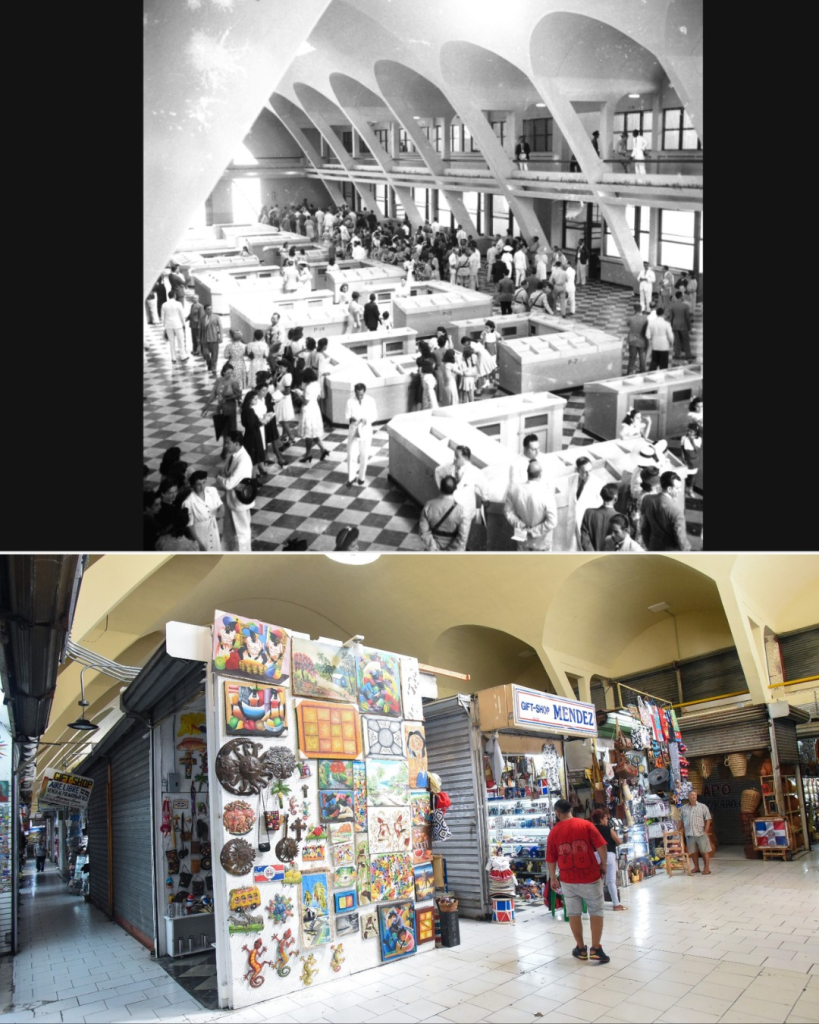
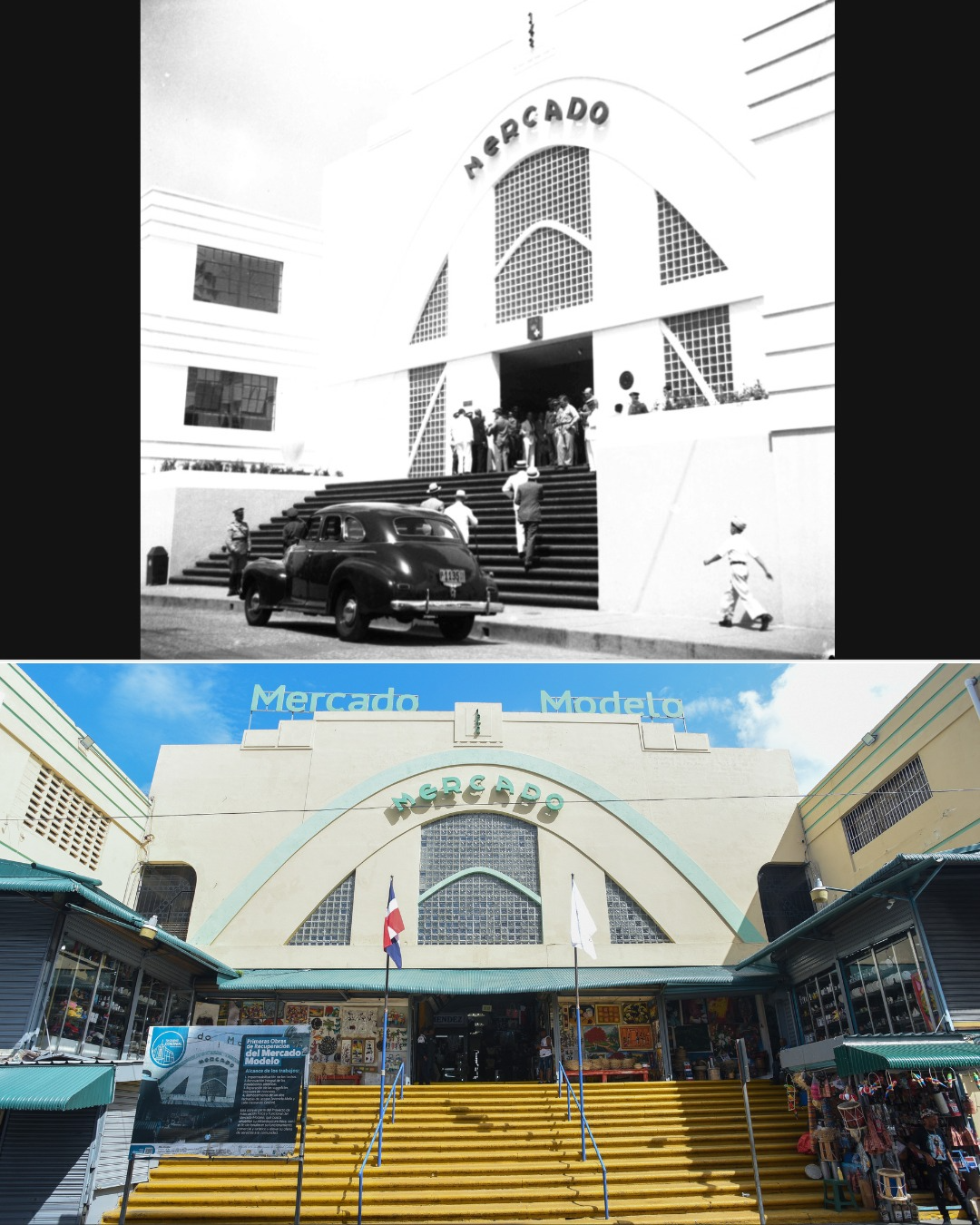
Images from when the Mercado Modelo was created and the present day. (Photo: AGN/Fidel Pérez).
The butcher shops, where they taught the difference between roti and meatballs, and the fishmongers, with the names of the species written on cardboard, occupied the west and east wings of the second floor, each in its own territory. The grocery and provision stores extended below and outwards, spilling out onto Hernando de Gorjón Street.
At the center of it all, a few gift shops that didn't yet know that over time they would dominate the landscape, surrounded by greengrocers and the odd stall selling iron stoves and cauldrons, aluminum and enameled jugs, wooden spoons, coffee strainers, guano brooms and enameled chamber pots.
But the heart of the market was its staircase on Mella Avenue. Wide and constantly busy, it was also the favorite spot for lottery ticket sellers and betting parlor operators, who offered luck every hour with a different number and the same unchanging promise: this is Sunday's prize. Nobody really believed them. Everyone listened, and many tried their luck.
For many Mexico City residents across generations, the Mercado Modelo was a kind of informal school, a place where they learned that food has a geography. They learned to haggle without offending, to do mental calculations before the vendor even finished speaking, and to recognize fresh fish by its bright eyes and red gills.
You learned that not all plantains are the same: "Are those from Mao?" "No, they're from the red pots." That good cassava has black soil: "Give me Moca cassava, it just sees water and splits open." That yautía from Yamasá has a texture that doesn't lie, and that the roquetes from Moca appeared as if by a miracle among the stalls.
And among the food and cuts of meat, colorful candles, scapulars, holy cards, reliquaries, litharge powder, sparklers, hair rollers, and hairnets coexisted without contradiction. Religious items and household goods always shared space, as if no one had ever drawn a line between the domestic and the spiritual.
The market that is
Eight decades later, the building still stands; that structure designed by Gazón Bona endures, although time and lack of maintenance have taken their toll. Light still streams vertically through the windows, illuminating an interior that has slowly changed.
The most visible transformation is in the content. Where there were once food stalls, today more than 150 craft shops predominate: rag dolls, larimar and amber jewelry, paintings, keychains, souvenirs of all kinds
The market that used to feed the neighborhoods has largely become the market that shows tourists a piece of Dominican culture to take home.
What hasn't changed, and perhaps never will, is Santería. The corridors that already smelled of botanicals in the seventies still offer mysterious colognes, liquids of dubious efficacy, and healers who guarantee love, money, and good luck. African heritage and popular devotion coexist here with a naturalness that no decree could regulate.
And that staircase, with its wide, solid concrete steps, rising with a certain republican gravity into the building. To any child passing by Mella Avenue and looking up, that staircase seems enormous, the threshold of something important.
The Mercado Modelo is not experiencing its best times in commercial terms, according to the original plan, but it remains a must-see for tourists looking for authenticity, for Dominicans in the diaspora who want to take something home, and for those who still remember what it was like to climb those steps on a Saturday morning, with a list in hand and the certainty that they would return with more than they were looking for.
The Mercado Modelo, although transformed, hasn't completely disappeared. It's the place where the capital learned to eat, to shop, to believe, to survive.
Recommended readings:







