


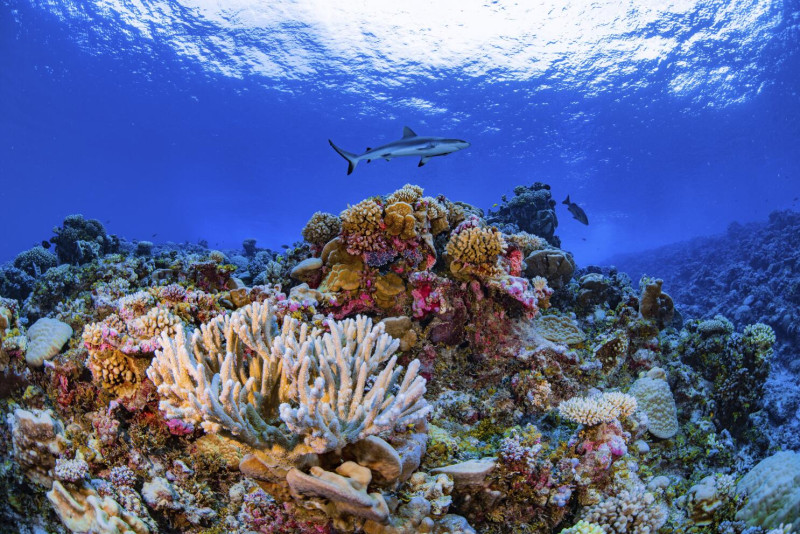
A report presented by the Monitorea program revealed that more than 70% of the 64 reefs evaluated by both entities have less than 10% live coral cover.
SANTO DOMINGO.–Rita Sellares, director of the Dominican Foundation for Marine Studies (Fundemar), stated that 60% of marine coral cover has been lost in the last four years, and therefore called for urgent measures to stop the deterioration of ecosystems and conserve those that remain.
She explained that marine ecosystems are in danger and experiencing an unprecedented decline. “Today, three ecosystems are calling on the public due to their critical situation, and in my 20 years of experience, I have never seen such a significant decline,” the expert stated during a meeting with the French Embassy, where they highlighted the risks facing mangroves and seagrass beds, as well as their vulnerable state.
The French ambassador to the country, Sonia Barbry, said that the preservation of maritime spaces is important for the development of the economy and the entry of more tourists to the Dominican Republic.
He stressed the importance of seeking viable solutions for this conversation and called for the union of the various institutions on the environment and protection of protected areas to find viable solutions to the deterioration of marine ecosystems.
They highlighted a report presented by the Monitorea program, a joint initiative of Fundemar and the Embassy, which revealed that over 70% of the 64 reefs assessed by both entities have less than 10% live coral cover. In the case of seagrass beds, 27% show less than 60% cover, and 19% of mangroves have less than 50% live vegetation cover.
The research results show the vulnerability of marineand coastal ecosystems and how both local and global ecosystems are threatened, compromising their conservation in the coming decades.
“This data collection represents the first step in understanding the current state of highly vulnerable ecosystems. Its continuation is essential to describe trends of stability, recovery, and decline, as well as to establish the factors that determine them, in order to define solutions based on scientific evidence.”.
"Sustained cooperation between institutions is key to preserving these resources of vital importance to the country," said the executive director of Fundemar.
Main contributions of Monitorea
This assessment is one of the main contributions of Monitorea, a program launched in 2023 by the French government through its embassy in Santo Domingo, with funding of half a million euros. The initiative was developed by the Dominican Foundation for Marine Studies (Fundemar), in coordination with the Ministry of Environment and Natural Resources, and with technical support from The Nature Conservancy (TNC).
Similarly, Aldo Cróquer, manager of the Marine Program for the Central Caribbean at TNC, highlighted the capacity of mangroves and seagrasses to capture carbon and store organic matter.
On average, mangroves and grasslands sequester tons of carbon and organic matter per square kilometer. Consequently, the loss of these ecosystems not only affects carbon absorption capacity but also negatively impacts food chains by reducing the food supply for numerous ecologically and commercially valuable species.
With information from Listín Diario.







