


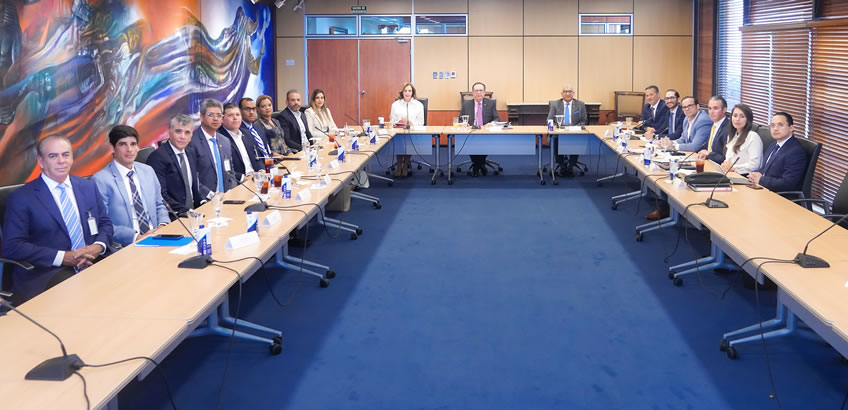
SANTO DOMINGO- The governor of the Central Bank of the Dominican Republic (BCRD), Héctor Valdez Albizu, received a visit from the board of directors of the Dominican Association of Housing Builders and Promoters (ACOPROVI), headed by its president, Annerys Meléndez; as well as representatives of the Dominican Chamber of Construction (CADOCON), whose president is Dino Campagna.
Representatives of the Construction sector considered the releases of resources from the legal reserve and Rapid Liquidity Facilities (FLR) to be decisive, aimed at facilitating access for Dominicans to low-cost housing solutions.
Valdez Albizu emphasized the special attention that the Central Bank of the Dominican Republic (BCRD) dedicates to this sector, which is fundamental to the Dominican Republic, highlighting its contribution to the added value of the economy and its role in building a housing stock in different modalities, especially low-cost housing.
In that regard, the governor highlighted that the release of legal reserves for low-cost housing amounted to RD$21.424 billion. Of this amount, financial intermediaries have channeled RD$12.502 billion at interest rates no higher than 9% annually (RD$8.905 billion for the acquisition of homes and the remaining RD$3.596 billion for their construction through interim loans to real estate developers).
As a result, 3,842 loans have been granted to purchasing families, and 47 interim loans have been provided to construction companies for the construction of these housing units. It is estimated that this program will lead to the construction of more than 13,000 low-cost homes.
The governor also highlighted that, through the liquidity measures approved by the Monetary Board in 2023, RD$127,593 million has been channeled, mainly to the sectors of commerce (RD$48,769 million), households (RD$20,507 million), construction (RD$12,777 million), manufacturing (RD$7,684 million), agriculture (RD$2,307 million), health (RD$1,847 million), among others, at interest rates of up to 9% per year.
He also emphasized that these liquidity measures, viewed as a whole, have benefited families and businesses with more than 17,000 loans, thanks to the resources allocated during the implementation of these programs.
Valdez Albizu specified that, of the aforementioned resources, approximately RD$12.784 billion remain unused by financial intermediaries. Of these available funds, some RD$8.923 billion can be allocated, interchangeably, for the acquisition or (interim) construction of low-cost housing, as recently authorized by the Monetary Board, which has accelerated the allocation of these resources.
Representatives from the construction sector expressed the importance of a monetary policy like the one being implemented by the Central Bank of the Dominican Republic (BCRD) for the consolidation of their projects, with the consumer price index (CPI) and the dollar reference rate being of particular relevance.
In this regard, Valdez Albizu pointed out that the CPI experienced a monthly variation of 0.52% in August 2023, and that, with this result, the year-on-year inflation, measured from August 2022 to August 2023, stood at 4.27%, remaining within the target range of 4.0% ± 1.0%, which is expected to continue until the end of the year.
He also indicated that the stability of the Dominican peso in the foreign exchange market will continue, and that, as a result of the easing measures, greater growth in monetary aggregates is observed, expanding at rates significantly higher than that of nominal GDP.
Members of the ACOPROVI delegations highlighted the benefit of the country's high levels of remittances, as a significant portion of these funds are used to purchase homes. Valdez Albizu responded that, during the first eight months of 2023, remittances reached US$6,769.9 million, representing a 3.9% increase compared to the same period of the previous year. This increase aligns with the projection of exceeding US$10 billion by the end of 2023.
Valdez Albizu was accompanied by the Vice Governor of the Central Bank, Clarissa de la Rocha de Torres; the manager, Ervin Novas Bello; the Deputy Manager of Monetary, Exchange and Financial Policies, Joel Tejeda Comprés; and the Deputy Manager of Regulation and Financial Stability, Máximo Rodríguez.
Also in attendance were the Deputy Manager of National Accounts and Economic Statistics, Ramón González; the Director of the Department of National Accounts and Economic Statistics, Elina Rosario; and the Director of the Department of Regulation and Financial Stability, Carlos Delgado.
Annerys Meléndez was accompanied by the following representatives from ACOPROVI: Guido Rosario, 2nd Vice President; Héctor Bretón, Advisor; Santiago Colomé, 1st Member; Pablo Piantini, Auditor; Ángel Paulino, 2nd Member; and Jorge Montalvo, Advisor. Dino Campagna, from CADOCON, was accompanied by Raúl Aguayo.
The governor of the Central Bank of the Dominican Republic (BCRD), Héctor Valdez Albizu, received a visit from the board of directors of the Dominican Association of Housing Builders and Promoters (ACOPROVI), headed by its president, Annerys Meléndez; as well as representatives of the Dominican Chamber of Construction (CADOCON), whose presidency is held by Dino Campagna.
Representatives of the Construction sector considered the releases of resources from the legal reserve and Rapid Liquidity Facilities (FLR) to be decisive, aimed at facilitating access for Dominicans to low-cost housing solutions.
Valdez Albizu emphasized the special attention that the Central Bank of the Dominican Republic (BCRD) dedicates to this sector, which is fundamental to the Dominican Republic, highlighting its contribution to the added value of the economy and its role in building a housing stock in different modalities, especially low-cost housing.
In that regard, the governor highlighted that the release of legal reserves for low-cost housing amounted to RD$21.424 billion. Of this amount, financial intermediaries have channeled RD$12.502 billion at interest rates no higher than 9% annually (RD$8.905 billion for the acquisition of homes and the remaining RD$3.596 billion for their construction through interim loans to real estate developers).
As a result, 3,842 loans have been granted to purchasing families, and 47 interim loans have been provided to construction companies for the construction of these housing units. It is estimated that this program will lead to the construction of more than 13,000 low-cost homes.
The governor also highlighted that, through the liquidity measures approved by the Monetary Board in 2023, RD$127.593 billion has been channeled, primarily to the following sectors: Commerce (RD$48.769 billion), Households (RD$20.507 billion), Construction (RD$12.777 billion), Manufacturing (RD$7.684 billion), Agriculture (RD$2.307 billion), and Health (RD$1.847 billion), among others, at interest rates of up to 9% annually. He further emphasized that these liquidity measures, taken together, have benefited families and businesses with more than 17,000 loans.
Valdez Albizu specified that, of the aforementioned resources, approximately RD$12.784 billion remain unused by financial intermediaries. Of these available funds, some RD$8.923 billion can be allocated, interchangeably, for the acquisition or (interim) construction of low-cost housing, as recently authorized by the Monetary Board, which has accelerated the allocation of these resources.
Representatives from the construction sector expressed the importance of a monetary policy like the one being implemented by the Central Bank of the Dominican Republic (BCRD) for the consolidation of their projects, with the consumer price index (CPI) and the dollar reference rate being of particular relevance.
In this regard, Valdez Albizu pointed out that the CPI experienced a monthly variation of 0.52% in August 2023, and that, with this result, the year-on-year inflation, measured from August 2022 to August 2023, stood at 4.27%, remaining within the target range of 4.0% ± 1.0%, which is expected to continue until the end of the year.
He also indicated that the stability of the Dominican peso in the foreign exchange market will continue, and that, as a result of the easing measures, greater growth in monetary aggregates is observed, expanding at rates significantly higher than that of nominal GDP.
Members of the ACOPROVI delegations highlighted the benefit of the country's high levels of remittances, as a significant portion of these funds are used to purchase homes. Valdez Albizu responded that, during the first eight months of 2023, remittances reached US$6,769.9 million, representing a 3.9% increase compared to the same period of the previous year. This increase aligns with the projection of exceeding US$10 billion by the end of 2023.
Valdez Albizu was accompanied by the Vice Governor of the Central Bank, Clarissa de la Rocha de Torres; the manager, Ervin Novas Bello; the Deputy Manager of Monetary, Exchange and Financial Policies, Joel Tejeda Comprés; and the Deputy Manager of Regulation and Financial Stability, Máximo Rodríguez.
Also in attendance were the Deputy Manager of National Accounts and Economic Statistics, Ramón González; the Director of the Department of National Accounts and Economic Statistics, Elina Rosario; and the Director of the Department of Regulation and Financial Stability, Carlos Delgado.
Annerys Meléndez was accompanied by the following representatives from ACOPROVI: Guido Rosario, 2nd Vice President; Héctor Bretón, Advisor; Santiago Colomé, 1st Member; Pablo Piantini, Auditor; Ángel Paulino, 2nd Member; and Jorge Montalvo, Advisor. Dino Campagna, from CADOCON, was accompanied by Raúl Aguayo.
The governor of the Central Bank of the Dominican Republic (BCRD), Héctor Valdez Albizu, received a visit from the board of directors of the Dominican Association of Housing Builders and Promoters (ACOPROVI), headed by its president, Annerys Meléndez; as well as representatives of the Dominican Chamber of Construction (CADOCON), whose presidency is held by Dino Campagna.
Representatives of the Construction sector considered the releases of resources from the legal reserve and Rapid Liquidity Facilities (FLR) to be decisive, aimed at facilitating access for Dominicans to low-cost housing solutions.
Valdez Albizu emphasized the special attention that the Central Bank of the Dominican Republic (BCRD) dedicates to this sector, which is fundamental to the Dominican Republic, highlighting its contribution to the added value of the economy and its role in building a housing stock in different modalities, especially low-cost housing.
In that regard, the governor highlighted that the release of legal reserves for low-cost housing amounted to RD$21.424 billion. Of this amount, financial intermediaries have channeled RD$12.502 billion at interest rates no higher than 9% annually (RD$8.905 billion for the acquisition of homes and the remaining RD$3.596 billion for their construction through interim loans to real estate developers).
As a result, 3,842 loans have been granted to purchasing families, and 47 interim loans have been provided to construction companies for the construction of these housing units. It is estimated that this program will lead to the construction of more than 13,000 low-cost homes.
The governor also highlighted that, through the liquidity measures approved by the Monetary Board in 2023, RD$127.593 billion has been channeled, primarily to the following sectors: Commerce (RD$48.769 billion), Households (RD$20.507 billion), Construction (RD$12.777 billion), Manufacturing (RD$7.684 billion), Agriculture (RD$2.307 billion), and Health (RD$1.847 billion), among others, at interest rates of up to 9% annually. He further emphasized that these liquidity measures, taken together, have benefited families and businesses with more than 17,000 loans.
Valdez Albizu specified that, of the aforementioned resources, approximately RD$12.784 billion remain unused by financial intermediaries. Of these available funds, some RD$8.923 billion can be allocated, interchangeably, for the acquisition or (interim) construction of low-cost housing, as recently authorized by the Monetary Board, which has accelerated the allocation of these resources.
Representatives from the construction sector expressed the importance of a monetary policy like the one being implemented by the Central Bank of the Dominican Republic (BCRD) for the consolidation of their projects, with the consumer price index (CPI) and the dollar reference rate being of particular relevance.
In this regard, Valdez Albizu pointed out that the CPI experienced a monthly variation of 0.52% in August 2023, and that, with this result, the year-on-year inflation, measured from August 2022 to August 2023, stood at 4.27%, remaining within the target range of 4.0% ± 1.0%, which is expected to continue until the end of the year.
He also indicated that the stability of the Dominican peso in the foreign exchange market will continue, and that, as a result of the easing measures, greater growth in monetary aggregates is observed, expanding at rates significantly higher than that of nominal GDP.
Members of the ACOPROVI delegations highlighted the benefit of the country's high levels of remittances, as a significant portion of these funds are used to purchase homes. Valdez Albizu responded that, during the first eight months of 2023, remittances reached US$6,769.9 million, representing a 3.9% increase compared to the same period of the previous year. This increase aligns with the projection of exceeding US$10 billion by the end of 2023.
Valdez Albizu was accompanied by the Vice Governor of the Central Bank, Clarissa de la Rocha de Torres; the manager, Ervin Novas Bello; the Deputy Manager of Monetary, Exchange and Financial Policies, Joel Tejeda Comprés; and the Deputy Manager of Regulation and Financial Stability, Máximo Rodríguez.
Also in attendance were the Deputy Manager of National Accounts and Economic Statistics, Ramón González; the Director of the Department of National Accounts and Economic Statistics, Elina Rosario; and the Director of the Department of Regulation and Financial Stability, Carlos Delgado.
Annerys Meléndez was accompanied by the following representatives from ACOPROVI: Guido Rosario, 2nd Vice President; Héctor Bretón, Advisor; Santiago Colomé, 1st Member; Pablo Piantini, Auditor; Ángel Paulino, 2nd Member; and Jorge Montalvo, Advisor. Dino Campagna, from CADOCON, was accompanied by Raúl Aguayo.
The governor of the Central Bank of the Dominican Republic (BCRD), Héctor Valdez Albizu, received a visit from the board of directors of the Dominican Association of Housing Builders and Promoters (ACOPROVI), headed by its president, Annerys Meléndez; as well as representatives of the Dominican Chamber of Construction (CADOCON), whose presidency is held by Dino Campagna.
Representatives of the Construction sector considered the releases of resources from the legal reserve and Rapid Liquidity Facilities (FLR) to be decisive, aimed at facilitating access for Dominicans to low-cost housing solutions.
Valdez Albizu emphasized the special attention that the Central Bank of the Dominican Republic (BCRD) dedicates to this sector, which is fundamental to the Dominican Republic, highlighting its contribution to the added value of the economy and its role in building a housing stock in different modalities, especially low-cost housing.
In that regard, the governor highlighted that the release of legal reserves for low-cost housing amounted to RD$21.424 billion. Of this amount, financial intermediaries have channeled RD$12.502 billion at interest rates no higher than 9% annually (RD$8.905 billion for the acquisition of homes and the remaining RD$3.596 billion for their construction through interim loans to real estate developers).
As a result, 3,842 loans have been granted to purchasing families, and 47 interim loans have been provided to construction companies for the construction of these housing units. It is estimated that this program will lead to the construction of more than 13,000 low-cost homes.
The governor also highlighted that, through the liquidity measures approved by the Monetary Board in 2023, RD$127.593 billion has been channeled, primarily to the following sectors: Commerce (RD$48.769 billion), Households (RD$20.507 billion), Construction (RD$12.777 billion), Manufacturing (RD$7.684 billion), Agriculture (RD$2.307 billion), and Health (RD$1.847 billion), among others, at interest rates of up to 9% annually. He further emphasized that these liquidity measures, taken together, have benefited families and businesses with more than 17,000 loans.
Valdez Albizu specified that, of the aforementioned resources, approximately RD$12.784 billion remain unused by financial intermediaries. Of these available funds, some RD$8.923 billion can be allocated, interchangeably, for the acquisition or (interim) construction of low-cost housing, as recently authorized by the Monetary Board, which has accelerated the allocation of these resources.
Representatives from the construction sector expressed the importance of a monetary policy like the one being implemented by the Central Bank of the Dominican Republic (BCRD) for the consolidation of their projects, with the consumer price index (CPI) and the dollar reference rate being of particular relevance.
In this regard, Valdez Albizu pointed out that the CPI experienced a monthly variation of 0.52% in August 2023, and that, with this result, the year-on-year inflation, measured from August 2022 to August 2023, stood at 4.27%, remaining within the target range of 4.0% ± 1.0%, which is expected to continue until the end of the year.
He also indicated that the stability of the Dominican peso in the foreign exchange market will continue, and that, as a result of the easing measures, greater growth in monetary aggregates is observed, expanding at rates significantly higher than that of nominal GDP.
Members of the ACOPROVI delegations highlighted the benefit of the country's high levels of remittances, as a significant portion of these funds are used to purchase homes. Valdez Albizu responded that, during the first eight months of 2023, remittances reached US$6,769.9 million, representing a 3.9% increase compared to the same period of the previous year. This increase aligns with the projection of exceeding US$10 billion by the end of 2023.
Valdez Albizu was accompanied by the Vice Governor of the Central Bank, Clarissa de la Rocha de Torres; the manager, Ervin Novas Bello; the Deputy Manager of Monetary, Exchange and Financial Policies, Joel Tejeda Comprés; and the Deputy Manager of Regulation and Financial Stability, Máximo Rodríguez.
Also in attendance were the Deputy Manager of National Accounts and Economic Statistics, Ramón González; the Director of the Department of National Accounts and Economic Statistics, Elina Rosario; and the Director of the Department of Regulation and Financial Stability, Carlos Delgado.
Annerys Meléndez was accompanied by the following representatives from ACOPROVI: Guido Rosario, 2nd Vice President; Héctor Bretón, Advisor; Santiago Colomé, 1st Member; Pablo Piantini, Auditor; Ángel Paulino, 2nd Member; and Jorge Montalvo, Advisor. Dino Campagna, from CADOCON, was accompanied by Raúl Aguayo.







