


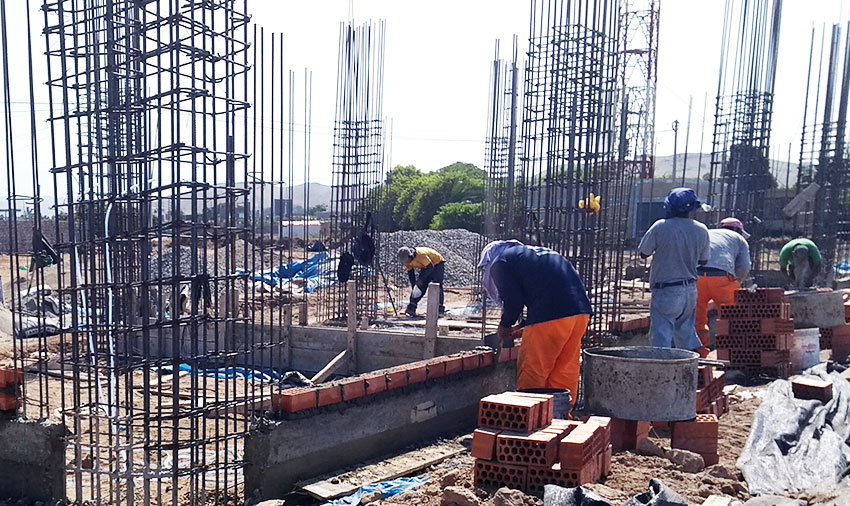
The data provided by two MIVHED officials and those from the ONE do not match; all three figures coexist in the public sphere without the MIVHED having reconciled them, and the difference between the highest figure, that of the ONE, and the lowest, the one cited by Rodríguez, exceeds 700 licenses, more than half of the total reported in the yearbook
SANTO DOMINGO. – The National Statistics Office (ONE) recorded 1,362 licenses granted to the private construction sector during 2025, according to the 2025 Yearbook of Economic Statistics, prepared with data supplied by the Plan Processing Department of the Ministry of Housing and Buildings.
That figure does not match the one offered by the ministry itself, already restructured under Law 160-21 as the Ministry of Housing, Habitat and Buildings (MIVHED), through two different officials who held the position this year.
On August 4, 2026, under the management of Ito Bisonó, the MIVHED reported, through a statement from the Presidency of the Republic, that it had issued 953 licenses throughout 2025, a monthly average of 79 according to the statement itself, which multiplied by the twelve months of the year yields a figure close to the one reported.
Bisonó left the ministry on August 16, 2026, when President Luis Abinader appointed him foreign minister by Decree 554-26 and named Jean Luis Rodríguez in his place.
As the new head of MIVHED, Rodríguez stated on September 15, 2026, during the Infrastructure and Investment panel of the First Punta Cana Leadership, Dialogue and Vision Forum, that the ministry's Zero Bureaucracy program had processed 628 licenses in 2025, a figure that, unlike the other two, corresponds to a specific program within the institution and not necessarily to the national total of licenses.
One possible explanation lies in the language used by each source. The ONE refers to licenses granted, Bisonó to licenses issued, and Rodríguez to licenses processed within a specific program.
Verbs that in the Dominican administrative process do not always describe the same step: an application can be processed without being issued, and a license issued in a year does not always correspond to the same year in which it was requested.
Adding to this possible cause is a fundamental regulatory change: on April 10, 2026, the new Construction Code of the Dominican Republic came into effect, through Resolution 007-2026, which modified the technical requirements demanded to approve a file and may have altered the way in which the ministry counts its own procedures, in addition to the change of management itself that occurred in August.
While the absolute figures for licenses are disputed, the behavior of the sector as measured by other indicators paints a more consistent picture.
The number of constructions that were built with private sector licenses fell 20.8% in 2025 compared to the previous year, to 4,163, and the appraised value of those works decreased 6.9%, to RD$75,894.7 million, according to the same ONE Yearbook.
57.3% of the licenses granted corresponded to apartment buildings, compared to just 16.3% for single-family homes, an imbalance that confirms the inclination of the formal market towards vertical housing.
This drop in the number and value of licenses contrasts with the performance reported by the Central Bank of the Dominican Republic (BCRD) for the added value of construction as an economic activity.
The Monthly Indicator of Economic Activity (IMAE) closed 2025 with a contraction of 1.8% in the sector, according to official figures, but registered a recovery of 6.6% in the first quarter of 2026 and 8.1% in July of that year, driven, according to the BCRD itself, by the execution of private projects and an increase of 18.2% year-on-year in credit allocated to the sector.
These are two different measurements of the same sector, the number of new permits versus the value of work already underway, and both can be true at the same time: fewer projects started in 2025, but those already underway generated more economic activity towards the beginning of 2026.
Meanwhile, construction costs showed no signs of slowing down. The Direct Housing Construction Cost Index (ICDV), jointly compiled by the Dominican Association of Housing Builders and Developers (ACOPROVI) and the National Statistics Office (ONE), closed 2025 at 236.17 points, with a cumulative increase of 3.72%, the highest variation recorded in six years.
ACOPROVI also warned that the 20% increase in the minimum wage for the construction sector, ordered by the National Wage Committee through Resolution CNS-04-2026, could increase the final price of homes by up to 6%.
The combination of fewer licenses, construction costs at their highest point in six years, and the legal uncertainty that the industry itself pointed out after a ruling by the Superior Administrative Court that annulled permits granted by the National District City Hall for a project under construction, makes up a picture that the number of licenses, taken in isolation, does not allow us to see.
ACOPROVI described that ruling as a risk to investor confidence and the stability of administrative processes related to the development of construction projects.
Recommended readings:






