


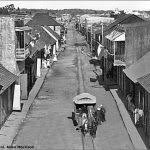
The central station was located in the triangle formed by Bolívar, Mella and Palo Hincado avenues, in the Concepción Fort, which is part of the Altar of the Fatherland complex, a must-see for those exploring the history of the walled city.
SANTO DOMINGO. – At the end of the 19th century, Santo Domingo was a metropolis of approximately 20,000 inhabitants, so modern that it even a tram , made of light, wooden, two-axle cars, pulled by horses or mules, with capacity for a few passengers, and they circulated through streets like El Conde, as a worthy representative of a desire for civilization and urban order.
Santo Domingo was still a city of dusty streets, some cobblestone, where the sun beat down. Starched suits rustled as people passed by, pedestrians offered their wares, and to this lively atmosphere was added the squeaking of iron wheels and the snorting of passing animals.
In those days Ulises Heureaux (Lilís) ruled with a firm hand, promoting "modernization" works in the city, and Salomé Ureña wrote her patriotic verses while educating a generation of normal school teachers at the Institute for Young Ladies.
The tramway was a private project with foreign capital operated by the Santo Domingo Tramway Company, founded in the 1880s, during the city's urban expansion, with authorization from the Santo Domingo City Council, which was responsible for maintaining the tracks, animals, and cars.
A photograph from 1894, from the holdings of the General Archive of the Nation, provides visual evidence of its existence and the urban life that accompanied it. In the image, the streetcar appears in front of low houses and some two-story buildings with colonial balconies, and some passersby dressed in the style of the time.
Arturo J. Pellerano Alfau founded the Listín Diario, around 1889, and from those pages were recorded the signs of that progress that was slowly arriving; it was also the time when entrepreneurs like Juan Bautista Vicini Burgos were consolidating mills and projects that would mark the economy of the new century.
What the fire took away
The central station was located in the so-called Fagina, opposite the Fort of the Conception and witnessed the passage of the two-axle carts that connected the walled city with its new peripheral neighborhoods.
Although an exact record of the route is not preserved, it is known that the route of this urban train went to Güibia, passed through El Conde, went down to Las Atarazanas and Santa Bárbara, covering areas near the dock, close to the Puerta de San Diego.
The tram or light rail service was shut down around 1904, following several incidents that culminated in the burning of the central station on the night of April 12, 1903, an event that marked the end of one of the first attempts at organized urban transport in the country.
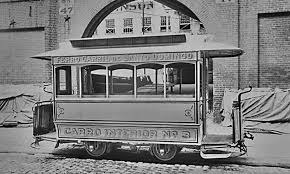
The tramway closed in 1904. (Photo/General Archive of the Nation).
The Concepción Fort, one of the oldest pieces of the defensive system of the Colonial City, was built in 1678 and originally served as a lookout point at the northern end of the wall, and more than two centuries later, in the transition to the 20th century.
The place, at the intersection of Simón Bolívar, Mella and Palo Hincado avenues, still retains that feeling of a border between the past and the present, as part of the surroundings of Independence Park, it is part of the Altar of the Fatherland complex, and continues to be a must-see for those who explore the history of the capital.
However, the site shows signs of neglect: some sections are deteriorating, and part of its surroundings has been turned into a public toilet and garbage dump due to urban decay. Between its symbolic value and its current vulnerability, the bastion offers a visible metaphor for the passage of time: where the clatter of the tram once echoed, today the sounds of a city struggling to preserve its memory resonate.
Today, no rails remain visible, nor are there any stations to remind us of its past. But if you stand in the middle of El Conde Street, right where the old walls open up to the sea breeze, you can imagine that wooden cart moving slowly along, its wheels clattering on the sleepers, amidst the echo of mules' hooves and the voices of a city that, for a moment, touched the future.







