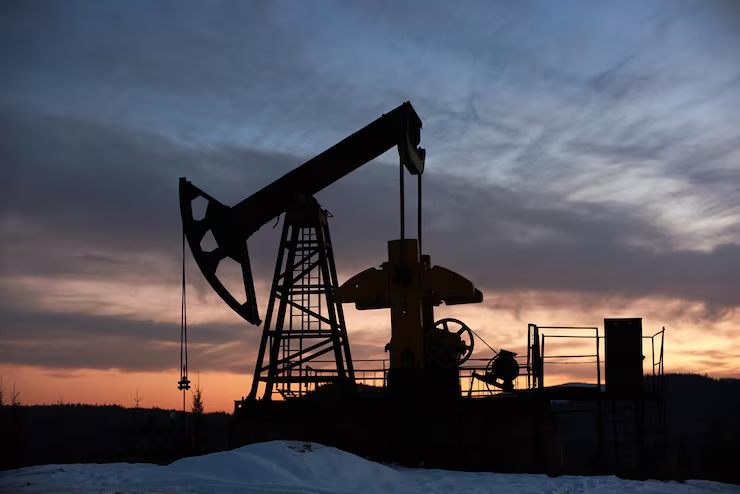
The organization projects that global demand for crude oil will grow by 23% by 2050, driven by economic development and increased energy consumption in Asia, Africa, and Latin America
SANTO DOMINGO – For years, the conversation about energy has been dominated by concepts such as energy transition, decarbonization, and electric mobility. However, while numerous governments are promoting strategies to reduce dependence on fossil fuels, the Organization of the Petroleum Exporting Countries (OPEC) maintains that the world will continue to need more crude oil for decades to come.
The specialized media outlet Periódico de la Energía compiled the main conclusions of the annual report on oil prospects 2026-2050 prepared by OPEC.
According to the organization's projections, global oil demand will increase from 105.1 million barrels per day in 2025 to 124.1 million barrels per day in 2050, representing a growth of approximately 23%.
Far from anticipating a decline, the organization believes that global crude oil consumption will continue to expand, driven by demographic, economic, and technological factors.
The energy transition does not mean the end of oil
The report presents a different view from that held by some international organizations and sectors linked to renewable energies, which predict that the demand for fossil fuels will reach a peak before beginning to decline.
For OPEC, that scenario is not yet close.
According to the Energy Newspaper, economic growth, population increase, urbanization and the development of energy-intensive industries will continue to sustain strong demand for oil.
Added to this is the accelerated growth of data centers and the energy needs of millions of people who still lack adequate access to basic services.
Emerging countries will set the pace
The biggest increase in consumption would not come from developed economies.
OPEC predicts that Asia, the Middle East, Africa and Latin America will be the engines of energy growth over the next few decades.
India appears as one of the main drivers of this expansion, accompanied by other emerging economies that continue to increase their industrial production and urban population.
In contrast, countries belonging to the Organisation for Economic Co-operation and Development (OECD) would register a more moderate evolution.
Transportation, aviation, and petrochemicals will continue to depend on crude oil
Although electric vehicles have gained ground in recent years, the organization believes that sectors such as land transport, aviation, and the petrochemical industry will continue to depend heavily on petroleum derivatives.
The only area where a gradual reduction is expected is electricity generation, due to the advancement of other energy sources.
A debate that remains open
OPEC's projections reignite one of the main debates in current energy policy: whether the transition to cleaner sources will be fast enough to reduce dependence on oil, or whether, on the contrary, economic growth and the planet's energy needs will keep crude oil relevant for much of the century.
While governments and companies invest billions of dollars in renewable energy, the oil organization argues that the world is not entering a post-oil era, but rather a scenario in which different energy sources will coexist for decades.
And, at least from OPEC's perspective, oil is still far from being gone.
Recommended readings: