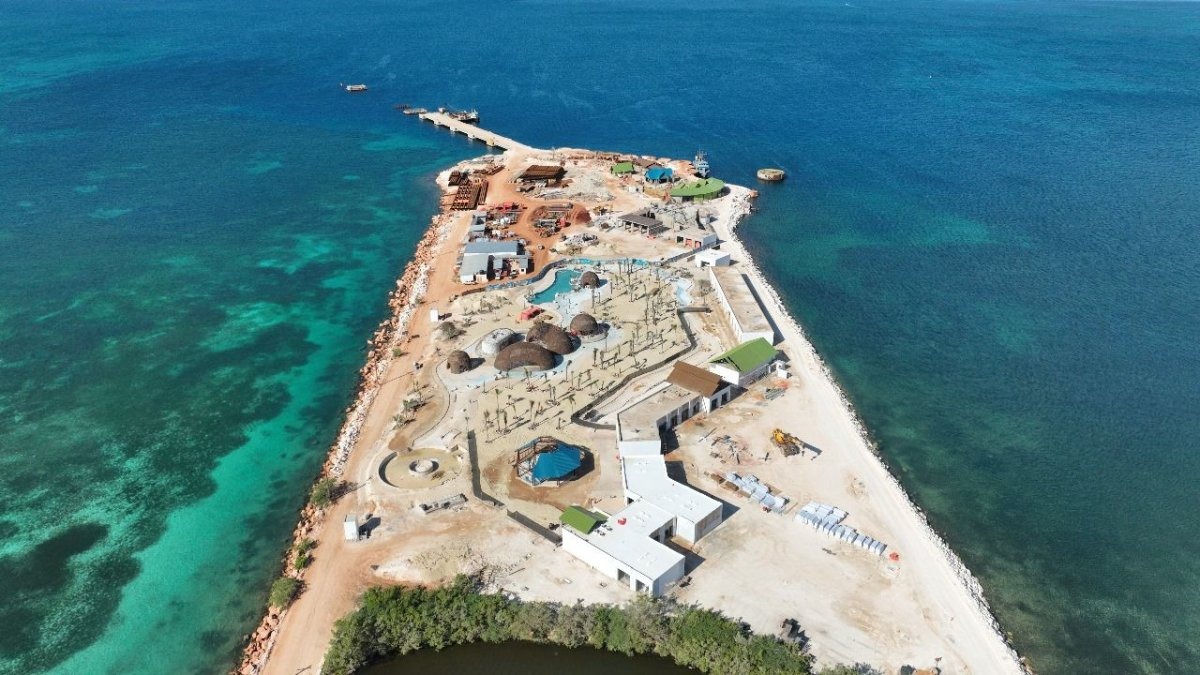
The first phase of Cabo Rojo alone will require more than 8,000 skilled workers, and the municipality of Pedernales has 24,423 inhabitants; these figures reveal a story that does not appear in official announcements
SANTO DOMINGO – When discussing tourism development in Cabo Rojo, Pedernales, the figures usually focus on investments, hotel rooms, the airport, or the cruise port. However, behind every planned room, every restaurant, and every commercial establishment lies a less obvious question: who will operate it all?
President Luis Abinader announced at Fitur 2022 in Madrid, during the presentation of the Master Plan, that the project contemplates an investment of US$2.245 billion, distributed in four phases over ten years, and that it will generate nearly 20,000 direct jobs and more than 50,000 indirect jobs.
These figures, published by the Office of the President, are the most ambitious of the project. But they are not the only ones: in February 2023, during the accountability report for the 179th anniversary of Independence, the president spoke of 2,200 direct jobs and 6,600 indirect jobs associated with the first phase.
And in July 2025, the Minister of Public Administration and Executive Director of the Pro-Pedernales Trust, Sigmund Freund, declared on the program El Día that by the end of the government's term, the project would have generated 15,000 direct and indirect jobs.
Three moments, three different figures. The discrepancies between the various projections have not been publicly explained by the Pro-Pedernales Trust.
The study of tourist carrying capacity commissioned by the Pro-Pedernales Trust and carried out by the firm Russa García y Asociados, published in July 2022, offers the most technical estimate available: the first phase of the project alone, with the 4,700 hotel rooms projected, will require 8,325 direct jobs and will generate about 24,975 indirect ones.
In other words, to operate just the initial stage of Cabo Rojo, more specialized workers will be needed than the municipality of Pedernales currently has inhabitants.
And here the dimension of the demographic challenge appears: according to the results of the X National Population and Housing Census 2022, published by the National Statistics Office (ONE), the province of Pedernales had 34,375 inhabitants at the time of the survey.
Of these, 21,382 were between 15 and 64 years old, that is, of potentially working age. The municipality of Pedernales, the provincial capital, had 24,423 inhabitants, and the province as a whole represents less than 0.4% of the national population, so its labor market, education system, and urban fabric were designed for a different reality.
This does not mean that the local population is insufficient to participate in development, but rather that a modern tourism economy requires far more personnel than any municipality of that size can provide on its own.
Each hotel room needs reception, cleaning, food and beverage, maintenance, security and administration workers, and you have to add the jobs in restaurants, transportation, excursions, shops, health centers, financial services, construction, logistics, environmental management and public services.
The discussion about the future of Pedernales is not only about tourism, it is also a discussion about population.
The mirror of La Altagracia
The experience of other Dominican tourist destinations offers concrete clues about what could happen. The case of La Altagracia, the province that includes Punta Cana and Bávaro, is the most documented.
According to census data from the ONE, La Altagracia went from 273,210 inhabitants in 2010 to 446,060 in 2022, a growth of 63% in just twelve years, and the municipality of Verón-Punta Cana, specifically, grew at an annual rate of 8.17%, reaching 138,919 inhabitants in 2022.
Press reports and authorities have attributed this growth to internal migration: people from different provinces of the country moved to La Altagracia attracted by job opportunities.
The tourism sector registered 74,604 formal jobs in July 2022, according to data cited by specialized media, and informal jobs are estimated at a similar number.
An influx of workers transformed the real estate market, boosted dozens of low-cost residential projects to meet housing demand, and changed the urban structure of the entire area.
Pedernales could face a similar process, albeit on a different scale and in a different geographical context. The province borders Haiti, is surrounded by protected areas, and its only access road has historically been limited.
If there is a significant influx of workers from other provinces, territorial questions will be unavoidable: Where will they live? Will they move with their families? Will the demand for rentals increase?
The Municipal Tourism Territorial Planning Plan presented by the Government includes social housing among its 14 points, but to date there is no public information on how many units are planned or in what timeframe.
Forming takes longer than building
The government initiated job training programs in parallel with the initial construction work. In December 2021, the same month President Abinader broke ground on the project, the then-Director General of INFOTEP, Rafael Santos Badía, announced that the institution would establish a hospitality and tourism school in Pedernales, eliminating the need for technicians to travel for training.
Between 2021 and 2022, INFOTEP trained 5,692 participants in the province across 28 areas, including culinary arts, bartending, hotel reception, tour guiding, masonry, and plumbing.
In June 2025, the Catholic Technological University of Barahona (UCATEBA) and the Genera ITM Foundation added a strategic collaboration agreement focused on technical training in hotel management, port operations, logistics, languages and specialized certifications.
Between January 2023 and August 2024, INFOTEP trained 4,952 participants in Pedernales in all combined areas, and in September 2025, the specialized diploma in cruise tourism launched by INFOTEP and the Genera ITM Foundation started with a first generation of 75 people.
Within that universe, the joint programs of INFOTEP and the Genera ITM Foundation had impacted a total of 1,328 participants since 2023. To date, the public documents of the Pro-Pedernales Trust do not detail a comprehensive job training plan with goals, deadlines and number of beneficiaries that allows comparing those figures with the projected demand.
The comparison with employment projections illustrates the scale of the challenge. The study by Russa García y Asociados, commissioned by the Trust itself, estimates that the first phase of the project alone will require 8,325 direct jobs. In contrast, the available training figures, accumulated over four years of INFOTEP's work in the province, do not even cover half of that demand, and not all participants were trained in areas directly related to tourism.
There is also a question of scope: the director of the Genera ITM Foundation stated that the certified participants have the capacity to enter the labor market anywhere in the country.
If that's the case, there's no guarantee that educated Pedernales residents will stay in Pedernales and not migrate to more established tourist destinations like Punta Cana or Puerto Plata, where job opportunities already exist and are readily available.
The Pro-Pedernales Trust has not publicly explained what mechanisms exist to retain that human capital in the province once it has been trained.
Official announcements have focused on investments, hotel rooms, and physical infrastructure. However, the carrying capacity study, commissioned by the Trust itself, establishes that tens of thousands of people will be needed to operate Cabo Rojo at its projected scale.
Roads can take years to build. Airports can open. Hotels can be erected, but the big question in Cabo Rojo is another: where will the tens of thousands of people needed for the new economy being built in Pedernales come from? And if there is a significant influx of migrants to the province, will the municipality be prepared to receive them, not only in terms of employment, but also in terms of urban and social development?
Recommended readings: