



SANTO DOMINGO– Holy Week is the time when devotees of the Catholic faith flock to churches to commemorate the passion, death, and resurrection of Jesus. Here are seven of the main parishes in the Dominican Republic that you can visit during this holiday.
Cathedral of Santo Domingo
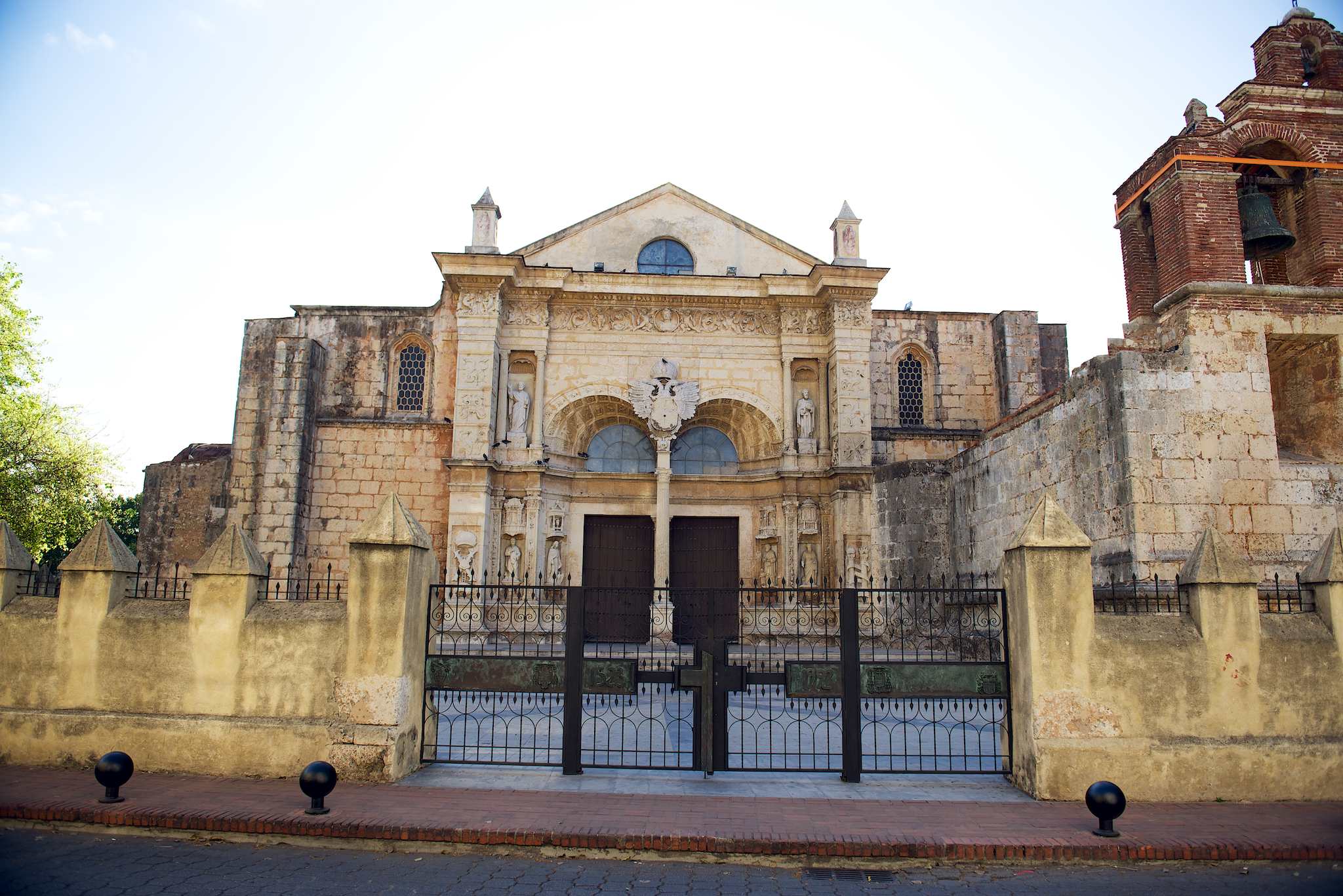
The Cathedral of the Americas was created by Pope Julius II, through his bull ROMANUS PONTIFEX, on August 8, 1511 and erected on May 12, 1512. The temple was blessed with a mass on August 31, 1541.
It measures 54.55 meters in length and 23 meters in width. It is constructed of limestone, with some walls made of masonry and brick. Among the most beautiful and prominent features of the Cathedral are its three portals: one Plateresque and two Gothic; one opening onto the Plaza de los Curas, and the other onto the Plaza Mayor, which today is called Parque Colón.
Inside, there are three naves covered by ribbed vaults from the late Gothic period, supported by cylindrical columns, the central nave being the widest and tallest. At the end of each nave is an altarpiece or altar. All are polychrome oil paintings on wood, decorated with gold leaf, in the Baroque style, and all date from the 17th and 18th centuries.
The Cathedral of Santo Domingo currently has fourteen side chapels, one main chapel, and two altars located at the ends of the side aisles. Masses are celebrated Monday through Saturday at 5:00 PM and on Sundays at noon and 5:00 PM.
Church Sanctuary of Our Lady of Mercy

Located northeast of La Vega, on Santo Cerro, is one of the most sacred places in the country, home to the Sanctuary Church of Our Lady of Mercy. Legend has it that during a battle with the Taíno people, Christopher Columbus placed a cross atop a hill next to the church, and when the Taíno tried to attack it, Our Lady of Mercy, patron saint of the Dominican Republic, appeared to them and drove them away. Now, an annual pilgrimage takes place on September 24th at Santo Cerro, when Dominicans from all over the country flock to pay homage to the nation's patron saint. Head to the open-air terrace at the back of the church and climb the steps to the symbolic 14-meter-tall Santo Cerro Cross, which rises above the Cibao Valley and offers spectacular panoramic views of the surrounding mountains.
Cathedral of La Vega or Cathedral of the Immaculate Conception
La Vega is considered the cradle of evangelization in the country, as it was here that the first person on the continent, Chief Guaticagua, was baptized in 1496. The cathedral was designed by Pedro Mena Lajara and inaugurated in 1992. Located in the center of La Vega, it took 15 years to build, beginning in 1977 and concluding in 1992. Its symbolism includes the gray color of the walls, representing humanity's limited capacity to reflect divine light; the semi-elliptical and asymmetrical columns, with one convex side facing outward and the other inward, symbolizing the state of humanity when it sins and when it repents; and the drapery, simulating clouds in the sky with lights that resemble stars. The number 12 is symbolically represented in the doors, stained-glass windows, and other windows, as there are twelve of each, just as there were twelve tribes of Israel, twelve gates of Solomon's Temple, twelve gates of the heavenly city of Jerusalem, and twelve apostles. Another interesting fact is that this impressive cathedral features a 15-foot-tall Risen Christ, instead of a crucified Christ like most churches
Basilica of Our Lady of Altagracia and Parish of Saint Dionysius

This impressive structure was designed by architects André-Jacques Dunoyer de Segonzac and Pierre Dupré in 1947. Within the same grounds, visitors will find the Parish of San Dionisio, one of the oldest surviving churches in the Americas. It was the first shrine dedicated to Our Lady of Altagracia. According to tradition, the image of the Virgin appeared on an orange tree where the church now stands. Also adjacent to the basilica is the Altagracian Museum, which houses artifacts over 300 years old.
Cathedral of Santiago de los Caballeros
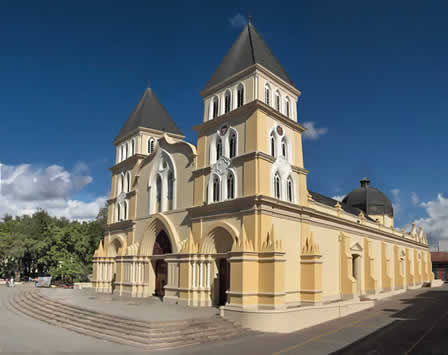
The Cathedral of St. James the Apostle is located in the city of Santiago de los Caballeros. It was built between 1868 and 1894 by Onofre de Lora and consecrated in 1895.
It houses the remains of President Ulises Heureaux, and Generals José María Imbert, Fernando Valerio, Pedro Antonio Pimentel, and Lucas Evangelista de Peña. It also contains one of only two copies in the world of Michelangelo's Pietà, as well as a painting by the Italian artist Hugo Nardo entitled "Four Apostles.".
This cathedral consists of three naves, one of which is crowned by a dome in the apse. Another of its features are the three doors on its façade, carved with allegorical motifs from the lives of Jesus and Saint James the Apostle, sculptures by Gaspar Mario Cruz. In the atrium, there are representations of Jesus, the twelve Apostles, and the Four Theological Virtues, by Bismark Victoria.
St. Stanislaus Church

This place of devotion is located in Altos de Chavón, La Romana, and is an architectural marvel. It was consecrated in 1979 and is the work of Robert Copa. To commemorate the occasion, Pope John Paul II sent the ashes of the patron saint of Poland.
Visitors to the area are encouraged to attend the 5:00 PM mass on Saturdays and Sundays, which is always an interesting experience. The Church of St. Stanislaus is open to the public daily.
Chapel of the Miraculous

Located in the community of Damajagua, in Los Montones, San José de las Matas, the La Milagrosa Chapel is one of those tourist attractions that gives you goosebumps upon discovering it. The heartwood pine trunks used for its construction, combined with imagination, achieve a true connection with nature and with God.
Inside the church are allegorical images of various saints. Its floor is extremely rustic, with touches of tree trunks, and for the faithful to sit, they placed palm-thatched chairs, very characteristic of the area since there are many artisans in the region.
Its main altar is a marvel of imagination. The wood contrasts harmoniously with the blue stained-glass windows and the central cross formed by other stained-glass windows in red and white.
The work was commissioned for the community of Los Montones by businessman Manuel Arsenio Ureña and his wife Camelia Rodríguez, who donated it to the Catholic Church as part of their social commitment.
It was inaugurated on December 14, 2003. It has a capacity for 100 people comfortably seated.
Sources: catedralprimadadeamerica.org, República Dominicana lo tiene todo, visitaRepúblicaDominicana.org, porconocer, Dgcine







