


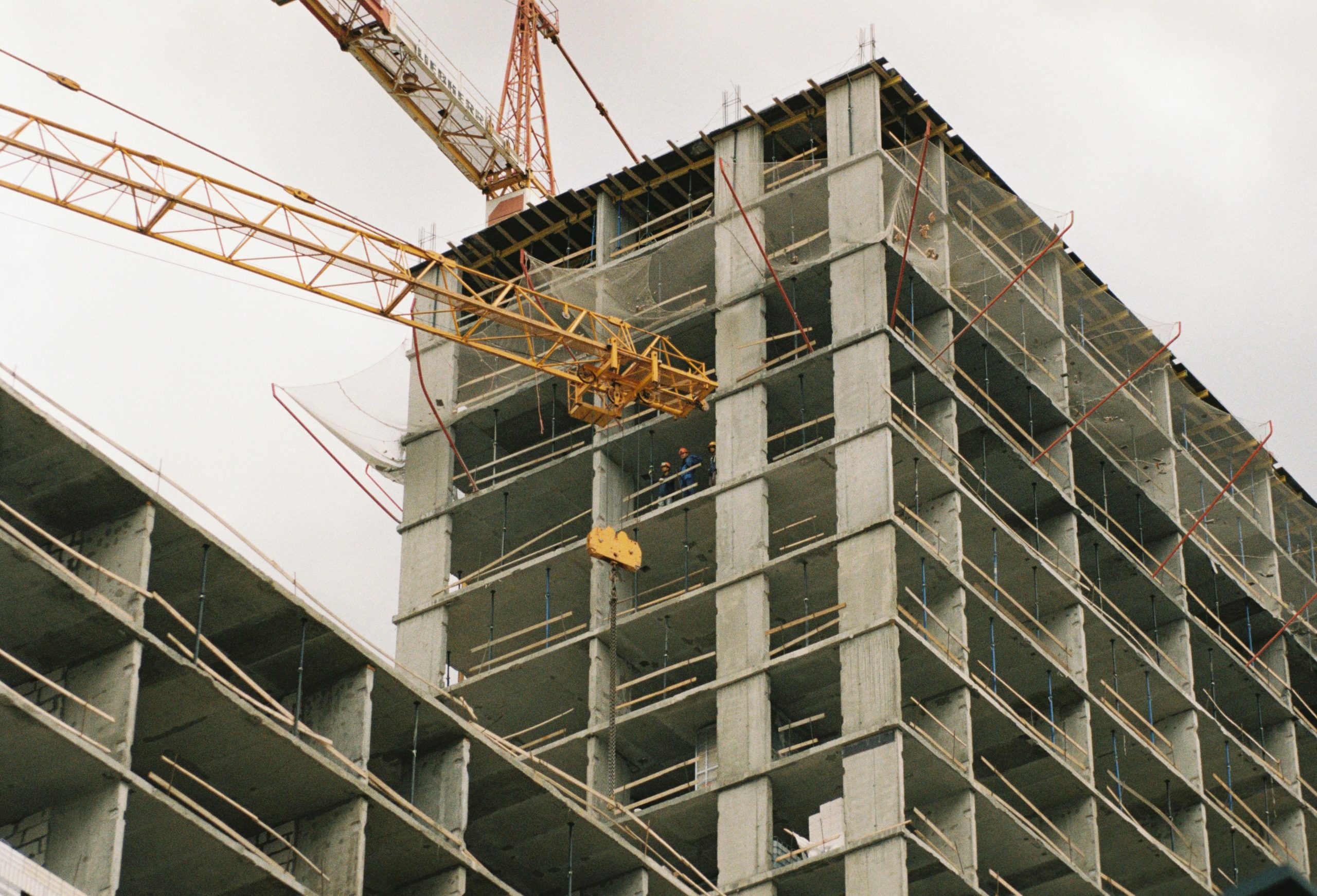
The local market is sustained by strong domestic production of cement and steel, but with low diversification in the use of materials
SANTO DOMINGO. – Construction in the Metropolitan Region is built almost entirely on a familiar formula: gray cement and rebar. Data from the ROE 2025-2 of the National Statistics Office confirms that more than 94% of construction projects use these basic materials, mostly of national production.
In parallel, the country produces around 6.5 million tons of cement and nearly one million tons of steel annually, according to figures from the Dominican Association of Portland Cement Producers and reports from the industrial sector collected by local economic media, which demonstrates a robust industry.
However, the low diversification in the use of materials raises a key question: is this about efficiency, or technical stagnation?
A recipe that is repeated
The pattern is clear. Of the 5,792 active projects registered in the ROE 2025-2, 94.6% use general-purpose gray cement, while 94.9% employ corrugated bars (rebar) as the main structural component.
The use of more specialized materials, such as structural cements or metal profiles, is marginal. In the case of steel, only 1.4% of projects incorporate profiles such as beams or columns, reflecting a low penetration of more advanced construction systems.
This behavior confirms that the predominant model remains that of traditional reinforced concrete, a proven, accessible and widely dominated solution in the sector.
The weight of local industry
If anything defines the sector, it is its strong dependence on domestic production. 89.9% of the cement used in construction comes from local manufacturers, while in the case of steel, 82.7% is also of national origin, according to the ROE 2025-2. Imports, in both cases, are practically nonexistent.
This data is not relevant, because it indicates that the Dominican Republic has a consolidated cement industry, with a production of around 7 million tons per year, according to the Dominican Association of Portland Cement Producers, enough to supply domestic demand and even generate surpluses for export.
Meanwhile, steel production, mainly rebar, is approaching one million tons per year, according to reports from the Dominican industrial sector, covering a significant part of the local market.
In structural terms, the country has achieved internal productive capacity to sustain its real estate growth, which is key for an industry whose development is continuous.
Operational efficiency… or technical limit?
Standardization has clear advantages. It reduces costs, simplifies construction processes, and allows for faster execution—variables that are crucial in a dynamic market.
However, it also raises questions. The limited diversity of materials may be hindering the sector's evolution towards more efficient, sustainable, or adaptable solutions for new architectural demands.
The almost exclusive use of rebar and gray cement suggests a model that prioritizes the known over innovation. In other words, the system works, but it doesn't necessarily evolve.
The data that is not seen
There is another element that deserves attention and, as with other indicators such as financing, it is vital: the lack of information.
Up to 9.9% of the projects do not specify the origin of the cement, and 17.1% do not detail the origin of the steel, according to tables A.26 and A.28 of the ROE 2025-2 report from the National Statistics Office. A smaller percentage also fail to identify the type of material used.
Although these values do not alter the overall trend, they do highlight gaps in the quality of data collection or in the traceability of materials, an increasingly relevant aspect in a context where transparency and sustainability are gaining importance in the industry.
Building forward
The Dominican construction industry is in a strong position: it has local industry, installed capacity, and an efficient operating model. The challenge, however, is significant.
The next step doesn't seem to be producing more, but building better. Diversifying materials, incorporating new technologies, and expanding the available structural solutions could make all the difference in the sector's competitiveness in the coming years.
Because, in the end, it's not just about how much is built, but how it is built.
Recommended readings:







