


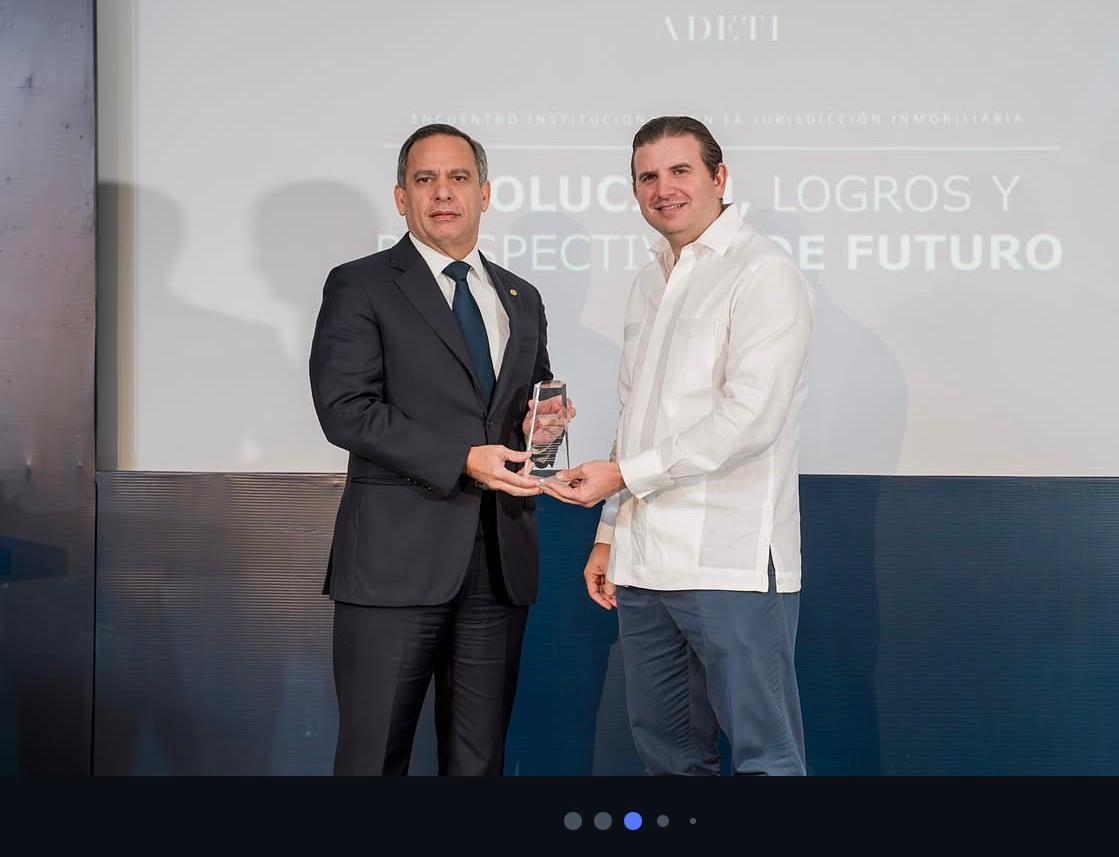
Protecting property rights through its registration is part of the State's responsibility for development, because by offering reliable information, it facilitates transactions, supports access to credit, and reduces the causes of conflict, Henry Molina stated
SANTO DOMINGO.- The Dominican Real Estate Registry is evolving at the pace of the growth registered in the country in the real estate sector, experiencing an increase of over 82% in applications received, going from 313,377 procedures in 2019 to 564,885 in 2025, in which period 572,270 applications were processed.
The entity specifies that the operational performance is complemented by the expansion of national coverage, which allowed it to achieve the digitization of 100% of the service offices during 2026
He explains that behind these results lies the implementation of a set of technological and regulatory milestones that have redefined the relationship of citizens with the real estate system, among them the consolidation of the Virtual Office (OFV), the RI mobile application, remote payments and deposits, the automated management of face-to-face and virtual appointments; as well as key legal security tools such as Registry Alerts and the Geodetic Network.
The RI highlights having promoted fundamental technical and regulatory improvements, such as Resolution No. 008-2020, approval of the new General Regulations of the Real Estate Registry, the massive vectorization project of historical parcels and the articulation of strategic agreements with the Ministry of the Presidency to strengthen the National Titling Plan.
Molina highlights property protection
Henry Molina, presiding judge of the Supreme Court of Justice (SCJ), who also chairs the Board of Directors of the RI, stated that protecting property from its registry base is part of the State's responsibility for development, because by offering reliable information, it facilitates transactions, supports access to credit and reduces the causes of conflict.
“This protection is complemented by courts capable of resolving disputes independently and within a reasonable timeframe. The land registry and the real estate justice system have distinct functions and a shared responsibility: to provide certainty to people regarding their rights. Trust grows when both fulfill their responsibilities,” the professional emphasized upon receiving an award from the Dominican Association of Tourism and Real Estate Companies (ADETI)for his contributions to the advancements, digital transformation, and results achieved in the Real Estate Jurisdiction and the Land Registry.
Evolution of the real estate system
Ricardo Noboa, general administrator of the Real Estate Registry, presented the “Evolution of the Real Estate System: Registry of the Future 2034”, and highlighted that the recognition validates the sustained process of institutional transformation implemented in the RI in the period 2019-2026, which is in line with the strategic guidelines of the Judiciary and the mission of strengthening legal security.
"Today we consolidate these advances and project what comes next towards the Real Estate Registry of the Future, as part of an institutional vision that seeks to continue transforming our services, strengthening our capabilities and offering an increasingly agile, accessible and reliable experience for users; our purpose is clear: to continue guaranteeing legal security for a country that is moving forward," he stated.
ADETI highlights pillars to strengthen investor confidence
The president of ADETI, Andrés Marranzini Grullón, emphasized that legal certainty and the protection of property rights are essential pillars for strengthening investor confidence and sustaining the country's long-term growth.
He pointed out that having secure titles, clear rules, and efficient processes protects investments and assets and generates opportunities for development and social mobility, by allowing families to build wealth, access credit, and find new possibilities to start businesses and invest.
The businessman praised the progress made by the Real Estate Jurisdiction in terms of digitization, customer service, and process efficiency, while also highlighting the importance of continuing to evolve towards a system that is increasingly agile, transparent, predictable, and closer to the citizen and the investor.
In that regard, he stated that the growth of real estate tourism, as an increasingly relevant component of the Dominican Republic's tourism offering and the country's capacity to attract capital, demands an institutional framework that supports its expansion and responds to new challenges, with an orderly and long-term vision.
Michael Lugo, executive vice president of ADETI, highlighted that the collaboration with the Real Estate Jurisdiction has driven progress in modernization, digitization, and streamlining of procedures. He noted that this joint effort between the public and private sectors has strengthened legal certainty and confidence in the real estate market, fostering investment and the consolidation of real estate tourism.
Recommended readings:






