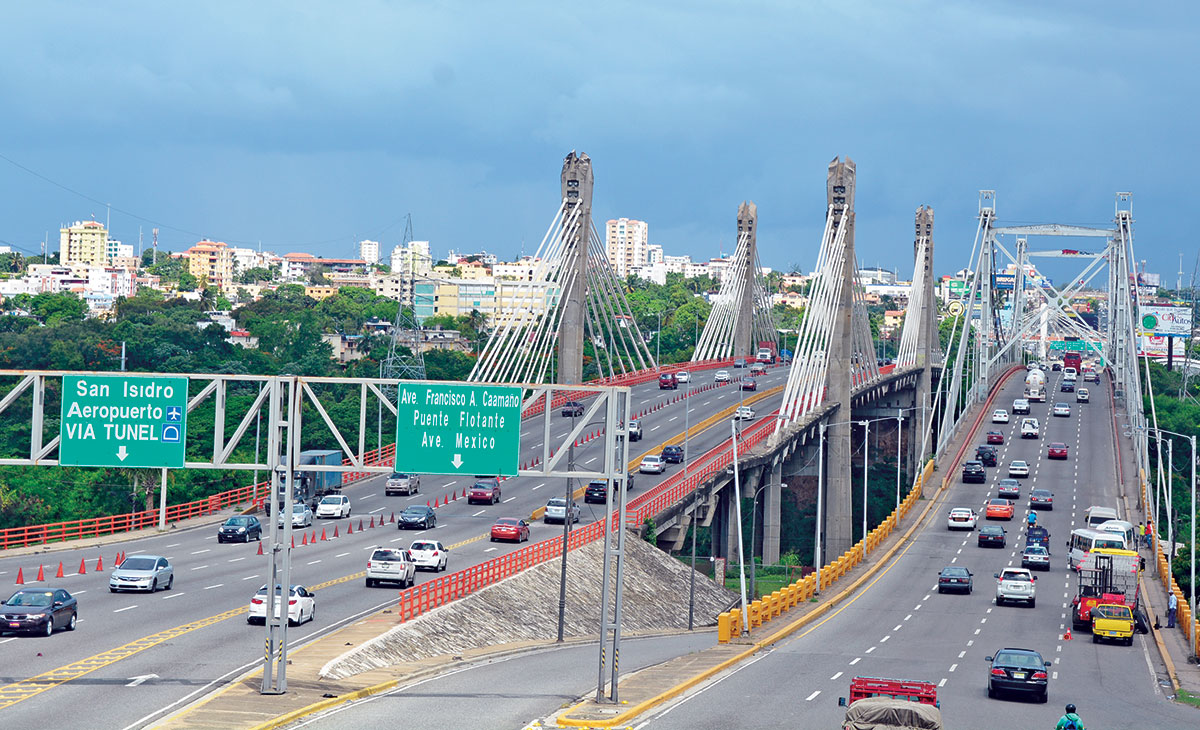
The president of the Commission for the Supervision of Public Infrastructure in the Face of Climate Change explains the technical reasons that guarantee the stability of the structure.
SANTO DOMINGO.– Geological engineer Osiris de León, president of the Commission for the Supervision of Public Infrastructure in the Face of Climate Change, stated yesterday that the Duarte Bridge does not present a risk of collapse, despite the visible damage it exhibits on the approaches.
The specialist explained that the problems detected are peripheral and do not compromise the structural stability of the work, after specifying that the damage observed corresponds to erosion and detachments in the approaches, but does not affect the structural elements of the bridge.
“The bridge is not going to collapse because of that problem, but it does require intervention and correction as soon as possible,” the professional explained when consulted by El Inmobiliario.
The geologist pointed out that the Duarte Bridge was built with deep foundations, designed to withstand loads greater than those currently present, even under adverse weather conditions. On this point, he stated, "That bridge has deep foundations and a cable system that supports the deck from well-supported piers.".
He added that the approaches can deteriorate due to heavy rains, undermining, or erosion, but this does not compromise the integrity of the bridge. “When there are problems with the approaches, what is affected is road connectivity, but not the structure itself.”.
He also said that "a hole may form that limits traffic or affects a tire, but it does not imply that the bridge is going to collapse.".
To illustrate the situation, De León used an analogy: “It’s like when you or I have the flu. It doesn’t mean we’re going to die, but we can’t let our guard down either.”.
Technical reasons
De León detailed the technical reasons that support his claim that the Duarte bridge is not at risk of collapse.
First, he explained that the structure has deep foundations, designed to guarantee stability even under adverse conditions:
-Structural cabling that supports the board
– Designed to withstand extreme weather events
-Localized damage to the approaches
-Operational risk, not structural risk