


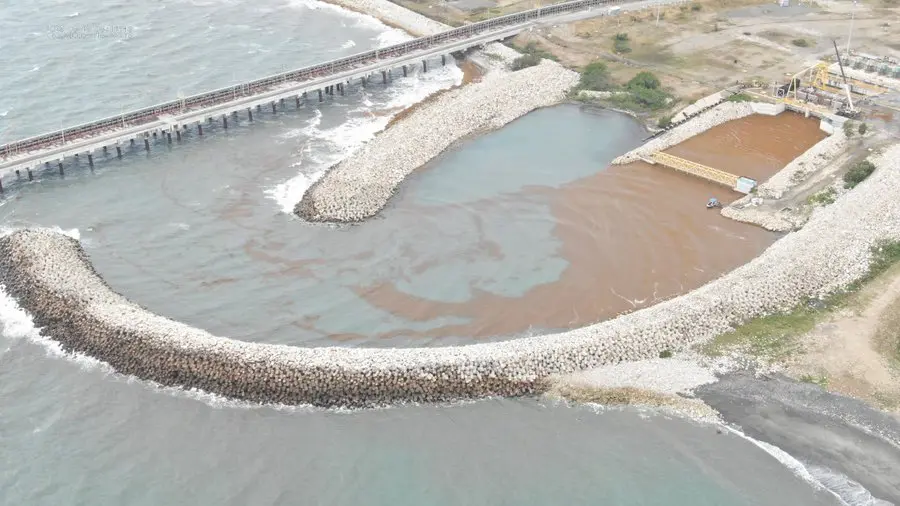
SANTO DOMINGO.- Celso Marranzini, president of the Unified Council of Electricity Distribution Companies (CUED), warned yesterday, Monday, that the massive arrival of sargassum has become a direct threat to electricity generation, affecting the operation of plants such as Punta Catalina 1.
Yesterday, Monday, August 18, the Punta Catalina Electric Generation Company (EGEPC) reported that Unit No. 1 of the Punta Catalina power plant had been offline since 6:25 a.m. due to a low water level in the intake. The sudden influx of seaweed occurred as a result of the severe weather caused by Hurricane Erin, obstructing the circulation system and forcing the unit to be taken offline as a precautionary measure, the company stated. Marranzini explained that after two years without receiving large volumes of seaweed due to Hurricane Erin, sargassum has once again accumulated on the coast , clogging the plant's cooling systems and forcing its temporary shutdown. "Punta Catalina 1 is perfectly fine; what we've had is a huge problem with the sargassum. With the low cooling level, we had to take the plant offline, but it should be back online by peak hours," he said. The executive indicated that specialized equipment for removing sargassum , such as clamshell cranes, is scarce in the country . They currently have one, but at least two are needed to guarantee an effective response. In this effort, he highlighted the support of the Dominican Navy, under the command of Rear Admiral Morillo. Marranzini noted that the country's energy demand reached a record high of 4,000 megawatts last week , compared to 2,800 megawatts in 2020, when the current administration took office. In this regard, he assured that the electrical system is preparing to meet this growth, with the addition of 600 megawatts in the coming months, including the first phase of Manzanillo (420 MW), a 120-megawatt plant by Energas, and an additional 60 megawatts from SIBA, which will be brought online gradually over the next month and a half. The addition of 400 megawatts of thermoelectric capacity and nearly 800 megawatts of renewable energy during the current administration. Marranzini emphasized that these additions represent “a record amount” and will contribute to greater stability in the system, although he insisted on the need to structurally address the threat of sargassum seaweed to coastal plants.







