


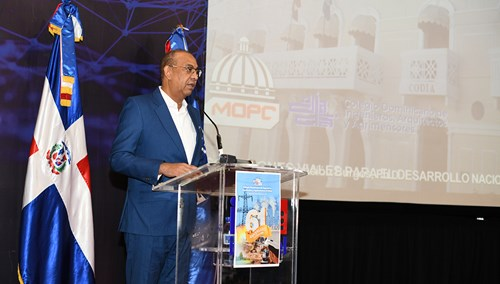
SANTO DOMINGO– The Minister of Public Works and Communications, Deligne Ascención, highlighted the significant investments made by President Luis Abinader's government in road infrastructure during his administration, and announced future projects that the Ministry will undertake in the coming months.
Speaking as a guest speaker at the 61st anniversary celebration of the Dominican College of Engineers, Architects and Surveyors (CODIA), Ascención highlighted that this large investment reflects Abinader's great vision, which has become what the country's development in terms of roads should be.
He added that because of this, the government created what he called the Construction Cabinet, in which the various institutions involved in the growth of infrastructure in the Dominican Republic converge in its different aspects.
“We have a President with a constructive vision and a thorough understanding of the importance of infrastructure for development. That is precisely President Luis Abinader, with that vision for his government, through which he has been developing and implementing a series of actions aimed at sustaining and maintaining the growth of the Dominican Republic and directly impacting the lives of Dominicans,” he said.
He referred to the importance of this investment in road infrastructure for the country's economic and social development.
“I also want to emphasize the importance of this investment in regional development and the support it provides for business growth, employment, and improved service quality in the region. These factors obviously translate into human progress and a positive transformation of people's quality of life,” he stated.
He said that this investment plan aligns with the National Development Strategy 2030, so that it corresponds with the design, approval and application of a Territorial Planning Plan that allows for the management of regional public policies, regulates land use and encourages the sustainable use of resources.
“In the same context, the MOPC's investments are organized in accordance with the actions promoted by the international community, which are geared towards achieving the Sustainable Development Goals, focused on social inclusion, environmental sustainability, job creation and decent work, and respect for the fundamental rights of people,” he stated.
He maintained that the execution of the investment budget is carried out by seeking the decentralization of the works and the planning of road projects based on the development plans that President Abinader has been promoting directly since August 2020.
“Our plans are aimed at ensuring that the construction and reconstruction of streets, avenues, rural roads, highways and related works, as well as road maintenance, constitute vital elements for the stimulation of development hubs, based on private projects and public investments that generate jobs, foreign exchange, entrepreneurial opportunities and sustainable economic growth,” he explained.
He said that numerous studies by the Economic Commission for Latin America and the Caribbean (ECLAC), the World Bank and the Inter-American Development Bank show that road transport is the fundamental basis of regional growth, and that the growth of the Gross Domestic Product is directly associated with the growth of land communication routes.
“It has been calculated that for every percentage point of GDP growth, the need for road and highway development is two to three times greater, due to the strong demand for transporting people and goods that economic growth creates. This relationship, in turn, is bidirectional, because investment in road infrastructure also has a direct impact on a nation's production development,” he noted.
He considered that highways and rural roads, avenues and streets, in good condition, plus the construction of sidewalks and curbs in neighborhoods and small communities, together with water, electricity and sanitation, not only make industrial production or the provision of basic services for citizens possible, but are an engine for development, since they increase productivity and reduce costs.
“In that order, our investments are made, aware that road infrastructure is essential for the socioeconomic development of any country. For that primary reason, we have launched a series of road development projects linked to national development in some cases and to regional development in others,” he stated.
He stated that the Southwest Tourist Hub and the Pedernales Master Plan are projects that translate into the development of the entire Enriquillo region, made up of the provinces of Barahona, Bahoruco, Pedernales and Independencia, which is one of the regions most in need of joining the economic growth that the country has maintained for decades.
He stated that improvements have been made to the rehabilitation and safety enhancements of the 6 de Noviembre highway and that progress is being made on the restoration and expansion work of the Barahona-Enriquillo highway, the first stage of which was recently inaugurated, and the road that connects Cabo Rojo with the Pedernales crossing was made available to allow land transport for the first cruise passengers who arrived at the new tourist port.
He stated that the shortcomings in human development in the Southwest region must be addressed with massive investment plans in public-private partnerships, and with substantial investments in road, port and airport infrastructure by the government, to connect it by land, sea and air with the main urban centers of the Capital and the Cibao.
“In support of that objective, we are investing in the Baní and Azua bypasses, the latter of which has already been completed and inaugurated by President Abinader. In the case of Baní, having completed the first stage, we have tendered and awarded a second stage to be finished during 2024,” he said.
Those attending the event included the Minister of the Presidency, Joel Santos, Onéximo González, advisor to the Minister of Public Works, and the Vice Ministers Roberto Herrera, Ángel Tejeda and Luis Bastardo.
Representing CODIA were its president, Juan Villar González; Mendoza Díaz, general secretary; Alejandro García, treasurer; Surelis Calderón Boyer, secretary of minutes; Irene López San Pablo, secretary of education and events; Enrique Rosario García, secretary of public relations, among others.







