


The United States remained the main source market, with 44% of arrivals, followed by Canada (9%), Colombia (8%), Argentina (5%), Spain and the United Kingdom (4% each) and Puerto Rico and Mexico (3% each)
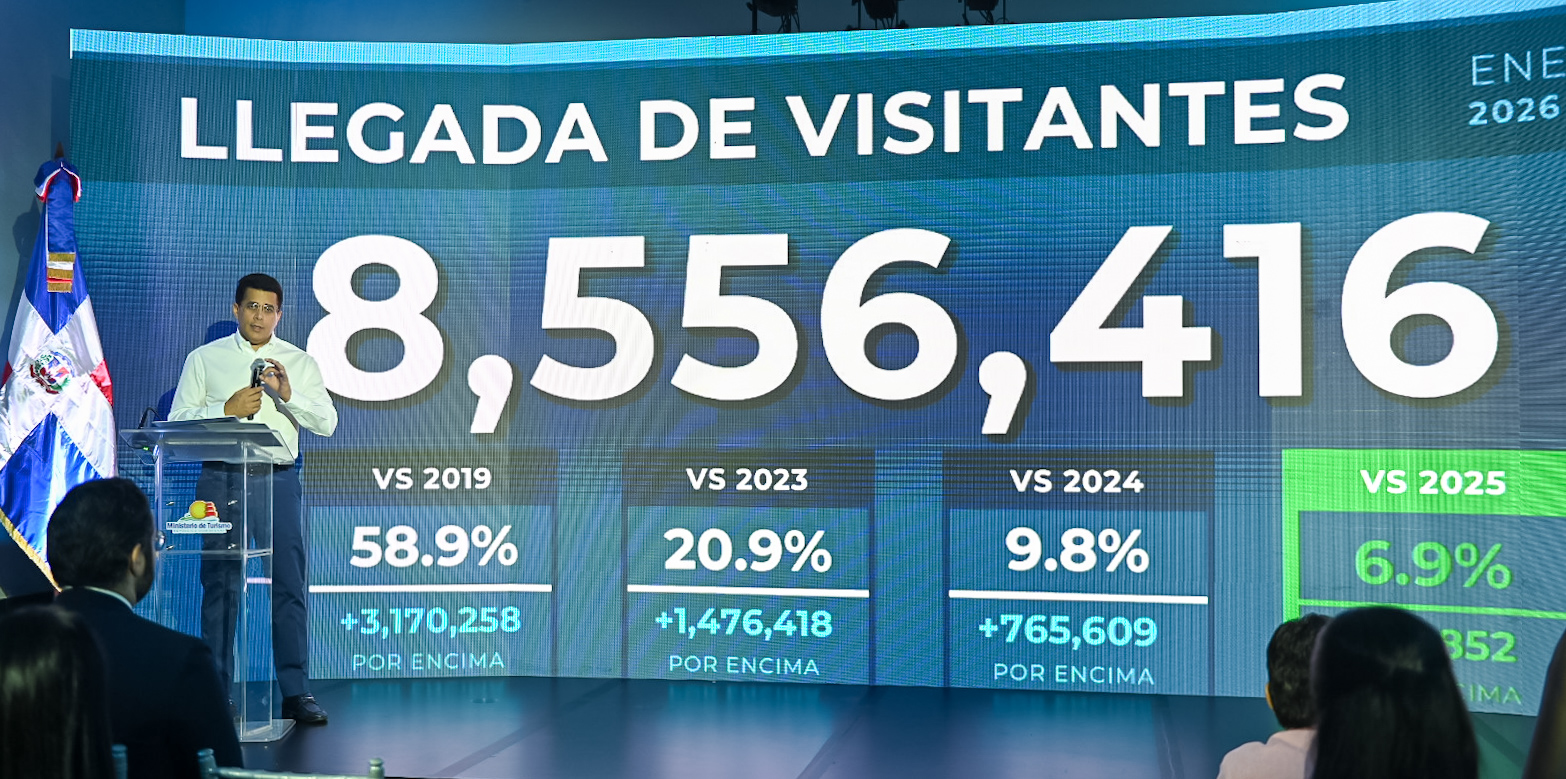
SANTO DOMINGO. – In the first eight months of 2026, the Dominican Republic surpassed 8.5 million visitors, a figure that Tourism Minister David Collado presented this Sunday as the latest step in a streak that has been rising for several years.
Between January and August, 8,556,415 visitors arrived in the country: 6,610,258 by air and 1,946,151 on cruise ships. Compared to the same period last year, the country received 6.9% more visitors; compared to 2014, the increase is 9.8%, and compared to 2019, the figure has almost doubled, with a growth of 58.9%.
"Another record in the history of Dominican tourism," Collado summarized before representatives of the sector, gathered in a hotel in the capital for the usual monthly presentation of statistics, where it was also said that in August alone 856,858 visitors entered: 725,560 airplane tourists and 131,298 cruise ship passengers, the latter with a jump of 31.9% compared to the same period last year.
Punta Cana airport accounted for almost half of the flights received in the month (49%), ahead of Las Américas (29%) and Cibao (14%).
Hotel occupancy in August closed at 68% and visitor satisfaction at 4.3 out of 5 points, with 90% intending to return and 60% willing to recommend the country as a destination.
A historic 2025
The Dominican Republic closed 2025 with 11.7 million visitors for the entire year, the best record in its history, and Collado has insisted that 2026 should end above 12 million, a leap that would consolidate the country as the tourist leader of the Caribbean.
This deployment is not a product of chance, since the Ministry of Tourism has a budget of RD$10,990.7 million this year, 18% more than the RD$9,314.4 million it operated in 2025, according to official data from the Ministry of Finance.
Almost 47% of the total budget of the tourism portfolio is allocated to the promotion and positioning of the country as a destination.
Of the total amount allocated, RD$5,138 million, almost 47% of the total, are specifically intended for tourism development and promotion, that is, for international promotion and positioning the country as a destination, while another RD$4,103 million are directed to tourism infrastructure and RD$556 million to supervision and regulation of destinations.
The increase in arrivals in 2026 coincides, then, with a ministry that also increased its spending capacity to sustain that promotion.
Challenges and impact on other sectors
That path is not without obstacles: the sector itself recognizes sargassum, rising operating costs, and international economic uncertainty as the main challenges to maintaining the pace for the remainder of the year.
Behind the arrival figures lies an effect that directly impacts the real estate and construction sectors. Tourism doesn't just fill hotel rooms: in 2025, it generated over RD$220 billion in purchases of goods and services from Dominican suppliers, according to data from Asonahores, a flow that extends to construction, manufacturing, technology, and agriculture.
This chain largely explains why every announcement of a new hotel project in Punta Cana, Samaná or Miches ends up translating into a demand for land, materials and labor far beyond the tourist area.
You may also be interested in:






