


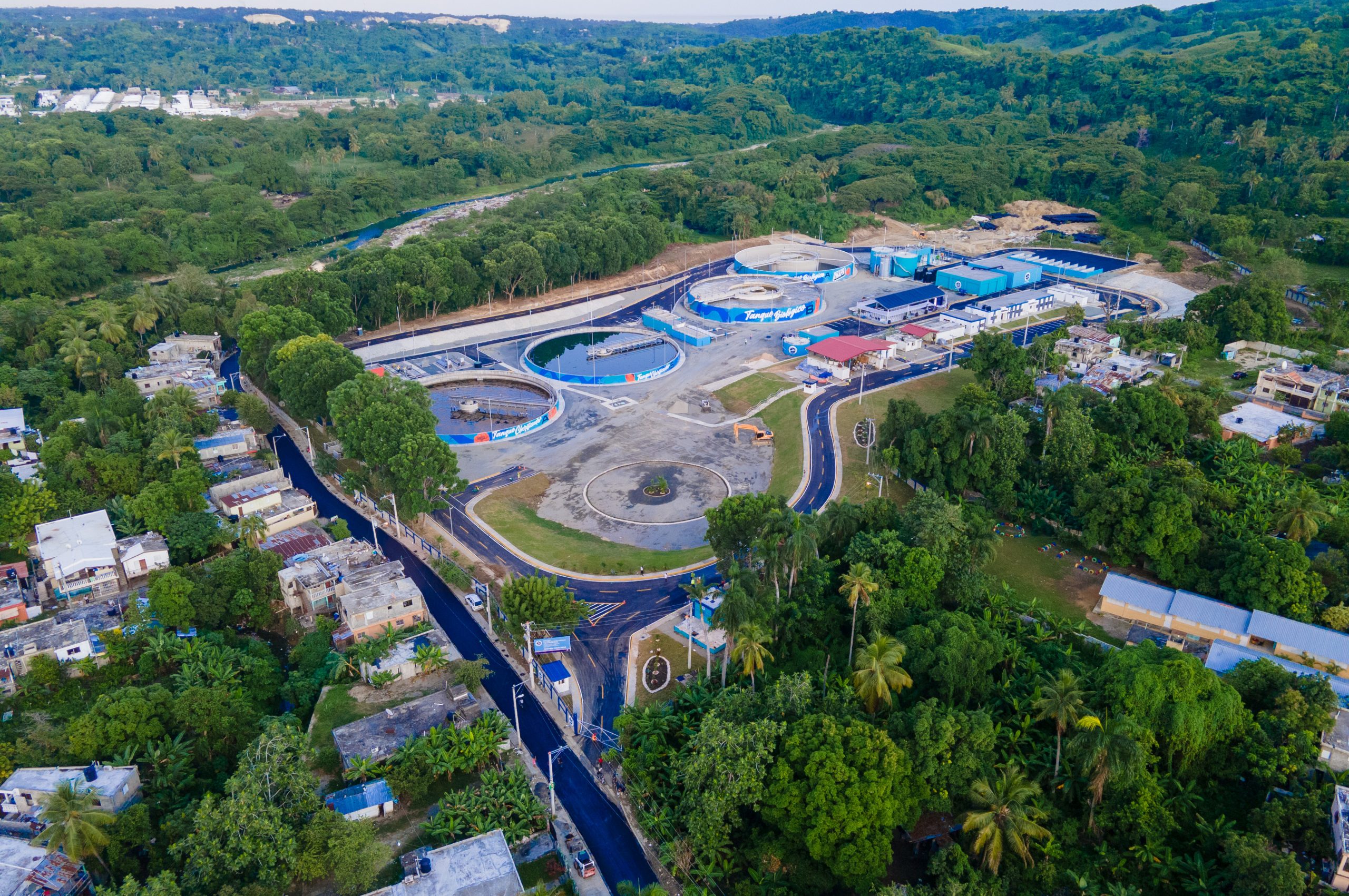
68.6% of Dominican households are not connected to the sewer system. What does this mean for the soil, subsoil, and value of real estate assets, according to the 2022 Census?
SANTO DOMINGO. – When a developer finalizes the purchase of a plot of land in Bávaro, Las Terrenas, or the expansion areas of Greater Santo Domingo, the technical discussion revolves around land use, height restrictions, setbacks, and available services.
Sewerage appears as an item in the list of services: "connected to public network or septic tank, without further analysis.
Fascicle II of the X National Population and Housing Census 2022, published by the National Statistics Office in May 2026, offers the complete picture of that item, and it is not reassuring:
- Nationally, 68.6% of Dominican households that have some type of sanitation service are connected to a septic tank.
- Only 25.2% use the public sewer system.
- 4.1% is discharged into natural drainage.
- The remaining 2.1% use other mechanisms that the census groups together without further specification.
- In urban areas the proportion improves, but not as much as one would expect: 63.3% of households with sanitation services depend on septic tanks, compared to 32.1% that have access to the sewer network.
- In rural areas, dependence on the well is practically absolute: 83.3%.
What the septic tank doesn't solve on a large scale
A well-designed and installed septic tank works. The problem isn't technical, but one of scale: how many septic tanks can fit in a high-density city block before the soil becomes saturated and the groundwater starts receiving what it shouldn't?
The question is relevant in any area of intensive development. In Los Alcarrizos, Pantoja, or Pedro Brand, localities in Greater Santo Domingo with accelerated horizontal growth, the soil does not have the same absorption capacity as an isolated rural plot.
Nor does the Punta Cana-Bávaro corridor, where thousands of residential, hotel and commercial units share a relatively shallow water table and a development projection that has not paused.
The census records 32,751 households in the Verón Punta Cana Municipal District. The province of La Altagracia as a whole has 88,896 households with sanitation services. Without specific data on connections at the municipal district level in the report, the national trend applies strongly: most of these households discharge into septic tanks in a territory that lacks a public sewer system developed to keep pace with its growth.
The 2.8% who have nothing
Before we continue with the wells, here's the hardest piece of data from this ONE report:
- 2.8% of Dominican households, some 104,000 in absolute terms, reported not having any type of sanitary service.
- In urban areas that percentage drops to 1.4%.
- In rural areas it rises to 6.4%.
For the real estate market, this data empirically delimits the most severe habitability deficits in the territory.
The provinces with the highest percentage of households without sanitation services are also those with the highest levels of informal construction and the lowest access to formal mortgage credit.
These are intervention markets for social housing rather than private investment markets, but their configuration affects the demand for labor, logistics costs and the perception of risk in the neighboring provinces.
Sewerage as a value variable
There's an angle the market could exploit more rigorously, and that's the difference in value between an asset connected to a sewer system and one that isn't. In mature markets, that connection is an established valuation factor.
In the Dominican Republic, where 68.6% of households live without one, the standard of comparison is distorted downwards: the septic tank is so normal that nobody appreciates it.
Should you do it? A condominium connected to the public sewer system has lower long-term maintenance costs, a lower risk of sanitary collapse in case of technical failure, and greater alignment with international environmental standards.
In a market where LEED certification is gaining ground and foreign buyers, particularly in tourist areas, bring expectations formed in contexts with complete sanitary infrastructure, connection to the sewer system could become a product differentiator.
But it isn't currently. Perhaps because 75% of the market operates without it and nobody is asking for it.
The natural drainage and the river or stream
The document reveals that 4.1% of households with sanitation services nationwide, and 6.1% in rural areas, discharge into natural drainage: in an additional 44,351 households, garbage, not excrement, but domestic waste, goes directly into a river or stream.
They are different census categories, but their effect on river basins and aquifers is convergent.
For real estate projects in areas with a focus onecotourism, agritourism, or conservation, such as those proliferating in Miches, Pedernales, or the Los Haitises corridor, the water situation of neighboring homes is not a peripheral detail. It is the context in which the project's promise of sustainability operates.
What the sector needs to ask
The ONE report is not an accusation, it's a measurement. But its figures raise questions that the Dominican real estate sector still needs to address:
- Do building permits in areas without sewage systems include soil absorption capacity studies before approving densities?
- Do financiers, banks, CONFOTUR, and investment funds require health assessments as part of environmental due diligence?
- Do appraisers have a protocol for discounting the future cost of a septic system on a high-density asset?
The country is building on shaky ground. As long as the answer to those questions is no, it will continue to do so without considering the risks.
Source: Fascicle II. Water and sanitation in households in the Dominican Republic. X National Population and Housing Census 2022, ONE, May 2026.
Recommended readings:







