The report indicates that the frequency of extreme weather events has practically doubled in recent decades, rising from an average of 5.2 events per year between 1960 and 1990 to 10.7 between 2000 and 2023
SANTO DOMINGO – Latin America and the Caribbean remain the most democratic developing region in the world. However, public trust in institutions faces increasing challenges in a context marked by insecurity, political polarization, digital disinformation, and the increasingly visible effects of climate change.
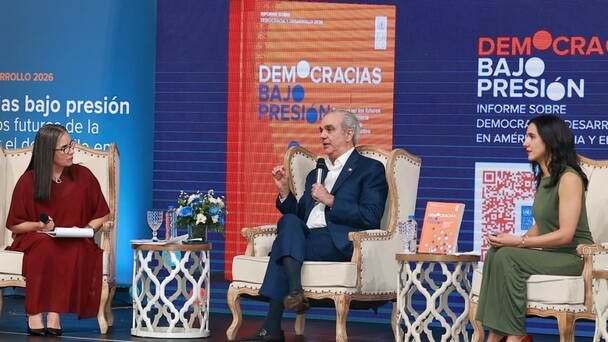
That is one of the main conclusions of the regional report “Democracies under pressure: Reimagining the futures of democracy and development in Latin America and the Caribbean”, presented by the United Nations Development Programme (UNDP) in the Dominican Republic during an event led by President Luis Abinader and the regional director of the organization for Latin America and the Caribbean, Michelle Muschett.
According to the study, although democracy remains the preferred system of government for the majority of the population, there is a growing gap between citizen support for the democratic model and satisfaction with the results offered by the institutions.
The case of the Caribbean
The report devotes a special analysis to the Caribbean, a subregion that, according to the UNDP, maintains relatively high levels of social cohesion and democratic stability compared to other areas of Latin America.
However, it warns that it faces increasing pressures linked to organized crime, economic vulnerability, and extreme weather events.
Among the data cited by the organization is that the homicide rate in the Caribbean reaches 27.9 cases per 100,000 inhabitants, above the regional average, while 59% of these events would be related to organized crime structures.
This is compounded by increasing exposure to severe weather events. The report notes that the frequency of extreme weather events has practically doubled in recent decades, rising from an average of 5.2 events per year between 1960 and 1990 to 10.7 between 2000 and 2023.
Despite this scenario, 57% of Caribbean citizens continue to consider democracy the best form of government. However, only about 32% say they are satisfied with how it works, according to the analysis.
Dominican Republic, between Latin America and the Caribbean
The UNDP identified the country as a special case within the region due to its status as a bridge between Latin America and the Caribbean.
The organization highlighted that the Dominican Republic shares institutional and political characteristics typical of Latin America, but at the same time faces vulnerabilities similar to those of small island states in the Caribbean, especially in climate matters.
During the presentation of the report, President Luis Abinader stated that one of the factors that has contributed to Dominican democratic stability has been the ability to build national consensus beyond partisan differences.
The study also acknowledges the country's progress in areas such as electoral democracy, political freedoms, and the reduction of poverty and inequality over the past two decades, although it notes that challenges related to women's inclusion and political participation persist.
Disinformation and artificial intelligence
Another topic addressed by the report is the impact of digital transformation on the region's democracies.
According to the data presented, 76% of the population believes that social media contains a significant or moderate amount of misinformation, a phenomenon that, according to the organization, is altering the way people access information and participate in public life.
Despite these risks, the report argues that technologies such as artificial intelligence also represent opportunities to expand access to services, strengthen citizen participation, and improve the productivity of economies.
A call to renew democracy
The UNDP regional director, Michelle Muschett, stated that the main challenge for the countries of Latin America and the Caribbean will be to turn the pressures that democracies face today into opportunities for transformation.
“The future of Latin America and the Caribbean depends on our collective capacity to transform the pressures facing our developing democracies, without sacrificing people’s capacity for action or their freedoms,” he said.
The report concludes that the strength of the region's democracies will increasingly depend on the ability of states to respond to citizens' demands, strengthen their institutions, and translate economic growth into concrete improvements in the population's quality of life.
Recommended readings: