


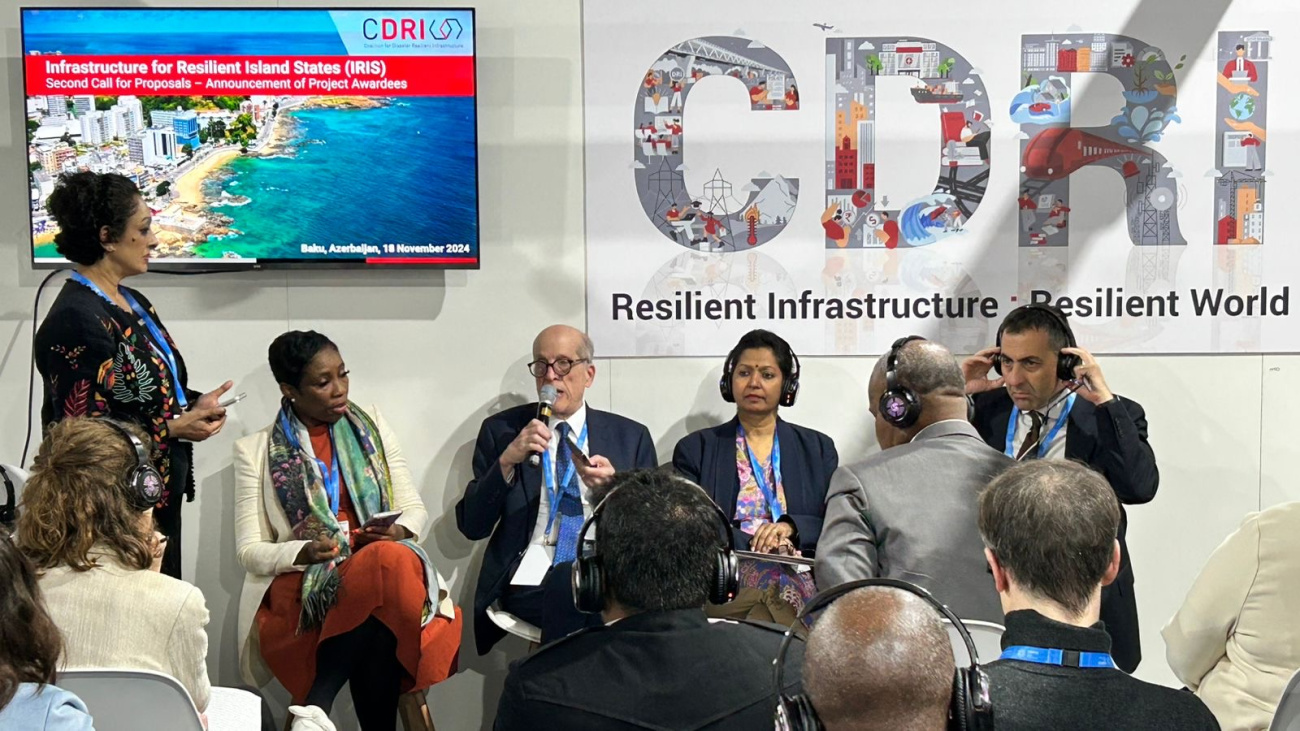
The Dominican Republic will be the beneficiary of a new cooperation project approved by the Coalition for Resilient Infrastructure Development (CDRI), as announced yesterday by that organization on Monday within the framework of the 29th Conference of the Parties to the United Nations Framework Convention on Climate Change, COP29.
This was announced by CDRI Director General Amit Prothiduring the panel “Unlocking Investments for Climate Resilient and Sustainable Infrastructure in Small Island Developing States,” in which the Executive Vice President of the National Council for Climate Change and Clean Development Mechanism, Max Puig.
“We are approving a total of $8 million for 18 countries; the first of these will be to support the Dominican Republic, Antigua and Barbuda, and Saint Lucia, and the funds will be allocated to the project for the socially inclusive strengthening of infrastructure and climate-resilient actions in the Caribbean,” Prothi explained.
For his part, Max Puig highlighted the support that the CDRI has provided to the country since its joining this coalition led by India. He also emphasized that this is the third project approved by the CDRI for climate action in the Dominican Republic, following the approval of two other initiatives to develop an early warning system for potentially catastrophic natural events.
“This project is regional in scope and will impact two other Caribbean islands; its specific aim is to strengthen the resilience of educational infrastructure to guarantee school and educational continuity after a disaster. The organization that proposed this project and will implement it is the NGO Integrated Health Outreach, based in Antigua and Barbuda,” Puig explained.
The project to strengthen socially inclusive climate-resilient infrastructure and actions in the Caribbean will be financed through the Infrastructure for Island Resilient States (IRIS) program and is part of a package of 12 proposals approved by the CDRI for 18 Island Developing States for a total of $8 million.
This is the second call for proposals approved through IRIS, for which 57 expressions of interest that, after being evaluated, benefited 9 Caribbean countries, including Haiti, Bahamas and Jamaica, among others, as well as 3 African countries and 4 Oceanian countries.







