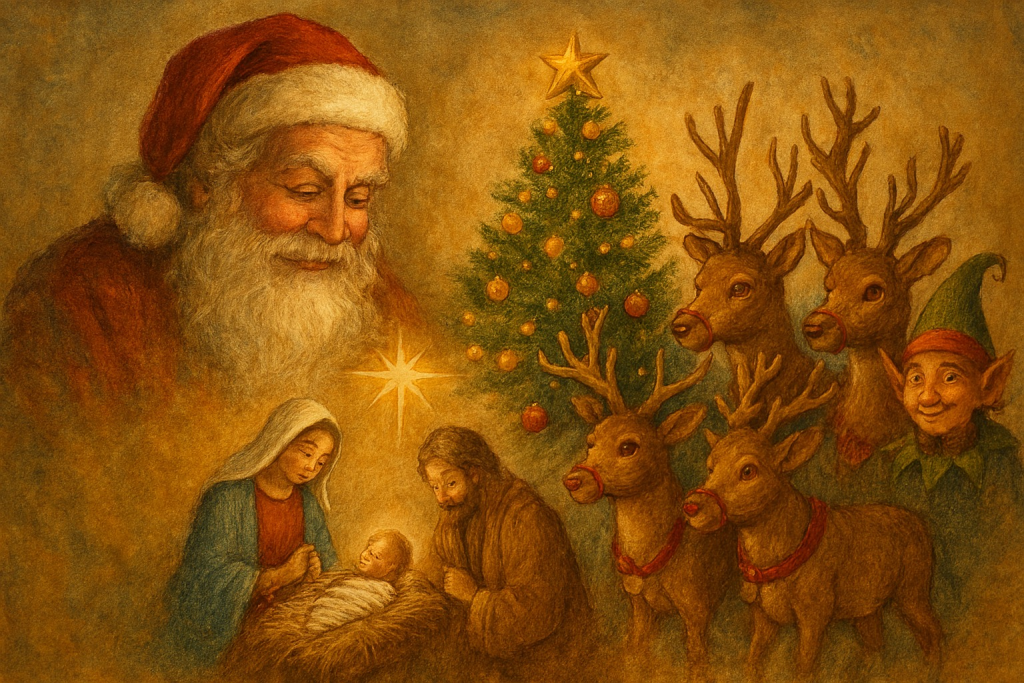
In a world marked by excess and haste, we must celebrate with joy, but also with physical and spiritual moderation—a message that speaks to both our personal and collective lives, even in the business world. Recovering this profound meaning is perhaps the greatest challenge and the greatest opportunity of our time.
SANTO DOMINGO. – The celebration of Christmas, as we know it today, is the result of a long history in which Christian tradition and ancient pagan festivities of the European winter are intertwined, although in all versions it has a profound meaning: hope, renewal and community, which has been maintained throughout the centuries, although with different forms according to the times.
It is a celebration deeply rooted in the country, which experiences it in different ways, with Caribbean intensity.
In the Dominican Republic, Christmas has been with us since the 15th century, when the first European settlement was established on the island, which in the Arawak language was called Quisqueya. The "Fort of Navidad" was built on the north coast (today Cap-Haïtien) with the remains of the Santa María caravel, which ran aground on December 24, 1492, and the name, given because of Christmas Eve, remained as a symbol of this historic encounter.
Christian history
The Christian world celebrates Christmas in commemoration of the birth of Jesus Christ in Bethlehem, according to the Gospels of Matthew and Luke. Although the exact date is not mentioned in the Bible, the Christian Church established December 25th as the day of celebration starting in the 4th century AD, during the pontificate of Pope Julius I
And the choice was not accidental, as this date coincided with the pagan festivities of the winter solstice, which facilitated the integration of the new believers, as a way for them to embrace the Christian faith on a date that was also significant for them.
For Christians, Christmas symbolizes the incarnation of God on earth, a message of hope and salvation that transformed the meaning of the winter holidays into a spiritual and communal celebration.
Yule: the Germanic festival of the reborn sun
Yule was a European celebration, observed by Germanic and Scandinavian peoples, that coincided with the winter solstice (December 21–22) and lasted for twelve days. Its roots are prehistoric, originating in agricultural communities of Northern Europe, although the first written records date from the Viking Age, in the 8th–11th centuries AD.
It was a festival dedicated to the rebirth of the sun and the hope of spring. A log of fir, pine, or holly was lit as a symbol of light and protection, and communal feasts were shared. According to historian Hilda Ellis Davidson, “Yule was a time of cosmic renewal, where darkness gave way to the promise of light.” Many current traditions, such as the tree, wreaths, and feasts, have their roots in Yule.
The Roman festival of equality
In Rome, the Saturnalia or Saturnalia were celebrated between December 17 and 23, in honor of the god Saturn and are festivities as old as the republican era and the Roman Empire in the 3rd century BC and 4th century AD.
During those days, social norms were suspended: slaves were served by their masters, gifts were exchanged, and public banquets were held. The historian Macrobius describes how “freedom and equality reigned during the Saturnalia, as a reminder of Saturn’s golden age.” This reversal of roles and the festive spirit directly influenced how Christmas came to be understood as a time of conviviality and generosity.
Hope, since prehistory
Beyond specific festivities, the winter solstice was celebrated throughout Europe as a time of spiritual renewal. Its practices date back to the Neolithic period, around 3000 BC, as evidenced by megalithic monuments such as Stonehenge in England, built to mark and give thanks for the sunrise on the shortest day of the year.
Archaeologist Mike Parker Pearson notes that “the solstice was a marker of hope, a spiritual calendar that united communities around the cycle of nature.” Observing the sky and the gradual return of light remain universal symbols of continuity and life.
From the Christmas Fort in Quisqueya to the Yule banquets and the Roman Saturnalia, the holiday has always been a space of shared hope.
These celebrations, though diverse in timing, form, and beliefs, share a common purpose: to balance body and spirit in the midst of winter, at the end of the year. The modest feast, the reversal of social roles, and the connection with nature were ways of remembering that life is not simply about consumption, but requires introspection and care.
Seen in this light, Christmas is heir to centuries of rituals that sought light in the darkness, and true clarity is not in the little lights, but in our ability to live with community, moderation, and faith in renewal.
| Did you know that… the Taíno people throughout the Caribbean spoke the Arawak language |
| The Santa Maríawas one of the three ships that brought Columbus and his adventurers to the Americas. It ran aground on the northern coast on December 24, 1492, and since the entire crew couldn't fit on the other two ships, the admiral ordered the construction of a fort to house his men while he explored the coast. Because it happened on Christmas Eve, it was called La Navidad (Christmas). But that's another story, which we'll tell in detail later. Arawak: The Taíno people of Quisqueya spoke variants of the Arawak language, a large language family that extended throughout the Caribbean and parts of South America. Depending on their origin, there were dialectal differences, but the common root was Arawak. |