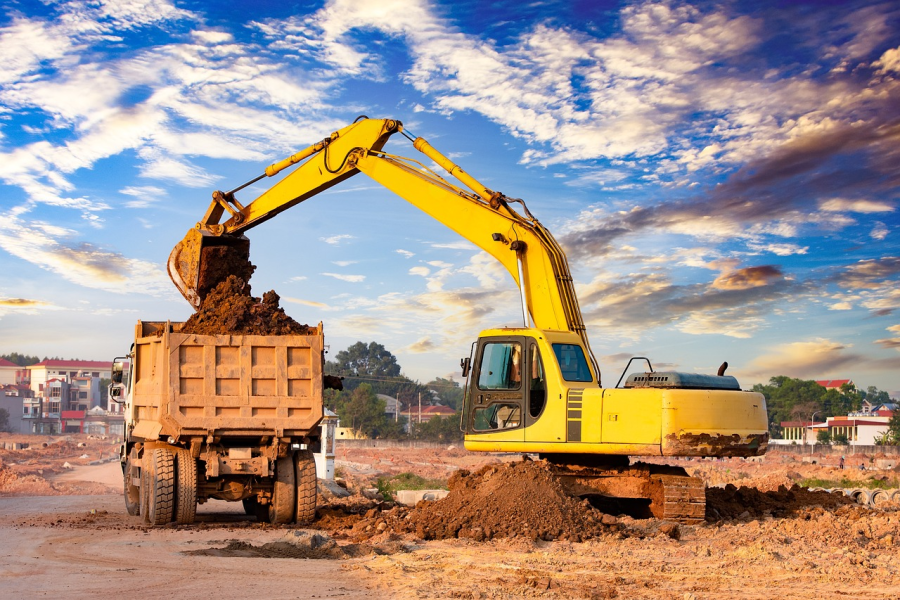
"Although mechanization has had important results in large infrastructure projects, its impact has been much more limited in many of the daily processes that characterize building construction," said the former president of CODIA.
SANTO DOMINGO.– When President Luis Abinader raised the need in 2023 to mechanize Dominican construction and reduce dependence on manual labor, the proposal was presented as part of a profound transformation for one of the most important sectors of the national economy.
Three years later, the debate continues. Although the incorporation of technology and machinery has gained ground in certain areas of construction, industry stakeholders believe that progress has been uneven and that much of the industry continues to operate using traditional methods.
The president's proposal was made during the eighth National Housing Roundtable organized by the Dominican Association of Housing Builders and Promoters (Acoprovi), where he stated that "foreign labor's days are numbered" and announced financial support to promote the mechanization and industrialization of construction processes.
At that time, the Government reported the availability of resources through the Development and Export Bank (Bandex) to facilitate the acquisition of equipment and technologies aimed at modernizing construction activity and gradually reducing dependence on foreign labor.
From proposal to debate
The initiative sparked a debate that continues to this day. While some sectors valued the government's push toward modernization, others have since warned that the process requires greater levels of funding, training, and support to achieve large-scale results.
Mechanization has been on the national agenda, especially during times marked by labor shortages and debates about productivity, competitiveness, and industrialization.
The advances that the sector does acknowledge
Engineer Teodoro Tejada, former president of the Dominican College of Engineers, Architects and Surveyors (CODIA) and Eliseo Cristopher, president of the Dominican Confederation of Micro, Small and Medium Construction Companies (Copymecon), agree that mechanization has advanced in recent years.
For Tejada, the evolution is particularly visible in large infrastructure projects, highlighting the incorporation of modern equipment for excavations, deep foundations, piles, bridge construction, roads and other works of great technical complexity.
He explained that processes that decades ago required long periods of execution can now be carried out more quickly thanks to the use of specialized machinery and more advanced technologies.
Cristopher also acknowledges that some sectors have modernized their operations. In his view, many construction and supply companies have incorporated equipment that allows them to perform tasks that previously required a large number of workers, thus increasing the efficiency of certain processes.
However, it remains biased
For both interviewees, however, this evolution has not yet managed to comprehensively transform Dominican construction.
Tejada argues that, at the level of buildings and housing, much of the work continues to depend on traditional methods and a high level of manual labor in activities such as masonry, plumbing, electricity, finishing and block laying.
“We are still in that era of rustic methods in the construction of homes and multi-story buildings,” he stated.
The businessman believes that, although mechanization has had important results in large infrastructure projects, its impact has been much more limited in many of the daily processes that characterize building construction.
In his view, the persistent dependence on workers for manual labor demonstrates that technological transformation has not yet reached the scale that some sectors projected.
The challenge for small and medium-sized enterprises
From another perspective, Eliseo Cristopher identifies one of the main limitations of the process. He believes that the financing programs implemented to promote mechanization primarily benefited companies with established financial structures and the capacity to access specialized loans.
“To this day, we still have the same levels of dependence on foreign labor in the construction sector several years later,” he said.
He explained that many of the large companies that accessed financing already had modernization processes underway or the necessary economic capacity to acquire equipment on their own.
Meanwhile, it argues that micro, small and medium-sized construction companies, which represent the majority of the sector's business fabric, continue to face difficulties in accessing machinery, technology and financial resources that would allow them to modernize their operations.
Christopher understands that a strategy more focused on SMEs could generate a broader impact on the transformation of the sector.
Recommended readings: