


“That foreign workforce definitely has a very strong negative impact on the construction sector, and we cover that impact.”.
By Escarlin Pozo
El Inmobiliario
SANTO DOMINGO.-The president of the Dominican Confederation of Micro, Small and Medium Construction Companies (Copymecon), Eliseo Cristopher, warned yesterday, Wednesday, May 7, that the construction sector could be paralyzed if the participation of Haitian labor were suddenly eliminated.
“We know the construction sector at the national level. If we suddenly eliminate foreign labor in the Dominican Republic, in this case Haitian labor, we will paralyze one of the country's main sectors,” he said.
In an interview on the program “El Día”, he indicated that this problem has been dragging on for almost six decades, because each government has allowed foreign labor to become “embedded” in different sectors, as has also happened in agriculture and tourism.
Cristopher stated that the State, institutions, and the people themselves have not implemented concrete measures to "Dominicanize" the sector.
“And it’s not a matter of finding someone to blame, but yes, governments in recent years and decades have had an enormous responsibility because they have been permissive of this constant peaceful migration in the Dominican Republic,” he pointed out.
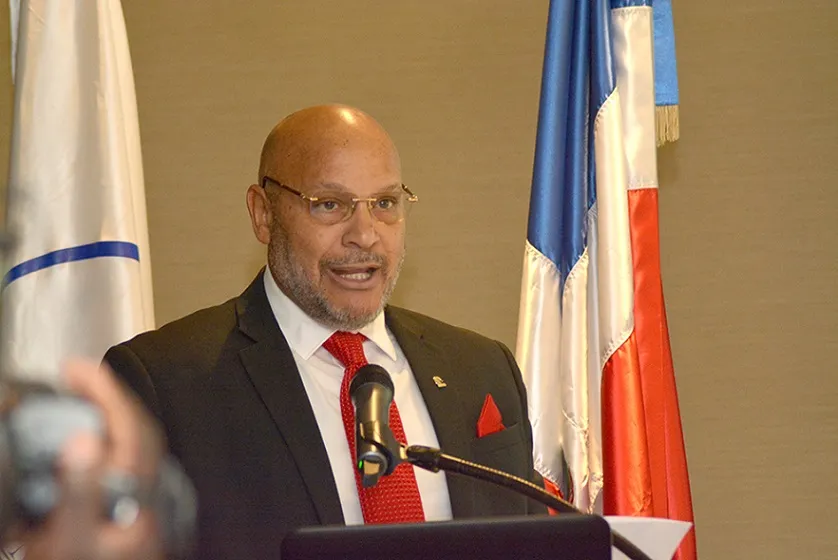
Eliseo Cristopher. (EXTERNAL SOURCE).
From that position, the president of Copymecon stated that this scenario remains latent because Dominicans do not want to venture into this type of work.
“It’s not about price. It’s not about wanting to pay less or about it being more convenient for us, it’s about availability,” he commented.
He said that many people have pointed out that business owners promote foreign labor in the Dominican Republic, unaware that "they are victims of these circumstances.".
To elaborate, he mentioned that working on a construction project with people who share the same language and culture is not the same as working with individuals with whom you cannot establish fluid communication or share basic codes of understanding.
As he explained, these differences generate conflicts, operational limitations, and even inappropriate situations within the construction sites.
“That foreign workforce definitely has a very strong negative impact on the construction sector, and we cover that impact,” he said.
The three key proposals to rescue the construction sector
Eliseo Cristopher proposed that one of the main actions to address this problem is to formalize the construction sector in the Dominican Republic.
According to what was expressed during the interview, construction belongs to an “eminently informal” industry and, given this reality, it harbors “large amounts of informal jobs”.
Although many claim that the level of informality is around 85%, Eliseo contradicts this position and warns that it exceeds that percentage.
For that reason, he argues that if formality is promoted there will be greater coverage for jobs, an element that would motivate the attraction of national labor.
As a second measure, he added that it is also necessary to look for specialized taxation mechanisms in the construction sector, especially for MSMEs.
“Why do we say that? Because we as a confederation have managed to formalize 2,000 construction companies, but when they enter the labor market they return to informality because they lack that support and the issue of taxation is very difficult,” he explained.
In a third approach, he recommended that once a company in the construction sector manages to formalize itself, this process should be accompanied by concrete mechanisms for financial inclusion.
He also said that this would allow, with the support of entities such as the National Institute of Technical and Professional Training (Infotep), the vocational schools of the Armed Forces, universities and technical centers, the continuous training of construction personnel to be promoted and progress towards a process of mechanization of work.
“It is absolutely necessary to mechanize the workforce in the construction sector, to seek out technology and, of course, to ensure that all those companies that we have in the informal sector can work sustainably within the legal framework,” he specified.







