


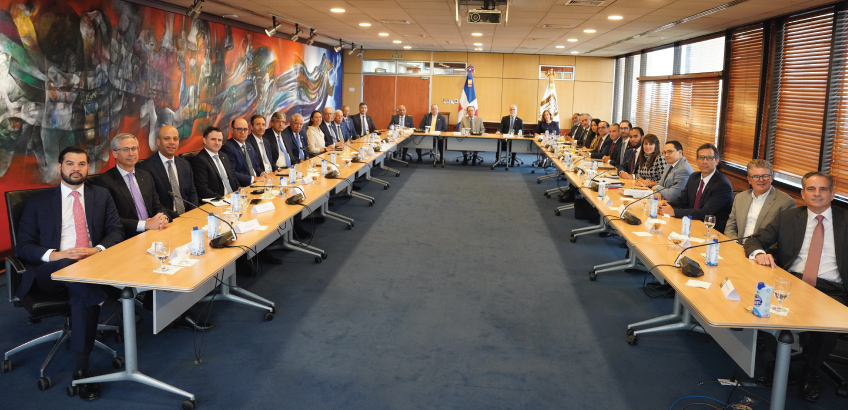
The governor indicated that this Thursday the Monetary Board will review the modification of the Exchange Regulations, which was open for public comment for about 30 days.
SANTO DOMINGO– The Governor of the Central Bank of the Dominican Republic (BCRD), Héctor Valdez Albizu, held a meeting, accompanied by the Minister of Finance and Economy, Magín Díaz, and the Superintendent of Banks, Alejandro Fernández, with the presidents of the country's financial sector. The objective was to review the performance of the national economy and its forecasts, highlight the positive results shown by the sector, and establish a dialogue and collaboration aimed at preserving macroeconomic stability.
The governor stated that “in a context like the current one of high uncertainty and in a turbulent and complex international environment, it is important to act prudently to preserve stability and strengthen the confidence of investors and external and internal economic agents.”.
Valdez Albizu indicated that the forecasts are that “the economy will continue to recover gradually during the rest of the year, reaching a growth of around 3.0% in 2025; the pace of economic expansion could accelerate further as a significant boost in public investment materializes and there is room to continue easing monetary conditions.”.
Regarding the recent exchange rate movements, he stated that there are no macroeconomic factors that explain this increased volatility, beyond the seasonal effect of September on inventory purchases in anticipation of year-end sales. Foreign exchange-generating activities have maintained their dynamism, with projected foreign exchange earnings exceeding US$46.16 billion by the end of this year. In this context, foreign direct investment (FDI) is expected to reach US$4.86 billion in 2025, comfortably covering the projected current account deficit for the year.
He noted that, for reference, the 2025 General State Budget used a projected average exchange rate of RD$63.11 per US dollar for the entire year. After the first eight months of the year, the average exchange rate observed was around RD$61.20, which would fall within the budget projections for the remainder of 2025.
The governor also indicated that the Monetary Board will review the amendment to the Exchange Regulations this Thursday, which was open for public comment for about 30 days.
Valdez Albizu highlighted the reductions in bank interest rates following the liquidity measures implemented last May, indicating that the interbank rate for multiple banks is at 8.59%, after reaching 13.19% in that month, for a reduction of 460 basis points (bp); the passive rate went from 9.63% to 7.51% (212 bp less); while the active rate went from 14.99% to 14.19%.
Regarding the situation of the financial sector, he noted that “it remains robust, well-capitalized, and highly profitable. In fact, return on equity (ROE) stood at 21.80% and return on assets (ROA) at 2.61% in July; while the non-performing loan ratio was 1.9% in June. The solvency ratio stood at 18.39%, above the regulatory minimum of 10%.”.
Meanwhile, the Minister of Finance and Economy, Magín Diaz, stated "the Dominican Government's determination to combat the slowdown and boost the economy, using absolute coordination of economic, monetary and fiscal policies, as well as implementing increased public investment.".
For his part, the Superintendent of Banks, Alejandro Fernández, expressed his conviction that “with the monetary measures implemented, interest rates have begun to decrease, which will have a positive impact on the reactivation of private sector credit, which is essential for economic growth.”.
The CEO of Banco Popular, Christopher Paniagua, expressed the Dominican financial system's willingness to "support the efforts of the monetary authorities in maintaining the stability that our country projects in the monetary, economic, fiscal and exchange rate spheres.".
For his part, the president of the BHD Financial Center, Luis Molina Achécar, expressed his conviction in finding solutions, as well as in seeking and studying ideas together, aimed at meeting the challenges of the future.
The governor was accompanied by the vice-governor, Clarissa de la Rocha; the manager, Ervin Novas; the deputy general manager, Frank Montaño; the deputy manager of Monetary, Exchange Rate, and Financial Policies, Joel Tejeda; the governor's economic advisor, Julio Andújar; the deputy operations manager, Liselotte Reyes; and the deputy managers of National Accounts, Regulation and Financial Stability, and Monetary Programming, Ramón González, Máximo Rodríguez, and Joel González, respectively. Also present were the treasurer, José Perdomo, and directors Elina Rosario and Carlos Delgado, of National Accounts and Regulation and Financial Stability, respectively.
Representing the financial institutions alongside Paniagua and Molina Achécar were Leonardo Aguilera, administrator of BanReservas; Fidelio Despradel, CEO of Banco BHD; Fausto Pimentel, CEO of Banco Santa Cruz; Rocio Velarde, general manager of CITIBANK for the Dominican Republic; Víctor Mendez Saba, president of Banco Vimenca; José Rodríguez Copello, president of Banco López de Haro; Juan Rodríguez Copello, CEO of Banco BDI; Edgar del Toro Toral, CEO of Banco Caribe; Juan Carlos Carneiro, CEO of Banesco; Andrés Bordas, CEO of Banco ADEMI; Gonzalo Gil of Scotiabank; Carlos Julio Camilo, president of Banco Promérica; Luis M. Bogaert Ciaccio, general manager of JMMB Bank; Brian Paniagua, general manager of Banco LAFISE; and Arturo Grullón, executive vice president of Banco Qik.







