


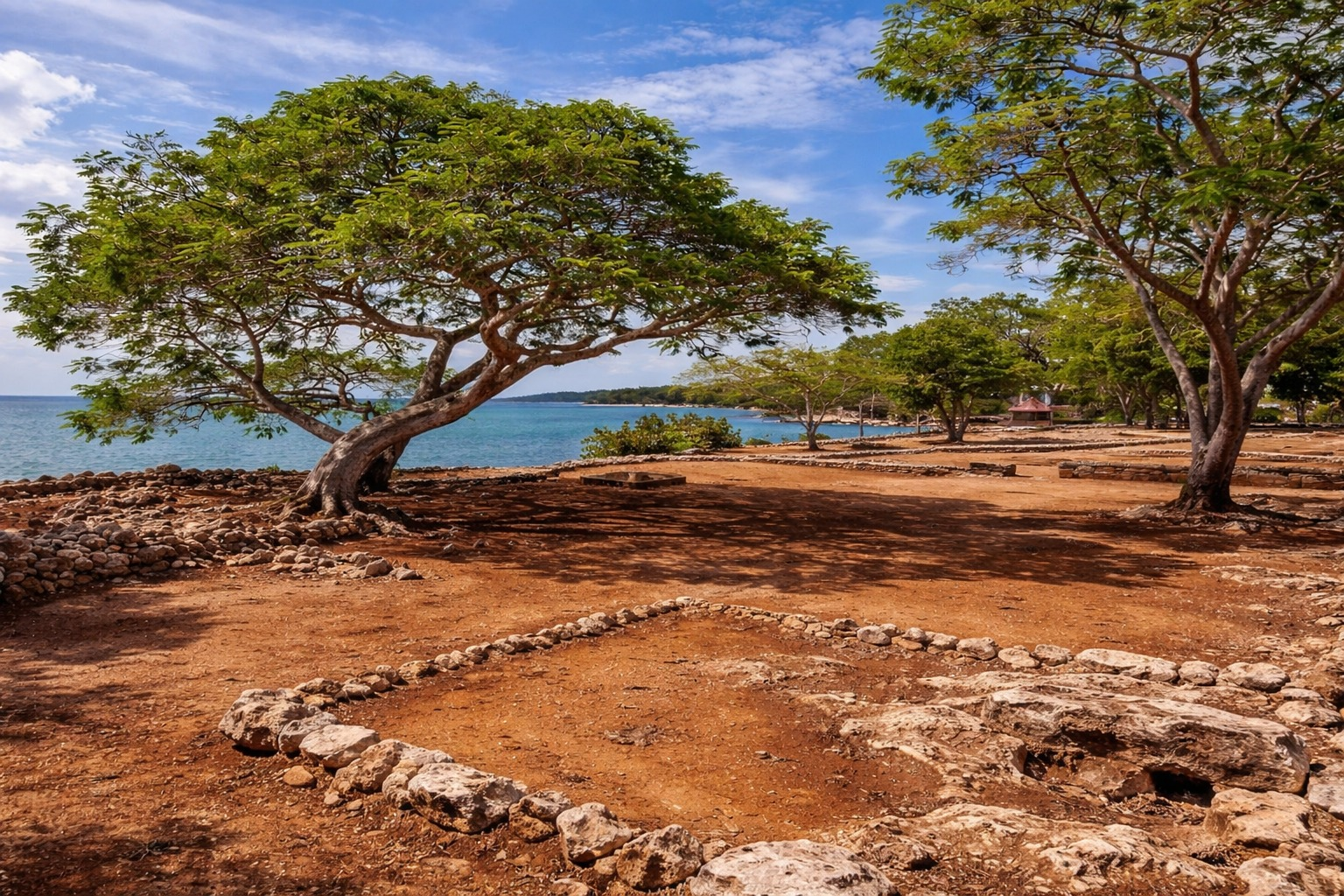
It was the first attempt to turn the landscape into a city, without understanding it and without asking, "How do you build community on foreign land?"
SANTO DOMINGO – On January 6, 1494, Christopher Columbus arrived on the north coast of Hispaniola with the urgency of someone who needed to start over. He came from the disaster of La Navidad fort, where he had left 39 men in December 1492, and upon his return found only ashes and silence.
The Taíno chief Caonabo had made it clear that guests who did not ask for permission were not welcome.
On this second voyage, Columbus decided to found something more permanent: a city. Not a makeshift fort built from shipwrecks, but a stone city with warehouses, houses, and a plaza. He named it Villa La Isabela, in honor of the queen who financed the voyage and who probably expected something more solid than shipwrecks and rumors of conflict.
A church was also built, the first on the continent, where Father Bernardo Boyl officiated mass on January 6, 1494, although colonial sources do not attribute a formal name to the temple.
Today the site is marked by the so-called Temple of the Americas, erected on the ruins of the first one.
According to the Admiral's Diaries, cited by Friar Bartolomé de las Casas in History of the Indies (1552), the choice of the place responded to practical criteria: it was a protected bay, with nearby fresh water and fertile land.
Also influential was the desire to move away from the scenario of the previous failure and start again, this time with stone and not with recycled wood.
What Columbus didn't find was an empty territory. The Taíno people had inhabited those lands long before Europe knew of their existence. They cultivated cassava, chili peppers, and tobacco, slept in hammocks, and lived without military hierarchies or maps of conquest. Columbus recorded everything, describing them as "gentle people," although history would show that they also knew how to resist.
Hostility or lack of diplomacy?
Life in La Isabela was, at best, difficult. The first settlers, some 1,200 men according to Las Casas, arrived hungry, diseased, and with little understanding of the tropical environment. The climate, their lack of adaptation, and conflicts with the Taíno people gradually emptied the city, and within a few years it was abandoned.
Among the names listed in the records are Friar Ramón Pané, the first chronicler of Taíno beliefs, and Diego de Arana, former commander of Fort Navidad. Others left only traces and human remains that eventually merged with the earth or were swept out to sea by a tractor in the unspeakable era.
The period between the shipwreck of the Santa María in 1492 and the founding of La Isabela in 1494 was a time of uncertainty during which Europe drifted aimlessly in the Caribbean. The makeshift fort of Navidad fell, not only due to the Taíno offensive, but also because of the inability to coexist and the arrogance of those who occupied it.
Las Casas makes it clear: the failure was both moral and military.
Isabela didn't last long
The chronicles of Friar Bartolomé de las Casas indicate that, initially, there were contacts and provision of food by the Taíno population, but the relationship deteriorated rapidly when the colonists began to impose demands for tribute, gold and labor, in a context of hunger, disease and internal indiscipline.
Unlike the Fort of Navidad, which was violently and suddenly destroyed, La Isabela experienced a progressive attrition marked by resistance, escapes, and localized confrontations.
More than a direct war, the settlement was caught in a structural conflict stemming from the impossibility of coexistence between the European colonial model and the Taíno way of life, a factor that decisively contributed to the early abandonment of the first city in the New World. This first city was abandoned in 1498.
By 1496 Bartolomé Colón had founded Santo Domingo, on the southern coast of the island, a city that did prosper and thanks to its location, access to the Caribbean and climatic conditions, became the first capital of the Spanish colonial government in America.
Today, all that remains of La Isabela are ruins and silence. An archaeological park preserves the remains of the church, the warehouse, the Admiral's residence, and the shipyard. Later excavations, such as those by archaeologist José María Cruxent, confirmed what Las Casas and Oviedo described: there, an attempt was made to implant the stone architecture of Europe onto the humid Caribbean soil, albeit on the Atlantic side of the island.
La Isabela was the first attempt to transform the landscape into a city without understanding the territory. It aspired to be eternal, but ended up being ephemeral, and its foundations serve as a reminder of both the glory of the first attempt and the harshness of its failure.
Today it remains peaceful, as if rocked by the Atlantic winds, guarded by flamboyant trees and a guayacán tree that they say is centuries old, and with a nagging question: how do you build community on foreign soil?
Isabela wanted to be a city before it was a community, and more than five centuries later, history does not repeat itself, but it continues to ask the same questions.







